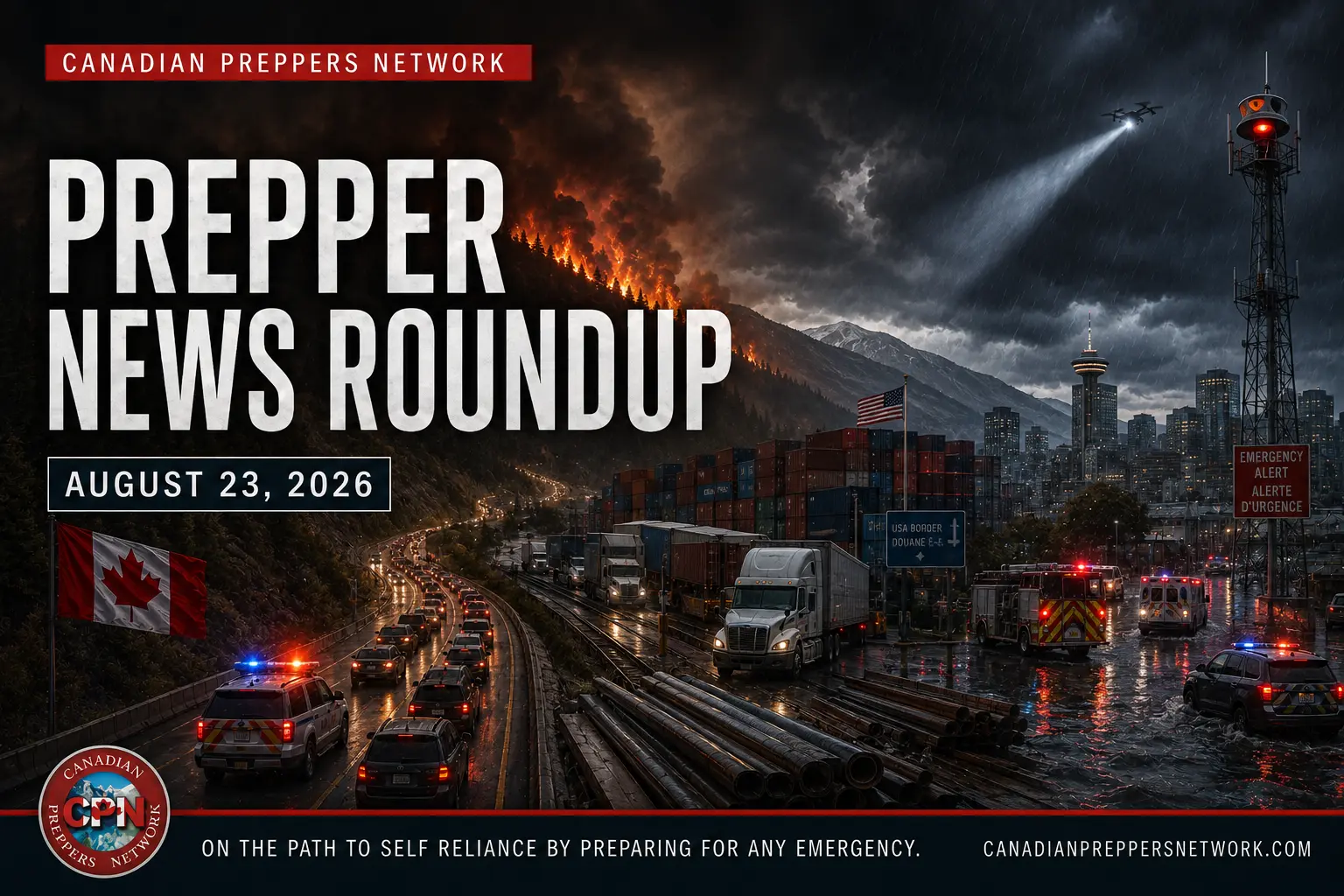
Wildfires, War, Trade Pressure and Civil-Defence Activity Shape the Week
This week’s preparedness news extends well beyond natural disasters. British Columbia remains under a wildfire state of emergency, Canada and the United States have entered a more serious phase of their trade dispute, air attacks are intensifying in Ukraine, and renewed confrontation with Iran is threatening shipping through the Strait of Hormuz.
At the same time, South Korea conducted a nationwide civil-defence exercise, more than 40,000 Indonesian earthquake survivors remained displaced, monsoon flooding affected millions across Asia, and Hawaii prepared for another tropical storm before recovering from the previous one.
Taken together, these stories demonstrate the full range of disruptions for which preparedness plans should account: evacuation, prolonged electrical failures, damaged supply chains, rising prices, communications interruptions and international events that produce consequences thousands of kilometres away.
British Columbia Extends Wildfire State of Emergency
British Columbia has extended its provincial state of emergency until August 29 as wildfires, evacuation measures and recovery operations continue across several regions.
The emergency was originally declared on August 8 after the Bald Range wildfire forced more than 20,000 people from their homes. Most have since returned, but thousands remain affected by evacuation orders and alerts.
On August 18, provincial officials estimated that approximately 2,200 people remained under evacuation orders and another 25,000 were on alert. The Bald Range fire damaged or destroyed approximately 150 structures, while returning residents faced additional concerns involving electrical service, roads, water systems and hazardous debris.
The wider Canadian fire situation also remains active. Public Safety Canada reported 582 active fires on August 18, including 31 considered out of control. Canada had recorded 4,793 fires and approximately 4.1 million hectares burned during the 2026 season.
More than 500 international firefighters from Mexico, Costa Rica, New Zealand and Australia have assisted Canadian crews this summer. Federal support has also included shelter, accommodations and assistance for displaced residents and affected First Nations.
Extending the emergency declaration does not necessarily indicate that conditions are deteriorating. It preserves the province’s ability to mobilize resources quickly if fires change direction or additional evacuations become necessary.
Sources: B.C. Government | Public Safety Canada
Preparedness takeaway: An evacuation bag is only one component of an evacuation plan. Families also need a destination, alternate routes, transportation arrangements and a reliable method of communicating if separated. Medications, identification, insurance information, chargers and supplies for pets should be ready before an evacuation alert becomes an order.
|
Free Canadian Preparedness Download
Canadian Grid-Down Starter Kit
Use this printable first-72-hours checklist to test your household’s water, power, food, sanitation, communications and operating routines before a short outage becomes a long-term grid-down emergency. |
Canada-U.S. Trade Dispute Escalates
Canada and the United States entered a more serious phase of their trade dispute after negotiations collapsed and Washington imposed 50 per cent tariffs on approximately $20 billion worth of Canadian exports.
Affected Canadian products reportedly include wine, cement, honey, hockey equipment, paper products, textiles, essential oils and certain electronics. Existing U.S. tariffs on Canadian steel, aluminum, lumber and automotive products remain separate from the new measures.
Prime Minister Mark Carney announced that Canada would respond with dollar-for-dollar tariffs on U.S. goods beginning September 8. The Canadian countermeasures are expected to affect products from sectors that include steel, dairy, electronics, household appliances and agricultural equipment.
The consequences will not be distributed evenly. Canadian exporters may lose orders or reduce production if their products become too expensive in the American market. Importers and retailers may face higher replacement costs. Companies on both sides of the border may change suppliers, delay investments or reduce inventories while waiting to see whether negotiations resume.
For individual households, tariffs do not automatically produce an immediate shortage. Their effects tend to appear gradually through higher prices, fewer product choices, delayed equipment purchases and employment losses in affected industries.
The larger preparedness concern is Canada’s heavy dependence on cross-border trade. A political dispute can quickly affect manufacturing inputs, replacement parts, farm equipment, construction materials and household goods even when no physical supply route has been damaged.
Source: Reuters
Preparedness takeaway: Avoid panic buying, but identify critical products your household, farm or business obtains from the United States. Consumables, repair parts and specialised equipment with no easy Canadian substitute deserve particular attention. Financial preparedness should also include enough flexibility to absorb temporary price increases or reduced employment income.
Russian Air Attacks Intensify in Ukraine
A Russian drone strike on a shopping centre in Kryvyi Rih killed at least 16 people and injured more than 130 on Friday, according to Ukrainian authorities. Twenty-two children were among the wounded.
Officials described the attack as a double-tap strike. A second drone reportedly struck approximately 30 minutes after the first explosion, while emergency personnel and bystanders were already responding. Twenty-nine victims were reported in serious condition, while nine people remained missing during recovery operations.
Another attack in Ukraine’s Mykolaiv region killed four people, including three children. The strikes formed part of a broader increase in Russian missile and drone attacks against Ukrainian cities and infrastructure.
Ukraine is seeking additional air-defence support as its supply of Patriot interceptors declines. France agreed this week to accelerate deliveries of French equipment and missiles, while European countries are discussing additional interceptor systems and licensed production within Ukraine.
Ukrainian forces have meanwhile increased drone attacks against Russian oil facilities, logistics networks and other economic targets. Russian President Vladimir Putin warned that Russia would retaliate against sensitive Ukrainian economic sectors.
Ukrainian President Volodymyr Zelenskiy also claimed that Russia is preparing to recruit an additional 300,000 troops following its September parliamentary elections. That claim has not been independently confirmed, but it signals that neither side is preparing for a quick conclusion to the war.
The most important preparedness implication is the continued targeting of energy, transportation and industrial infrastructure. Modern war increasingly affects civilians through interruptions to heat, electricity, fuel, medical care and communications rather than through front-line fighting alone.
Sources: Kryvyi Rih attack | Air-defence deliveries
Preparedness takeaway: Ukraine continues to demonstrate the importance of blackout capability, protected sleeping areas, redundant communications and supplies distributed across more than one location. Concentrating every useful item in a single building creates a serious vulnerability during any destructive emergency.
U.S.-Iran Confrontation Threatens the Strait of Hormuz
The confrontation between the United States and Iran intensified after Washington ruled out extending the ceasefire and announced plans for substantially stronger economic sanctions.
Iran warned that it could adopt a fully offensive position in the Strait of Hormuz if diplomacy fails. Hostilities have already included Iranian action against vessels attempting to use routes Tehran considers unauthorised.
The Strait of Hormuz is one of the world’s most important energy and shipping chokepoints. Disruption there can affect oil and fuel prices far beyond the Middle East, even when the actual volume of lost production is limited. Insurance costs, shipping delays and the perceived risk of further attacks can all increase prices.
Pakistan’s army chief is expected to visit Tehran as part of an effort to reduce tensions. Pakistan has acted as an intermediary during previous negotiations, but the current positions of Washington and Tehran leave little room for an immediate settlement.
For Canada, the first effects of a major disruption would likely appear through energy markets and transportation costs. Higher fuel prices eventually influence the cost of farming, trucking, heating, manufacturing and almost every product moved over long distances.
A prolonged interruption could also affect specialised goods and industrial materials carried through the region’s ports.
Sources: Strait of Hormuz confrontation | Diplomatic efforts
Preparedness takeaway: International conflict does not need to reach Canadian territory to affect Canadian households. Keep routine fuel reserves within legal and safe limits, combine unnecessary trips and maintain adequate stocks of essentials that depend on long-distance transportation. Fuel should be rotated and stored only in approved containers and suitable locations.
|
Support Canadian Preppers Network
Preparedness Books and CPN Merchandise
Visit the Canadian Preppers Network shop for preparedness books, CPN clothing and merchandise created for Canadians working toward greater self-reliance. |
South Korea Conducts Nationwide Civil-Defence Drill
South Korea conducted a nationwide civil-defence exercise on August 20 as part of its annual Ulchi training.
Air-raid sirens sounded at 2:00 p.m. and the exercise continued for approximately 20 minutes. Police halted traffic on designated roads to create clear routes for emergency vehicles, while residents were directed toward metro stations and other underground shelters.
Participants at Seoul City Hall received first-aid and CPR instruction. The exercise tested public warning, evacuation, traffic control, sheltering and the ability of emergency services to operate during a national crisis.
South Korea conducts these drills because of the continuing military threat from North Korea, but the procedures also apply to industrial accidents, terrorism and major disasters. The exercise asks ordinary citizens to participate rather than limiting readiness testing to the military and professional emergency services.
That distinction is important. A warning system has limited value if residents do not recognise the signal, know where to go or understand what officials expect them to do. Regular exercises reveal practical problems that written emergency plans may overlook.
Sources: U.S. Embassy in Korea | Euronews
Preparedness takeaway: Canada has no comparable system of regular nationwide civilian shelter drills. Canadians should therefore take more responsibility for learning how local alerts are delivered, where substantial shelter is available and how family members will respond if mobile networks become overloaded.
|
You Asked for It. Now It’s Happening!
Plinkin’ in the Woods
with Frugal Gunnie
A private, professionally supervised day of practical shooting, skill development and range time at Great Ape Empire.
Date: Saturday, September 12, 2026 PAL holders may bring their own .22 LR rifle and ammunition. Eye protection, hearing protection and closed footwear are recommended. The event proceeds rain or shine. Professional supervision and strict range-safety rules apply. Registration is intended for adults who meet the organizer’s eligibility requirements. Alcohol, impairing substances, horseplay and disregard for safety rules will not be tolerated. RESERVE YOUR SPOTPresented in partnership with Off-Grid School, Preppers Meet, Canadian Preppers Network and Great Ape Empire. People have been waiting for this one. With limited space available, don’t leave your registration until the last minute. Let’s Go Plinkin’! |
More Than 40,000 Displaced by Indonesian Earthquake
More than 40,000 people remained in tents, evacuation centres and makeshift camps after the powerful earthquake that struck the Indonesian island of Flores on August 15.
At least 70 people were killed and nearly 1,200 injured. Authorities reported damage to almost 12,000 homes, along with 172 health facilities, 658 schools, 187 offices and 172 places of worship.
The earthquake struck shortly before 6:00 a.m. at a depth of approximately 10 kilometres. A tsunami warning was issued and later cancelled, but the emergency continued through more than 2,100 recorded aftershocks.
Aftershocks complicate search operations and prevent residents from safely returning to damaged buildings. They can also bring down walls, bridges and utility systems weakened by the original earthquake.
The loss of health facilities is particularly serious. A community may have large numbers of injured people at precisely the time when hospitals, clinics, roads and communications are least capable of supporting them.
Source: Associated Press
Preparedness takeaway: Earthquake planning must extend beyond “drop, cover and hold on.” Keep footwear, a flashlight and basic protective equipment near the bed. Expect aftershocks, know how to shut off utilities and do not re-enter a damaged structure until it has been assessed.
Floods and Landslides Affect Millions Across Asia
Prolonged monsoon rain continued to produce flooding and landslides across the Philippines, affecting more than five million people.
At least 23 deaths were reported, most involving floods or landslides, while nearly 25,000 people remained in emergency shelters. Flooded streets disrupted transportation in metropolitan Manila, leading authorities to suspend government work and in-person classes.
The emergency followed several weeks of intermittent rain. This is an important distinction because cumulative rainfall can saturate the ground, fill reservoirs and overwhelm drainage systems even when the latest storm does not appear exceptional.
South Korea also experienced severe rainfall. The city of Geoje received more than 800 millimetres of rain, while nearby Tongyeong recorded more than 670 millimetres. A landslide killed one person and injured four others. Approximately 390 people were evacuated, more than 3,500 homes lost electricity and schools and public buildings were flooded.
Flood emergencies frequently affect several systems at once. Roads become impassable, electrical equipment is damaged, drinking-water systems may become contaminated and emergency vehicles can have difficulty reaching isolated neighbourhoods.
Source: Associated Press
Preparedness takeaway: Never assume a familiar route will remain passable. Identify more than one way out of the community and monitor upstream rainfall as well as local conditions. Floodwater may conceal washed-out pavement, moving debris and damaged electrical equipment.
|
Preserve the Knowledge You May Need Later
CPN Gold Membership
Gold Membership includes access to the CD3WD collection and hundreds of practical manuals covering food production, water, energy, repairs, health, agriculture and self-reliance. Gold members also receive the monthly Canadian Preparedness Intelligence Briefing. Membership is only $5 per year. |
Hawaii Faces Another Storm During Recovery
Hawaii began preparing for Tropical Storm Moke while parts of the state were still recovering from Hurricane Lala.
Moke strengthened while approaching the islands, although a direct landfall was not expected. Forecasts called for 125 to 250 millimetres of rain across windward and southeastern portions of the Big Island, with isolated totals possibly approaching 380 millimetres.
Flooding and landslides remained serious concerns because the ground was already saturated.
Hurricane Lala had flooded communities, blocked roads, damaged power lines and left more than 100,000 electrical customers without service at the height of the emergency. Days later, more than 8,000 Big Island customers reportedly remained without power. At least one death was attributed to the storm.
The arrival of another weather system before recovery was complete created a cascading emergency. Household supplies had already been used, utility crews were still making repairs and some roads and communications systems remained unreliable.
Back-to-back emergencies can be more disruptive than one larger event because households and responders have no opportunity to recover, restock or repair equipment.
Source: Associated Press
Preparedness takeaway: Replenish water, fuel, batteries and ready-to-eat food as soon as conditions safely allow. Recharge every available device and power bank whenever electricity returns, even if officials expect service to remain stable.
The Preparedness Takeaway
This week demonstrates why preparedness cannot be limited to weather events or wilderness survival.
Wildfires displaced Canadians and damaged infrastructure. A trade confrontation created new risks for employment, prices and cross-border supply chains. Wars threatened civilians, energy facilities and international shipping. South Korea treated civil defence as a responsibility shared by government, emergency services and the public. Earthquakes and consecutive storms showed how the second emergency can arrive before recovery from the first is complete.
A practical preparedness plan must cover several categories at once:
- A rapid evacuation with little notice
- Several days without electricity or normal communications
- Temporary loss of income
- Higher fuel and food prices
- Delayed replacement parts and imported goods
- Contaminated drinking water
- A second emergency arriving before supplies are replenished
The goal is not to predict which headline will become personally important. It is to build enough household flexibility that several different emergencies can be managed with the same core preparations.
Space-weather check: No G3 or stronger geomagnetic storm was recorded during the reporting period, so no geomagnetic event has been included in this week’s roundup.