
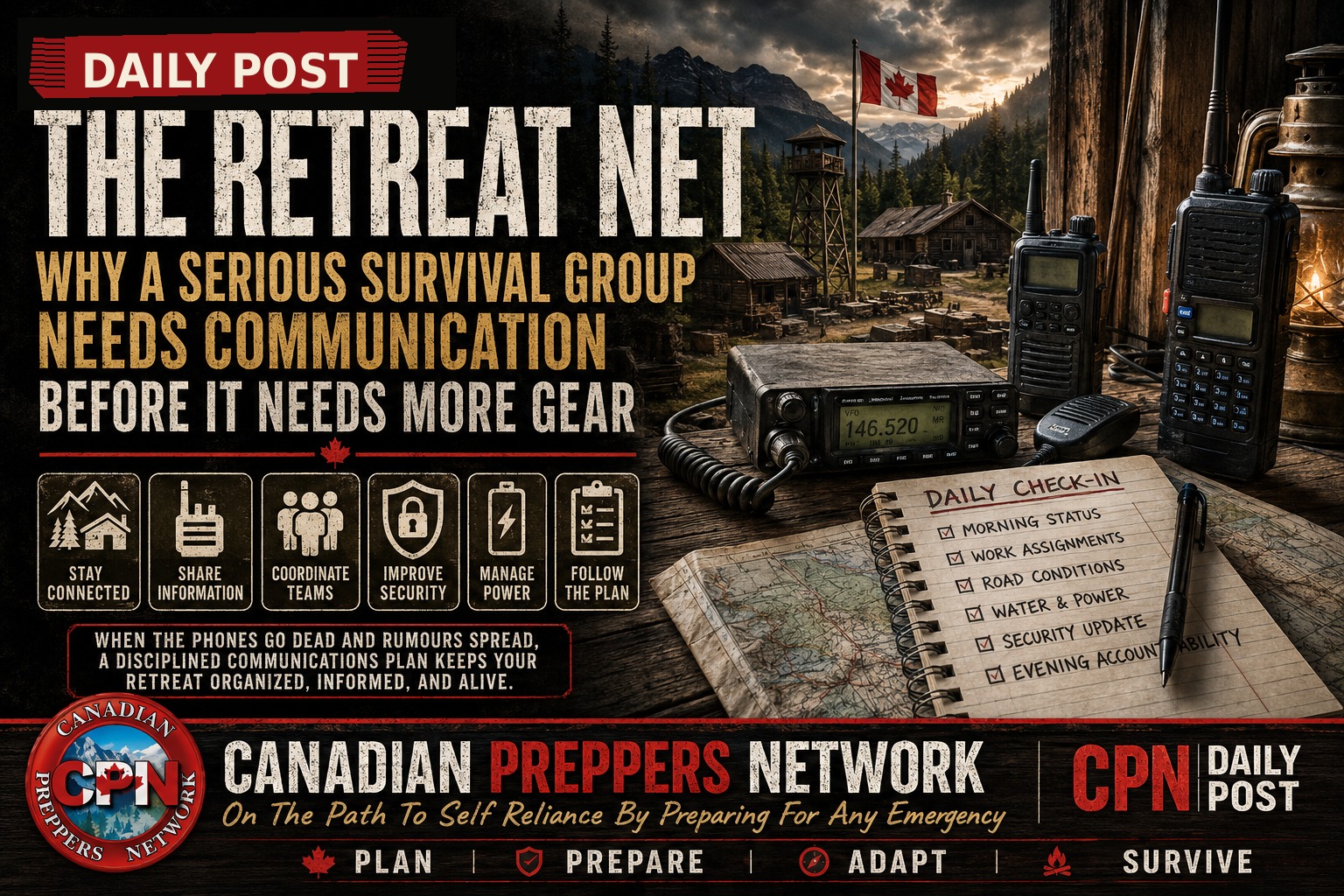
Why A Serious Survival Group Needs Communication Before It Needs More Gear
A retreat without communications is not a retreat.
It is a collection of people hoping they all notice the same problem at the same time.
That may work during a weekend campout. It will not work when the phones are dead, the roads are questionable, the power is gone, rumours are spreading, and nobody knows who is moving, who is hurt, who is missing, or what is coming up the road.
Preppers love gear. Radios, antennas, solar panels, batteries, scanners, power stations, notebooks, maps, signal mirrors, whistles, and laminated plans all have their place. But none of those things create communication by themselves. A radio tossed into a drawer is not a communications plan. A group chat is not a grid-down plan. A retreat agreement is not a functioning network.
In a long emergency, the group that communicates first, clearly, and consistently will make better decisions than the group that owns more equipment but cannot coordinate under pressure.
Canadian Preppers Network Communications Hub
The First Problem Is Distance
A serious retreat is not one room full of people sitting around a table. It has homes, outbuildings, fields, gates, woodlots, water points, gardens, livestock areas, fuel storage, workshops, trails, access roads, and fallback locations. People move. Work parties split up. Someone checks the road. Someone hauls water. Someone tends animals. Someone watches children. Someone fixes equipment. Someone is asleep because they were on watch the night before.
Without communications, every small decision becomes slow.
Where is the medical kit? Who took the fuel key? Is the road blocked? Did the supply team return? Was that noise a vehicle, a tree coming down, or someone near the gate? Does the person at the far shed know the weather is turning? Did the family in the lower cabin hear the warning? Has anyone checked on the elderly couple two properties over?
When normal systems work, these questions are minor. You call, text, or walk over.
When normal systems fail, they become cracks in the retreat.
The Second Problem Is Panic
When people cannot confirm information, they start filling the silence with guesses. That is when rumour becomes more dangerous than ignorance. One person says looters were seen near the highway. Another says the bridge is out. Someone else heard fuel is available in town. Someone claims the police are gone. Someone heard a neighbour has been robbed. Someone says a convoy is moving through the area.
Maybe some of it is true.
Maybe none of it is.
A retreat net gives the group a way to slow the panic down. Reports can be logged. Observations can be confirmed. Messages can be passed in a disciplined way. Nobody needs to run around yelling half-information from cabin to cabin. Nobody needs to burn fuel chasing rumours. Nobody needs to expose the whole group because one person heard something from someone who heard something from someone else.
The group with a working communications plan can ask the questions that matter.
Who saw it? Where exactly? What time? Moving in what direction? How many vehicles? Was it confirmed by anyone else? Does it affect our road, our gate, our water source, our supply route, or our people?
That kind of discipline does not appear magically during collapse. It has to be built before the pressure comes.
The Third Problem Is Security
Yesterday’s article dealt with the looting timeline: opportunistic theft, targeted pressure, organized looting, and eventually wider movement from desperate populations. A retreat net is one of the systems that keeps that pressure from arriving as a surprise.
Security is not just locks, lights, and barriers. Security is knowing what is happening early enough to avoid being forced into bad decisions.
A road watch with no radio is just a person standing somewhere alone. A gate post with no way to call back is a weak point. A work party in the woodlot with no contact becomes a liability. A supply run with no check-in window can turn into hours of uncertainty. A medical problem in an outbuilding becomes worse if nobody can call for help inside the retreat.
A communications net gives the group reach.
It connects the gate to the main house. It connects the livestock area to the medical area. It connects the water point to the kitchen. It connects the workshop to the watch rotation. It connects the retreat to trusted neighbours. It connects family units without forcing everyone to gather in one place every time a decision needs to be made.
A retreat net should start simple.
Every family unit needs a way to receive instructions. Every work group needs a way to report problems. Every watch position needs a way to alert the rest of the retreat. Every planned movement needs check-in times. Every radio user needs to know when to talk, what to say, and when to shut up.
That last part matters.
In a collapse, sloppy communication is dangerous. People talk too much. They give exact locations. They mention supplies. They name who is alone. They broadcast routines. They turn a useful tool into an intelligence leak.
A proper retreat net uses short messages.
Not stories. Not arguments. Not panic. Not chatter.
“Road check complete. North route clear.”
“Water team returning. Two people. Ten minutes.”
“Unknown vehicle stopped near west entrance.”
“Medical needed at cabin three.”
“Generator off-line. Switching to battery.”
“Check-in missed. Send runner.”
That is useful communication.
Everything else can wait.
The Fourth Problem Is Power
A retreat communications plan that depends on wall outlets is a fair-weather plan. Radios need charging. Flashlights need batteries. Phones may still be useful for photos, offline maps, notes, and stored documents even when towers are down. Small tablets or old laptops may hold maps, inventories, medical references, manuals, and contact lists. All of that needs power.
This is where communications ties directly into energy production.
A serious retreat should not rely on one charging method. There should be AA and AAA rechargeable batteries where appropriate, USB power banks, 12-volt charging options, solar charging, vehicle charging when fuel use is justified, and at least one protected backup system kept quiet and reserved.
Power discipline matters as much as radio discipline.
Do not leave everything charging at random. Do not drain every power bank because people are bored. Do not run a generator just to top up handheld devices if a quieter method will do. Do not let every household manage batteries differently. Standardize as much as possible. Label chargers. Label battery sets. Keep written logs. Know which radios are ready, which are charging, and which are reserved.
The Fifth Problem Is Structure
A retreat net needs roles.
Someone should be responsible for the daily communications schedule. Someone should keep the message log. Someone should maintain the radios and batteries. Someone should monitor outside information when possible. Someone should manage contact with trusted neighbours. Someone should train new users so that one skilled radio operator does not become the single point of failure.
This does not need to be complicated. In fact, complicated plans usually fail first.
A practical retreat net can be built around scheduled check-ins. Morning status. Midday work update. Evening security and supply update. Emergency call procedure. Missed check-in procedure. Quiet hours. Backup signals if radios fail.
The group should know what happens if someone misses a check-in.
Do you call once? Twice? Send a runner? Wait ten minutes? Alert the watch? Lock down the entrance? Send two people instead of one? These decisions should not be invented while everyone is tired, cold, and irritated.
The Sixth Problem Is Outsiders
A retreat does not exist in an empty world. Roads connect to other roads. Neighbours hear things. Travellers pass through. Relatives may arrive. Rumours move. Trouble moves. Weather moves. Fire moves. Smoke moves. Scarcity moves.
A retreat net should include a trusted outside layer where possible.
That does not mean telling every neighbour everything. It means identifying a small number of reliable contacts before the crisis and agreeing on basic communication methods. Road condition reports. Fire or flood warnings. Suspicious movement. Medical needs. Supply information. Weather observations. Community pressure.
A trusted local network can give early warning long before a problem reaches the gate.
But it also requires discretion. The retreat should not become the loudest signal in the area. It should not broadcast supply levels, defensive details, exact headcounts, fuel status, or storage locations. Communication is useful only when it does not compromise the people using it.
The Seventh Problem Is Failure
Radios break. Batteries die. Antennas come loose. People forget procedures. Weather interferes. Terrain blocks signal. Someone drops a handheld in water. Someone takes the wrong charger. Someone forgets the call schedule. Someone panics and talks over everyone else.
The plan needs backups.
Written messages. Runners. Signal whistles. Coloured flags or markers. Prearranged light signals inside the property. Paper maps. Printed contact lists. Message boards at known locations. Physical check-in points. Simple codes for routine status.
None of this needs to be dramatic. It needs to be understood.
A fallback system should be boring enough that tired people can use it.
That is the standard.
The retreat net is not about playing radio operator. It is about keeping the group from becoming blind, scattered, and reactive.
It tells the kitchen when the water team is late.
It tells the watch when a vehicle stopped near the road.
It tells the medical person where help is needed.
It tells the work crew when weather is turning.
It tells families when to stay put.
It tells leadership when a rumour has been confirmed or dismissed.
It tells everyone that they are not alone.
That matters more than people think.
In a real long-term emergency, morale breaks when people feel cut off. Families worry. Small problems grow in silence. Arguments start because nobody knows what is happening. Fear fills empty space. A retreat net reduces that empty space.
It creates rhythm.
Morning check-in. Work assignments. Road status. Water status. Power status. Security notes. Evening accountability. Overnight watch. Emergency procedure.
That rhythm becomes stability.
The lone-wolf fantasy says one person with enough gear can outlast the collapse. A serious retreat says survival is coordination. Food must be grown. Water must be hauled or pumped. Heat must be maintained. Children must be watched. Tools must be repaired. Animals must be cared for. Injuries must be treated. Security must be maintained. Decisions must be made.
None of that works well in silence.
A retreat without communications becomes a camp full of assumptions.
A retreat with communications becomes a working system.
And in a long emergency, systems beat piles of gear.
Practical Communications Gear Worth Considering
The goal is not to buy radios and call the job finished. The goal is to build a layered system that can pass messages, maintain check-ins, support watch routines, and keep people coordinated when phones and internet fail.
Communications Gear Buying Box
Two-Way Handheld Radios
https://www.amazon.ca/s?k=two+way+handheld+radios&tag=canadianprep-20
Rechargeable AA and AAA Batteries
https://www.amazon.ca/s?k=rechargeable+aa+aaa+batteries&tag=canadianprep-20
USB Battery Banks
https://www.amazon.ca/s?k=usb+power+bank&tag=canadianprep-20
Portable Solar Chargers
https://www.amazon.ca/s?k=portable+solar+charger&tag=canadianprep-20
Radio Earpieces and Speaker Mics
https://www.amazon.ca/s?k=two+way+radio+earpiece+speaker+mic&tag=canadianprep-20
Weather Radio
https://www.amazon.ca/s?k=weather+radio+canada&tag=canadianprep-20
Waterproof Notebooks
https://www.amazon.ca/s?k=waterproof+notebook&tag=canadianprep-20
Laminating Sheets For Comms Plans
https://www.amazon.ca/s?k=laminating+sheets&tag=canadianprep-20
For a broader communications framework, see:
Acres of Preparedness
A serious retreat is not just land. It is a human system built around trust, roles, food, water, energy, security, and communication.
That is the core idea behind Acres of Preparedness: Planning the Last Safe Place. It moves beyond the single-family bunker fantasy and looks at how a group retreat can function when normal systems no longer support daily life.
Acres of Preparedness
https://amzn.to/4mRu7b5



One Comment