Why preparedness usually fails at the decision point, not the supply shelf
Most preparedness failures don’t start with shortages. They start with hesitation.
When pressure rises, households and groups don’t collapse because they lack gear — they collapse because nobody commits to a decision early enough. Time slips away while people debate, wait for confirmation, or hope the situation clarifies itself. By the time action is taken, options are already narrower, costs are higher, and stress is driving the process instead of planning.
Preparedness is not about having answers in the moment. It’s about removing the need to decide under stress at all.
Stress breaks decision bandwidth, not intelligence
Under pressure, people don’t suddenly become incapable — they become overloaded. Stress compresses attention, magnifies emotion, and shortens planning horizons. Even competent adults struggle to weigh trade-offs once uncertainty piles up.
This is why “we’ll figure it out when it happens” consistently fails. Real-time judgment is the most fragile part of any preparedness plan. Resilient households reduce judgment calls by pre-deciding actions long before they’re needed.
Delay is a decision — and it’s usually the wrong one
Waiting feels cautious. In practice, it’s often the most expensive option.
Delaying action increases fuel burn, increases emotional tension, and invites disagreement. It also turns manageable problems into cascading ones — especially when multiple systems are involved, like food access, energy use, or communications.
This pattern showed up repeatedly during COVID disruptions, when many Canadians waited for official reassurance instead of adjusting early. The result wasn’t panic — it was late, rushed decisions made with fewer choices. The dynamic is discussed in earlier CPN analysis such as Are We About to See Food Shortages?
https://canadianpreppersnetwork.com/are-we-about-to-see-food-shortages/
Rules outperform judgment under pressure
High-reliability systems don’t rely on “good instincts.” They rely on rules and triggers.
A trigger is not a prediction — it’s a threshold. Once crossed, the response is automatic. That might mean switching power sources, changing food usage patterns, or reducing outside exposure. The key is that the decision is already made, in writing, without emotion.
This approach mirrors formal emergency management doctrine used by organizations like the Canadian Red Cross, where predefined roles and escalation points consistently outperform ad-hoc responses during extended disruptions.
Authority must be defined before it’s needed
Groups fail fastest when authority is vague.
In many households, decision power is assumed to be shared — until stress arrives. Then disagreements slow everything down. Clear authority doesn’t mean domination; it means clarity. Who controls energy use? Who controls food rationing? Who makes time-critical calls if communications are unclear?
When these boundaries are defined ahead of time, conflict drops sharply. When they’re not, every decision becomes a negotiation — and negotiations are slow.
Write it down or it doesn’t exist
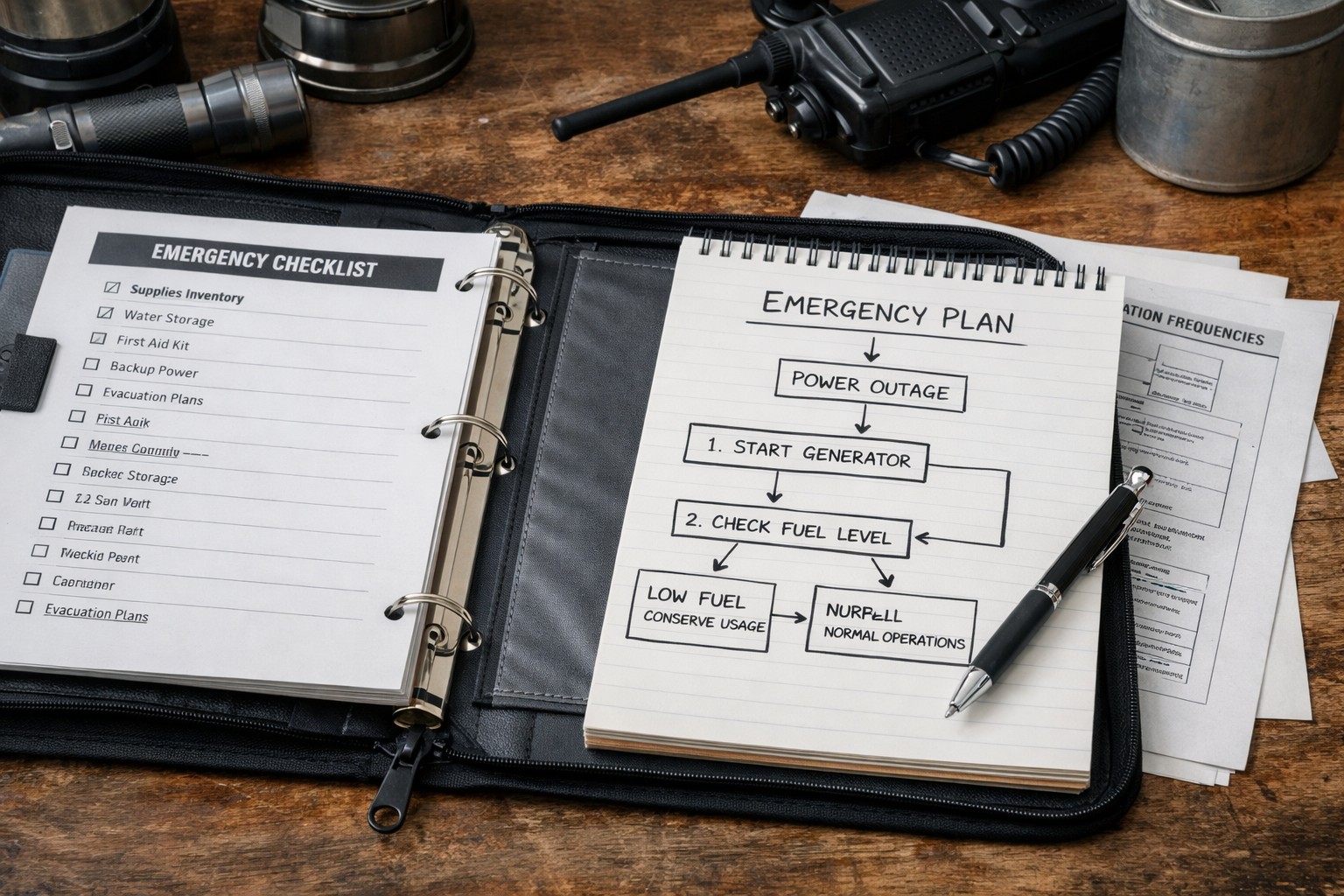
If a decision matters, it should live on paper.
Written decision trees and procedures reduce mental load and prevent second-guessing. They work when you’re tired, sick, or dealing with multiple problems at once. Phones fail. Batteries die. Paper persists.
This is why a physical preparedness binder remains one of the most undervalued tools in a household plan. Simple, durable materials matter more than apps in real-world stress environments. Practical examples include waterproof binders
https://www.amazon.ca/dp/B07X3YH2QF?tag=canadpreppn01a-20
and write-in-the-rain notebooks that allow changes without losing structure
https://www.amazon.ca/dp/B0013AVZK2?tag=canadpreppn01a-20.
Perfect information is a myth
Many people delay decisions because they want certainty. Certainty rarely arrives in time.
Prepared decision systems assume incomplete, conflicting, or delayed information. The goal is not to be right — it’s to act early on reversible decisions and reserve irreversible ones for clearly defined triggers.
If a choice can be undone cheaply, make it early. If it can’t, define the threshold precisely and commit to it. This principle alone prevents most cascading failures.
Long-term preparedness lives or dies here
In extended disruptions, decision fatigue becomes as dangerous as shortages.
This is why serious long-term planning — especially for retreats or multi-family setups — prioritizes authority, procedure, and escalation rules alongside physical infrastructure. These concepts are foundational in Acres of Preparedness: Planning the Last Safe Place, which treats preparedness as an operational system rather than a collection of supplies.
https://amzn.to/4iLrm9Y
Final perspective
Supplies buy you time.
Decisions determine how that time is used.
If your plan relies on clarity magically appearing in the moment, it isn’t a plan — it’s hope. And hope is the first thing stress strips away.