
Emergency Communication Supplies Canada: Buying Guide
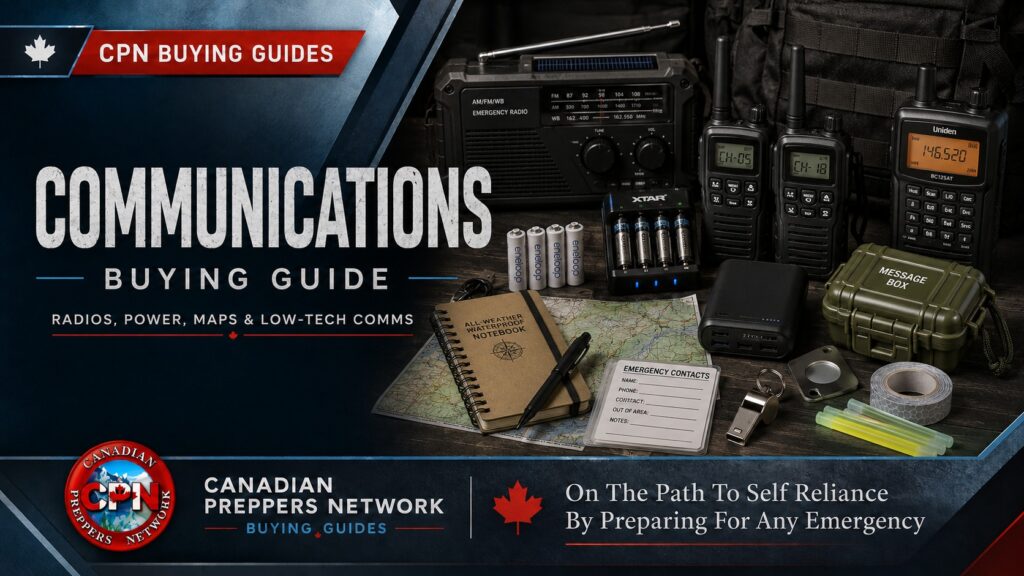
When the power goes out, the internet fails, cell towers overload, or a storm cuts off normal contact, communication becomes more than convenience.
It becomes coordination.
A household needs to know what is happening, where people are, who needs help, whether roads are open, whether weather is worsening, and how to reach others if normal systems stop working. In a short outage, that may mean receiving public information, checking on family, and keeping phones charged. In a larger disruption, it may mean local radio monitoring, neighbourhood coordination, family message plans, backup charging, printed contact sheets, route message boxes, and low-tech communication methods that do not depend on a smartphone.
Canadian readers should also understand one major change: Weatheradio and Hello Weather are no longer in service. For current weather forecasts and alerts, Environment and Climate Change Canada directs Canadians to the interactive weather map and the WeatherCAN app instead. That does not make radios useless. It means emergency radios should be treated mainly as AM/FM public-information tools, not as dedicated Canadian Weatheradio receivers.
This buying guide focuses on practical communication supplies for Canadian households, rural properties, retreats, farms, and long-term disruption planning. The goal is not to turn every reader into a radio expert overnight. The goal is to build layered communication options that still work when normal systems fail.
Start Here: Core Emergency Communications Supplies
If you are building your emergency communications system from scratch, start with the basics: receive information, contact your household, keep devices charged, and preserve important information offline.
Waterproof Notebooks and Low-Tech Message Supplies
Weatherproof Message Containers
These categories form the foundation: information, short-range contact, backup power, offline planning, and durable low-tech communication.
Best First Purchase: AM/FM Emergency Radio
The first communication tool most households should own is not a fancy transmitter. It is a reliable way to receive public information.
An AM/FM emergency radio can still be useful during power outages, storms, evacuations, and local disruptions because ordinary broadcast radio may continue delivering news, official statements, road information, and regional updates when the internet or cell service is unreliable. Many models also include hand-crank charging, solar trickle charging, USB charging, built-in flashlights, and power bank features.
The key point for Canadian buyers is accuracy: do not buy one assuming it will replace Weatheradio. Buy it as a general receive-only emergency information tool.
Best For Official Alerts: WeatherCAN, Alert Ready, and Offline Backup
Official alerts in Canada are now more app, phone, web, broadcast, and local-authority driven than Weatheradio-driven.
That means your communication plan should include more than one pathway. WeatherCAN can help provide official weather alerts when data service is available. Alert Ready-compatible phones may receive emergency alerts. Local radio, local TV, provincial emergency agencies, municipal alert systems, and local government pages may also provide important updates depending on the event.
The weakness is power and access. Apps do not help if the phone is dead. Web pages do not help if the internet is down. Alert systems do not help if the household never sees the message.
That is why the buying goal here is not another weather receiver. It is keeping phones charged, keeping printed information available, and having a radio backup for broadcast information.
USB Charging Cable Multi Packs
Best For Household Coordination: Handheld Two-Way Radios
Handheld two-way radios are useful for short-range communication around a property, campground, event, retreat, neighbourhood, or convoy.
They are not magic. Terrain, buildings, trees, hills, battery condition, antenna quality, and radio type all affect range. But for practical household use, they can still be extremely useful. They help family members coordinate without shouting, save phone batteries, and provide a backup when cell service is weak.
For basic non-technical use, consumer two-way radios are often easier for families than more advanced radio equipment. For readers interested in ham radio, licensing and proper operating practices matter. A radio is only useful if the household knows how to use it legally and effectively.
Best For Serious Preparedness: Ham Radio Study and Accessories
Ham radio is one of the most capable communication systems available to prepared citizens, but it is not plug-and-play.
The equipment is only part of the system. The real value comes from licensing, practice, local repeater knowledge, emergency nets, antennas, power planning, and operating discipline. A handheld radio left in a drawer with no programming, no spare battery, and no understanding of local repeaters is not a communication plan.
For Canadian preppers who want to move beyond basic household radios, start with study material, a licensing goal, and simple equipment that can be used regularly. Learn local repeater frequencies, net schedules, antenna basics, and how to operate clearly.
Best For Keeping Radios Working: Batteries and Chargers
Communication gear is only useful if it has power.
Many emergency plans fail at the battery level. Radios are bought, placed in a drawer, forgotten for years, then found dead during an outage. The better plan is to standardize around common battery sizes, keep rechargeable batteries charged, own a quality charger, and store disposable backups where appropriate.
Rechargeable AA and AAA Batteries
Best For Phone and Device Backup: Power Banks and Charging Cables
Phones are still useful in many emergencies.
Even if cell service is unreliable, a phone can store maps, documents, photos, contact lists, downloaded reference material, notes, and offline apps. The problem is power. A dead phone is just a small piece of glass.
Every household should have power banks, charging cables, wall chargers, car chargers, and a way to recharge devices during a longer outage. Keep cables organized by type, because the wrong cable at the wrong time is useless.
Best For Local Information: Scanner Radios and Broadcast Monitoring
Listening is often more important than transmitting.
A scanner or wide-coverage receiver can help monitor local broadcasts, weather-related public information where available, aviation, marine, and other radio traffic depending on location, legality, and equipment. This is especially useful for people who want situational awareness without needing to transmit.
Rules matter. Do not interfere with emergency communications. Do not attempt to access encrypted communications. Do not rebroadcast sensitive information. The preparedness value is in awareness, not interference.
Best Low-Tech Backup: Printed Contact Plans and Notebooks
Communication is not only electronics.
A printed contact plan may be more useful than a radio nobody knows how to operate. Every household should have important phone numbers, addresses, meeting points, medical contacts, neighbours, emergency services, insurance details, and out-of-area contacts written down.
Do not assume every phone will be charged, unlocked, or available. Do not assume everyone remembers numbers under stress. A printed plan in a binder or waterproof notebook gives the household a simple fallback.
Best For Low-Tech Communication: Message Boards, Signals, and Written Systems
Low-tech communication is easy to overlook because it is not exciting, but it may be the most reliable layer in the whole plan.
A whiteboard on the fridge, a waterproof notebook in the vehicle, laminated contact cards, signal flags, driveway markers, reflective tape, whistles, clipboards, and printed message forms can still work when phones are dead, apps are unavailable, and radios are out of range.
For families, low-tech communication can be as simple as a written check-in plan: where to leave a note, which neighbour to contact, what time to check in, where to meet if the house is not safe, and what route to take if roads are blocked.
For retreats, farms, homesteads, and preparedness groups, low-tech communication becomes even more useful. A shared message board, map board, sign-in sheet, radio log, task board, and visible status markers can prevent confusion when several people are working in different areas.
Best For Route Communication: Weatherproof Drop Boxes and Message Containers
A communication plan does not always require electronics.
For rural properties, retreats, farms, hunting camps, large homesteads, or family fallback routes, a weatherproof drop box can hold written information where people are likely to need it. This might include laminated maps, check-in sheets, spare pencils, route instructions, gate notes, contact cards, or a simple message log.
The goal is to create a durable, weather-resistant place where trusted people can find basic instructions if phones are dead, radios are out of range, or nobody is at the main house.
A good drop box should be waterproof, durable, easy to identify by the right people, and boring enough not to attract attention. Keep the contents practical: paper, maps, markers, small notebooks, basic forms, and weatherproof labels.
Waterproof Geocache Containers
Best For Field Use: Maps, Compasses, and Message Tools
A communication plan should include navigation and written messages.
During an outage or evacuation, people may need to leave notes, mark routes, record times, document sightings, share instructions, or navigate without phone service. Paper maps, waterproof notebooks, pencils, markers, flagging tape, and simple message boards can all help.
Best For Emergency Signalling: Whistles, Mirrors, Lights, Flares, and Smoke
Signalling tools are small, easy to overlook, and sometimes more useful than another radio.
A whistle can carry farther than a voice and uses less energy. A signal mirror can be useful in daylight. Reflective tape, glow sticks, LED strobes, and high-visibility flags can help people locate a vehicle, trail, camp, driveway, retreat entrance, shoreline, or meeting point.
Pyrotechnic signalling tools such as flares and smoke signals may have a place in marine, aviation, remote-area, hunting, wilderness, or retreat signalling plans, but they should be treated as situational emergency tools rather than casual household gear. They can create fire risk, may expire, may be regulated by use or location, and should only be stored and used according to the manufacturer’s instructions and applicable Canadian rules.
Smoke can be useful for daytime visibility, especially in open areas, on water, or where searchers need to see a location from a distance. Flares can be useful for night signalling or urgent distress marking. Both should be handled with caution, stored away from children, kept away from heat and flame sources, and avoided during dry fire-risk conditions unless there is a genuine emergency.
Marine Signal Flares
Check Canadian marine, transport, storage, and local fire-safety rules before purchasing or carrying.
Emergency Smoke Signals
Use only where legal, safe, and appropriate for genuine signalling needs. Avoid use during high fire-risk conditions or anywhere they could create panic, nuisance, or emergency-service confusion.
Best For Group Preparedness: Message Boards and Shared Systems
A household communication plan is useful. A neighbourhood or retreat communication plan is better.
Groups need simple systems: where to post updates, who checks on whom, what radio channel is used for local coordination, where printed instructions are kept, and how messages are logged. A whiteboard, clipboard, notebook, laminated map, and basic forms can prevent confusion.
What To Buy First
For a basic emergency communication setup, start with the items that help you receive information, contact your household, and keep devices powered.
- AM/FM emergency radio
- Handheld two-way radios
- Rechargeable AA and AAA batteries
- Battery charger
- Power banks
- Charging cable kit
- Waterproof notebook
- Permanent markers
- Printed contact plan
- Laminated contact cards
- Emergency whistles
Then expand into:
- Radio scanner or shortwave receiver
- Ham radio study guide
- Handheld amateur radio
- External antennas
- Laminated maps
- Signal mirrors
- LED emergency strobes
- Weatherproof drop boxes
- Whiteboard or community message system
Related CPN Reading
Final Buying Advice
Do not build your communications plan around a single device.
A phone is useful until the battery dies, the tower fails, or the network overloads. A radio is useful only if someone knows how to use it. A contact list is useful only if it exists outside the phone. A plan is useful only if the household has practised it.
Layer the system.
Receive information. Talk locally. Keep devices powered. Write down the plan. Use paper backups. Create visible message points. Prepare low-risk visual signals. Practise before an emergency.
Good communication is not about owning the fanciest radio. It is about making sure the right people can get the right information when normal systems fail.
Amazon Disclosure:
As an Amazon Associate, Canadian Preppers Network may earn from qualifying purchases made through links in this guide. This does not change the price you pay, but it helps support the site.