
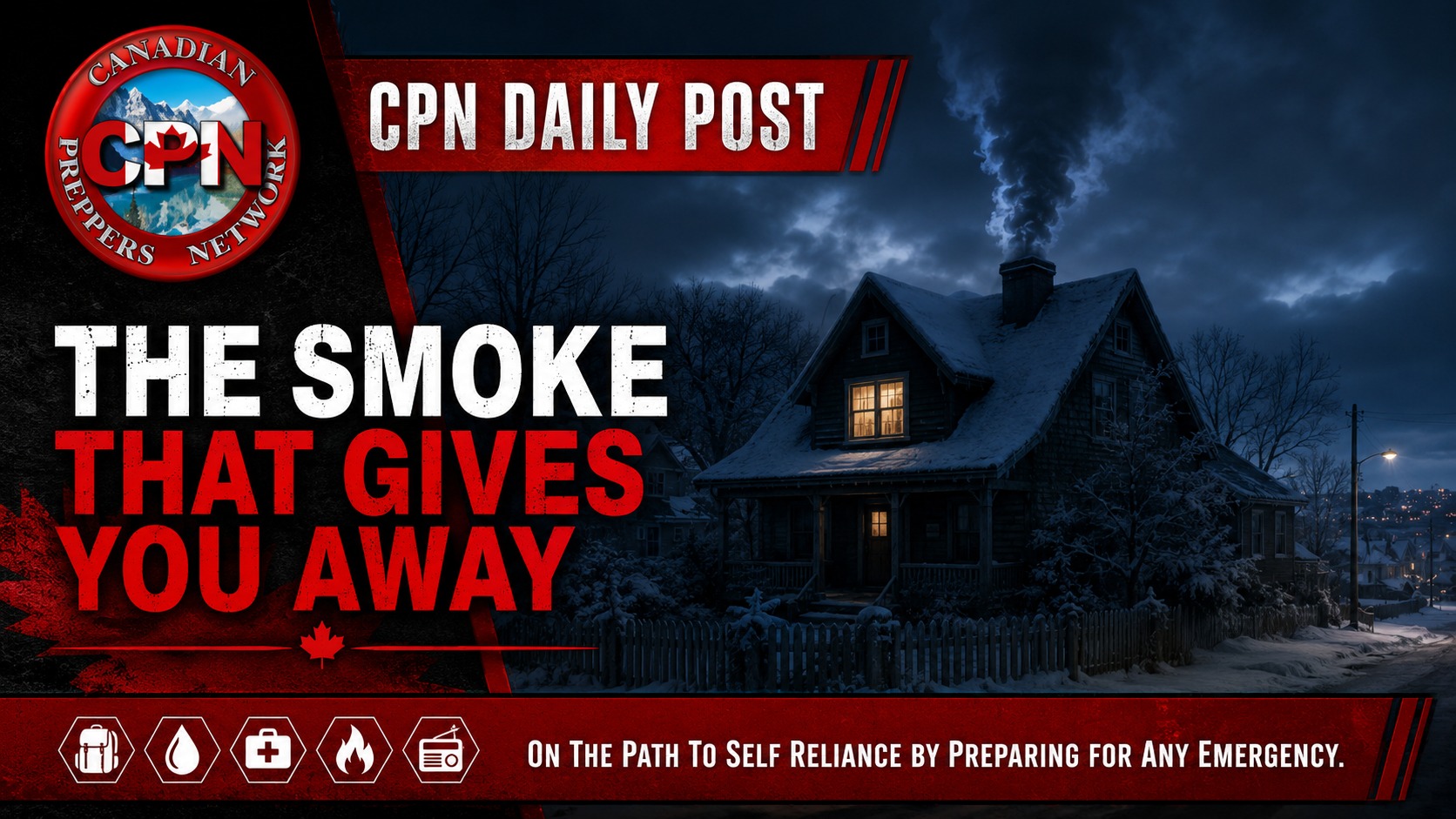
In a silent winter collapse, chimney smoke, generator noise, and light leaking from windows can tell everyone who still has heat, fuel, food, and shelter.
In normal times, chimney smoke is comforting. It means someone has a fire going. It means the house is warm. It means there is life inside.
In a long emergency, that same smoke means something else.
It means someone has fuel.
It means someone has a functioning stove or fireplace.
It means someone has enough food, water, tools, and organization to stay put.
It means that while other houses are dark, frozen, abandoned, or desperate, yours still works.
That is a bigger problem than most preparedness plans admit. Preppers often talk about emergency heat as if the only goal is staying warm. In Canada, that is certainly the first priority. Exposure can kill quickly, and a house without heat can become dangerous in a matter of hours during deep winter. But in a prolonged collapse, heat is not just comfort or survival. Heat is a signal.
Smoke rises. Light leaks. Generators bark. Axe blows carry. Wood piles shrink. Footprints in the snow tell stories. A warm house in a dead neighbourhood does not stay invisible just because the doors are locked.
The serious shelter and heat plan has to account for that.
Heat Is Life, But It Is Also Information
A cold house does not advertise much. A warm house does.
That does not mean you should avoid heat. That would be foolish. It means your heat plan needs discipline. The more fragile the outside world becomes, the more important it is to control what your home reveals.
In a winter outage lasting a few hours or a couple of days, nobody cares that smoke is coming from your chimney. Everyone is dealing with the same storm. Neighbours may check on one another, compare notes, and share help. That is normal community resilience.
But in a longer breakdown, visible heat starts to sort households into categories. Some have no heat. Some have unsafe heat. Some are burning wet wood, garbage, furniture, or whatever they can find. Some have generators running until the fuel is gone. Some are trying to keep children, elderly relatives, or sick family members warm in one room. Others have already left.
Then there is the one place with steady smoke, visible light, regular movement, and signs of routine.
That house becomes a point of interest.
The problem is not only looters or gangs. The problem may be extended family arriving with no supplies. It may be neighbours who ignored every warning and now expect your stove to become a public warming centre. It may be strangers following smoke, noise, or tracks. It may be exhausted people making bad decisions because cold strips away patience and pride.
Heat attracts attention because heat means survival.
The Goal Is Not Invisibility. The Goal Is Reduced Signature.
You will not make an occupied winter home disappear. That is fantasy.
Snow will be disturbed. Wood will be moved. Ash will be dumped. Water will be hauled. Curtains will shift. Chimney smoke may be visible. If you are using a generator, someone will hear it. If you are cutting or splitting wood, that sound will carry farther than expected in cold air.
The realistic goal is not perfect invisibility. The goal is reduced signature.
That means fewer obvious signs. Less unnecessary noise. Less light leakage. Less visible waste. Less routine movement. Less evidence that your home is better supplied than everyone else’s.
Most households leak information without realizing it. Bright lights in every room. Open curtains at night. Outdoor cooking smells. Generator use after dark. Loud tools. Repeated trips to the same storage shed. Fuel cans left visible. A woodpile stacked where anyone passing by can estimate how long you can last.
In normal times, none of that matters. In a hard winter collapse, it matters.
Your Heat Plan Should Start With a Smaller Living Zone
The best way to reduce heat demand is to stop pretending you can run the whole house like normal.
Trying to keep every room warm burns fuel, increases movement, and creates more visible activity. A better plan is to shrink the home into a controlled living zone. This could be one main room, a basement area only if it is dry and safe, or a central room close to the wood stove or fireplace.
Close off unused rooms. Hang blankets, tarps, or plastic sheeting to reduce drafts. Use rugs, foam mats, mattresses, bookshelves, or stored supplies to create thermal mass and block cold surfaces. Move sleeping arrangements into the heated zone. Keep water, basic food, medical supplies, lighting, fire tools, and communication gear close to that zone.
A smaller heated area burns less fuel. Less fuel burned means less smoke, less wood movement, less ash, and less labour. It also keeps the household together, which matters when people are tired, cold, and stressed.
The family that can live in one well-managed room will last longer than the family trying to keep a four-bedroom house feeling normal.
Smoke Discipline Starts With Fuel Quality
Bad fuel makes more smoke.
Wet wood, green wood, painted wood, treated lumber, garbage, plastics, and random debris are not smart emergency fuels. Some burn dirty. Some create dangerous indoor and outdoor air problems. Some increase chimney buildup. Some can damage equipment. Some can poison the people you are trying to keep alive.
In a desperate collapse, people will burn stupid things. That does not mean you should build your plan around stupid fuel.
Your best wood heat plan starts long before the emergency. Cut, split, stack, and season firewood properly. Keep it off the ground. Cover the top while leaving the sides open to breathe. Rotate your supply. Keep kindling dry. Have a way to measure moisture. Maintain your stove, chimney, flue, gaskets, and fire tools.
Dry, properly seasoned wood burns hotter and cleaner. That matters for heat output, chimney safety, indoor air, and smoke signature.
A smoky, smouldering fire tells the world you are burning poorly and wasting fuel. A hot, controlled fire in a proper appliance gives more heat with less visible waste. That does not make you invisible, but it does make your system more efficient and less obvious.
Do Not Trade Smoke for Carbon Monoxide
Some people hear “reduce your smoke signature” and immediately start thinking in dangerous directions.
Do not.
Do not block chimneys. Do not choke a fire down to the point where it smoulders heavily and builds creosote. Do not run combustion appliances without proper ventilation. Do not bring outdoor cooking equipment inside. Do not use a generator indoors, in a garage, in a shed attached to the home, or near openings where exhaust can drift back inside.
Carbon monoxide is invisible, odourless, and ruthless. You do not tough it out. You do not smell it coming. You do not solve it with willpower.
Every serious emergency heat setup needs working carbon monoxide alarms, smoke alarms, fire extinguishers, and a plan for ventilation. Battery-powered and backup units matter when the grid is down. So does having spare batteries stored where you can actually find them.
A quiet death from bad heat is not preparedness. It is failure.
Light Discipline Is Part of Heat Discipline
At night, light gives away occupancy just as much as smoke does during the day.
A dark street with one glowing house is easy to read. Even a small lantern near a window can show movement inside. Headlamps flash across curtains. Phone screens show through gaps. Bright LEDs in a kitchen or living room can turn your home into a beacon.
Blackout curtains, heavy drapes, blankets, cardboard panels, and interior barriers all help. The goal is not to live in darkness. The goal is to stop leaking light outside.
Use low, controlled lighting inside the heated zone. Keep unnecessary rooms dark. Avoid moving lights across uncovered windows. Set up interior work areas away from exterior glass. Check your house from outside at night during normal times so you understand where light escapes.
Most people never test this. They assume curtains work because they look closed from the inside. Then they step outside and realize their house is glowing through every gap.
In a long emergency, that lesson should not be learned too late.
Generator Noise Is a Dinner Bell
Wood smoke is not the only signal.
A generator may be worse.
In a quiet neighbourhood, a generator can be heard from a long distance, especially at night. It tells people you have fuel, equipment, electricity, charged batteries, possibly refrigeration, possibly communications, and probably other supplies worth asking about or stealing.
That does not mean a generator is useless. It means generator use should be deliberate.
Use it for charging, pumping, tool use, refrigeration cycles, or essential loads when needed. Do not run it casually for comfort noise or normal household convenience. Do not run it all night unless there is a life-support reason. Do not leave fuel cans, cords, or equipment visible from the road. Do not create a routine that anyone nearby can predict.
A better long-term power plan uses layers: stored battery power, solar charging where practical, rechargeable lights, hand tools, non-electric backups, and minimal electrical demand. The less often you need the generator, the less often you announce yourself.
Ash, Tracks, and Woodpiles Tell Stories
A collapse shelter does not just give itself away through smoke and light. It gives itself away through patterns.
A huge woodpile visible from the road tells a story. So does a path beaten into the snow from the back door to the shed. So does a pile of fresh ash dumped in the same place every morning. So do stacked fuel cans, empty propane cylinders, food packaging, and repeated foot traffic to outbuildings.
You do not need to become paranoid. You do need to become aware.
Store fuel and firewood in a way that makes sense for access but does not advertise your full supply. Keep some wood close for weather and safety, but do not display everything you own. Manage ash safely in a metal container away from combustibles, but do not create an obvious signal pile. Break up predictable routines when possible. Keep tools, sleds, axes, and fuel containers out of casual view.
Security is often less about dramatic confrontations and more about not creating curiosity in the first place.
Community Can Reduce the Threat
There is another side to this. A warm house becomes a target partly because everyone else is cold.
The best way to reduce desperate pressure is not to hide from every neighbour until collapse day. It is to build practical community before systems fail. A small network of households with their own heat, water, food, tools, radios, medical supplies, and labour is more stable than one prepared family surrounded by total dependency.
That does not mean advertising your supplies. It means encouraging preparedness now, while there is still time. Talk about backup heat in general terms. Encourage people to install carbon monoxide alarms. Share knowledge about winterizing, firewood, water storage, and outage cooking. Build relationships with people who bring something to the table.
If a long emergency comes, you do not want to be the only heated house in a frozen neighbourhood. You want other capable households nearby. You want mutual aid, not a line of people at your door because you were the only one who planned.
Preparedness kept completely private may protect supplies. Preparedness spread carefully through trusted relationships can protect the whole area.
The Hard Truth About Saying No
Even with good community, you need household rules before pressure arrives.
Who gets inside?
Who gets warmed up?
Who gets sent away with supplies?
Who gets told no?
How much fuel can be shared?
How many extra people can your shelter support before everyone is at risk?
These are ugly questions, which is why most people avoid them. But avoiding them does not make them disappear. In a serious cold-weather collapse, uncontrolled charity can destroy the very shelter your family depends on.
That does not mean becoming cruel. It means recognizing limits.
A household with one stove, one season of wood, limited food, and limited sanitation cannot absorb endless unprepared people. A retreat or family group needs a plan for visitors, relatives, neighbours, barter, work contributions, sleeping space, medical risk, and conflict. Those decisions should not be made for the first time while someone is pounding on the door in the dark.
Heat is a resource. Shelter is a resource. Space is a resource. Fuel is a resource.
Resources need rules.
Build the System Before You Need the Discipline
The smoke that gives you away is not really the problem. It is only the visible sign of a deeper issue.
If your heat plan depends on burning too much fuel, making too much noise, lighting up the whole house, running a generator constantly, and moving supplies in plain view, then the system is weak. If your home cannot be reduced to a smaller heated zone, the system is weak. If your stove and chimney are not maintained, the system is dangerous. If your neighbours are completely unprepared, the system is isolated.
The answer is not panic. The answer is design.
Build a smaller winter living zone. Store proper fuel. Maintain heating equipment. Install and test alarms. Reduce light leakage. Cut electrical demand. Keep backup lighting simple. Store tools and fuel discreetly. Encourage nearby preparedness without exposing your full inventory. Decide your household rules before the emergency.
In normal times, chimney smoke is a pleasant winter scene.
In a collapse, it is a flag.
Make sure that if your house is the one still giving off smoke, it is not doing so carelessly.
Related Canadian Preppers Network Reading
Shelter and Emergency Heat Buying Guide
Dealing With Extreme Cold During a Grid-Down Emergency
Building Redundant Power When the Grid Can’t Be Trusted
Preparedness Buying Box
Disclosure: As an Amazon Associate, Canadian Preppers Network may earn from qualifying purchases.
This article is not about buying comfort. It is about reducing failure points in a cold-weather emergency: fire detection, carbon monoxide detection, chimney maintenance, fuel efficiency, light control, and keeping one room livable when the rest of the house goes cold.
Battery-Operated Carbon Monoxide Detectors
Battery-operated carbon monoxide detectors on Amazon.ca
Battery Smoke Alarms
Battery smoke alarms on Amazon.ca
Home Fire Extinguishers
Home fire extinguishers on Amazon.ca
Firewood Moisture Meters
Firewood moisture meters on Amazon.ca
Wood Stove Thermometers
Wood stove thermometers on Amazon.ca
Chimney Cleaning Brush Kits
Chimney cleaning brush kits on Amazon.ca
Thermal Curtains
Thermal blackout curtains on Amazon.ca
Window Insulation Film
Window insulation film on Amazon.ca
Weather Stripping
Weather stripping on Amazon.ca
Rechargeable LED Lanterns
Rechargeable LED lanterns on Amazon.ca
Bottom line: the safer your heat system is, the less fuel you waste. The less fuel you waste, the less smoke, noise, movement, and attention you create.
Final Thought
The house with heat will always matter.
In a Canadian winter emergency, staying warm is not optional. But in a longer collapse, the way you stay warm can either protect your household or advertise it. Smoke, light, noise, tracks, fuel use, and routine all say something.
A good shelter and heat plan keeps people alive.
A better one keeps them alive without telling the whole world exactly what they have.