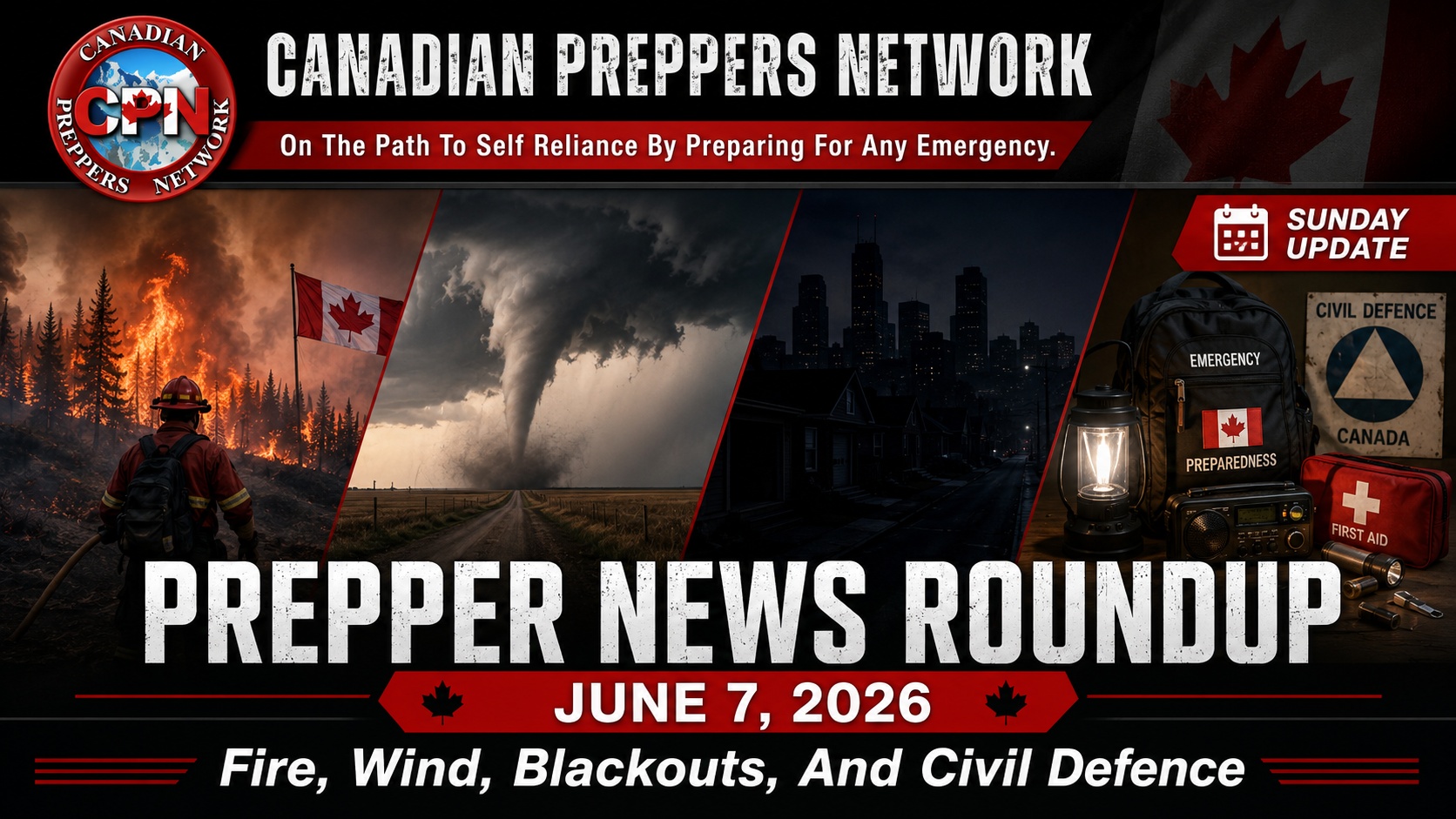
Fire, Wind, Blackouts, And Civil Defence
This week’s preparedness picture is not built around one dramatic event. It is built around several reminders that systems fail in different ways, often at the same time.
Canada is moving deeper into wildfire season. Tornadoes have already been confirmed in Manitoba and Quebec. Tropical activity has begun in the Pacific while the Atlantic remains quiet for now. Jamaica experienced a rare islandwide blackout. NATO is shifting forces and expectations in Europe. Germany is putting serious money into civil defence, while Finland’s shelter system continues to draw global attention.
None of these stories require panic.
All of them require attention.
The pattern is what matters. Weather threats are active. Power systems remain fragile. Civil defence is becoming a serious government priority in parts of Europe. Military planning is shifting. Cyber threats remain persistent. For Canadian preppers, this week’s lesson is simple: the people who wait for certainty will always be late.
Canada’s Wildfire Season Is Already A National Preparedness Issue
Public Safety Canada’s late-May update reported 65 active wildfires across Canada, with six listed as out of control at the time of that update. The federal outlook also warned that above-normal temperatures are expected for nearly all Canadian regions through June, July, and August, while fire danger is expected to build across the country through July.
That does not mean every region will burn. It means wildfire season has to be treated as more than a western problem or a rural problem.
Wildfire affects evacuation routes, fuel availability, livestock movement, air quality, insurance, power lines, food transport, emergency shelters, and medical pressure. Smoke alone can turn a distant fire into a local health and logistics problem. A family hundreds of kilometres from the flames may still need clean indoor air, backup power, stored medications, and the ability to shelter in place without relying on a last-minute store run.
The oil sands region remains one of the areas to watch. Recent reporting from northern Alberta showed active fires once again near oil-producing regions. Even without a major disruption, the presence of fires near industrial infrastructure is a reminder that energy supply chains are not abstract. Fuel, electricity, trucking, and heating costs are tied to real infrastructure in real terrain.
For preppers, the immediate takeaway is to review evacuation readiness before the smoke is in the sky. Keep fuel tanks topped up when risk rises. Maintain go-bags that are not just “camping bags” but evacuation bags: documents, medications, chargers, cash, pet gear, masks, hard-copy contact lists, maps, and clothing suited to rough travel. At home, have a way to improve indoor air, cook without grid power, and communicate if cell service gets overloaded.
Wildfire season punishes people who assume they will have time.
Tornado Season Is Also Active In Canada
While wildfires are getting much of the national attention, tornado season also belongs in this week’s roundup. The Northern Tornadoes Project confirmed three EF0 tornadoes in southern Manitoba from the June 2 storm system, with events near Douglas, Manitou, and Sperling. These were not catastrophic events, but they still produced damage indicators such as tree damage, roof damage, fence damage, and ground scouring.
Quebec also saw its first confirmed tornado of 2026 near Saint-Thomas-Didyme in the Saguenay region on May 25. It was also rated EF0, with reported minor damage and no injuries.
The lesson here is not that every storm will become a disaster. The lesson is that severe weather warnings can move faster than households do.
Many people still treat tornadoes as something that happens somewhere else. In Canada, that attitude is dangerous. The Prairies, southern Ontario, southern Quebec, and parts of the Maritimes all have tornado risk. Rural households, cottage properties, farms, trailers, sheds, barns, and small towns can all be hit hard by fast-moving severe weather.
A proper tornado plan is simple but must be rehearsed. Know where everyone goes when the warning comes. Basement first, interior room if there is no basement, away from windows. Keep shoes, gloves, flashlights, power banks, a battery radio, first aid gear, pet leashes, helmets if available, and important documents easy to grab. After the storm, assume broken glass, nails, unstable branches, downed lines, blocked roads, and damaged roofs until proven otherwise.
The time to decide where the family shelters is not when the alert tone is already sounding.
Hurricane Season Is Active, Even If The Atlantic Is Quiet
Hurricane season is no longer just a future forecast. It is underway.
At the time of writing, the Atlantic basin remains quiet, with no tropical cyclone formation expected over the next several days. That is good news for Atlantic Canada, the Caribbean, the Gulf, and the U.S. East Coast, but it should not be mistaken for a free pass. Early June can be quiet right up until it is not.
The Eastern Pacific, however, has already produced activity. Amanda became the first named tropical storm of the 2026 Eastern Pacific season and has since weakened, while the National Hurricane Center has also been issuing advisories on Tropical Depression Two-E south of southern Mexico. These systems are not direct Canadian threats, but they matter because they show the tropical season has begun in real time, not just on a calendar.
For Canadian preppers, the point is not to track every storm cone obsessively. The point is to understand what tropical systems can disrupt. Hurricanes and tropical storms can affect ports, fuel movement, food distribution, rail and trucking routes, insurance costs, power grids, communications, and emergency response capacity. Even a storm that never reaches Canada can still ripple through supply chains if it affects the wrong corridor at the wrong time.
Atlantic Canada has already learned that post-tropical systems can still be destructive after losing classic hurricane structure. Inland regions should pay attention too. Heavy rain, washed-out roads, extended power failures, fuel delays, and supply interruptions do not care whether a storm is still officially called a hurricane by the time its remnants arrive.
The household takeaway is simple: do the boring work before the storm name matters. Store water. Keep vehicles fuelled when systems are tracking north. Secure loose outdoor items. Maintain battery lighting, radios, power banks, cash, tarps, and non-electric cooking options. Check sump pumps, drainage, gutters, and backup power before the rain starts. Protect documents and have an evacuation route that does not depend entirely on GPS or cell service.
A quiet Atlantic does not mean a quiet season. Tropical activity has already started, and the time to prepare is before a storm has your region in the cone.
Jamaica’s Islandwide Blackout Shows How Fast A Grid Can Fall
Jamaica experienced a rare islandwide blackout this week, leaving all utility customers across the country without power after a grid collapse on June 4. According to the Jamaica Public Service Company, restoration began within hours, with roughly 57 percent of customers reconnected by late evening and full restoration efforts continuing overnight into the following day. Early reporting pointed to likely lightning-related damage near key substations and grid infrastructure, though authorities were still investigating the exact cause.
The specific cause matters for Jamaica. The broader lesson matters everywhere.
Modern life is built on the assumption that electricity is always coming back soon. That assumption is comfortable, but it is not a plan. One grid event can shut down lighting, refrigeration, banking, pumping, traffic signals, elevators, communications, business operations, and medical routines. Even when restoration happens quickly, the first few hours can expose who prepared and who simply hoped.
Every household should be able to operate through at least a short grid failure without panic. That means flashlights that work, charged battery banks, stored water, cash, a way to cook, a way to keep warm or cool depending on the season, backup charging for radios and phones, and a plan for refrigerated food.
For a longer failure, the stakes rise quickly. Water pressure may drop. Stores may close. Fuel pumps may stop. Card payments may fail. People may begin moving around looking for supplies. Families with medical devices, elderly relatives, infants, or refrigerated medication will feel the pressure early.
A blackout is not just a power problem. It is a household systems test.
NATO, Canada, And The Direction Of Travel
This week also brought another reminder that international security planning is shifting. Reuters reported that the United States expects European NATO allies and Canada to increase their contributions of aircraft, drones, refuelling capability, and naval vessels as Washington reduces some of the forces it makes available to NATO planning.
That does not mean war is imminent. It does mean the defence assumptions of the last several decades are changing.
At the same time, NATO’s BALTOPS naval exercise is running in the Baltic Sea from June 4 to June 20. This year’s exercise is smaller than last year’s, but still involves around 20 vessels, 15 nations, and roughly 6,000 personnel. The Baltic region remains strategically important because of sea routes, military logistics, and access to allies that rely on narrow land and maritime corridors.
For Canadian preppers, the point is not to obsess over every military movement. The point is to recognize direction. Governments are talking more openly about readiness, infrastructure protection, supply routes, defence production, and civil resilience. Those are not fringe topics anymore.
The household version of that lesson is simple: build resilience before officials need to tell you to.
Europe Is Relearning Civil Defence
Germany is preparing to allocate 10 billion euros to civil defence measures, including medical infrastructure, special vehicles, portable cots, shelters, and mass alerting systems. That kind of spending sends a signal. A major European government is not treating civil defence as a dusty Cold War leftover. It is treating it as part of national preparedness.
Finland offers an even stronger contrast. Its shelter system continues to attract international attention, especially Helsinki’s large dual-use shelters that can function as sports facilities and public spaces in normal times, then convert to emergency shelter use when needed. Finland’s approach is not based on slogans. It is based on infrastructure, maintenance, law, and public expectation.
Canada does not have that same shelter culture. Most Canadian households will not have access to a purpose-built civil defence shelter. That makes household and community-level planning even more important.
Where would your family go during a tornado warning? Where would you sleep during a winter blackout? How would you keep indoor air breathable during wildfire smoke? Where would neighbours gather if communications failed? Who checks on the elderly, the isolated, or the medically fragile? What supplies exist locally, and what disappears within hours?
Civil defence is not only bunkers and sirens. It is the serious work of keeping people alive when normal services are delayed, damaged, or overwhelmed.
Cyber Threats Stay In The Background Until They Do Not
There was no single Canadian cyber incident this week strong enough to lead the roundup, but cyber risk still belongs in the preparedness picture. Canada’s Cyber Centre continues to identify cybercrime, ransomware, and threats to organizations and essential services as persistent concerns.
Preppers sometimes ignore cyber risk because it does not feel as tangible as firewood, water, food, and tools. That is a mistake.
A cyber incident can affect banking, pharmacies, hospitals, fuel distribution, municipal services, schools, supply chains, and communications. It can lock up business systems, delay paycheques, disrupt appointments, expose personal data, and create local confusion.
The household response is not complicated. Keep some cash. Print key documents. Maintain paper contact lists. Back up important files offline. Use strong passwords and multi-factor authentication. Do not depend on one phone, one app, one bank card, or one cloud account for everything. In a crisis, digital convenience can become digital dependence very quickly.
Final Takeaway
This week’s roundup is not about one giant emergency. It is about overlapping pressure.
Wildfires are active. Tornadoes are being confirmed. Tropical storm activity has started. A national grid failed in Jamaica. NATO planning is shifting. Europe is investing in civil defence. Cyber threats remain part of the background noise that can suddenly become a front-page problem.
The useful prepper does not need to predict the exact next crisis.
The useful prepper builds a household that can absorb disruption.
Store water. Maintain food reserves. Keep fuel discipline. Have battery lighting. Build evacuation plans. Practise severe weather sheltering. Keep paper backups. Protect indoor air. Know your neighbours. Watch the news without being ruled by it.
The world rarely gives perfect warning.
But it gives signals.
This week, there were plenty.