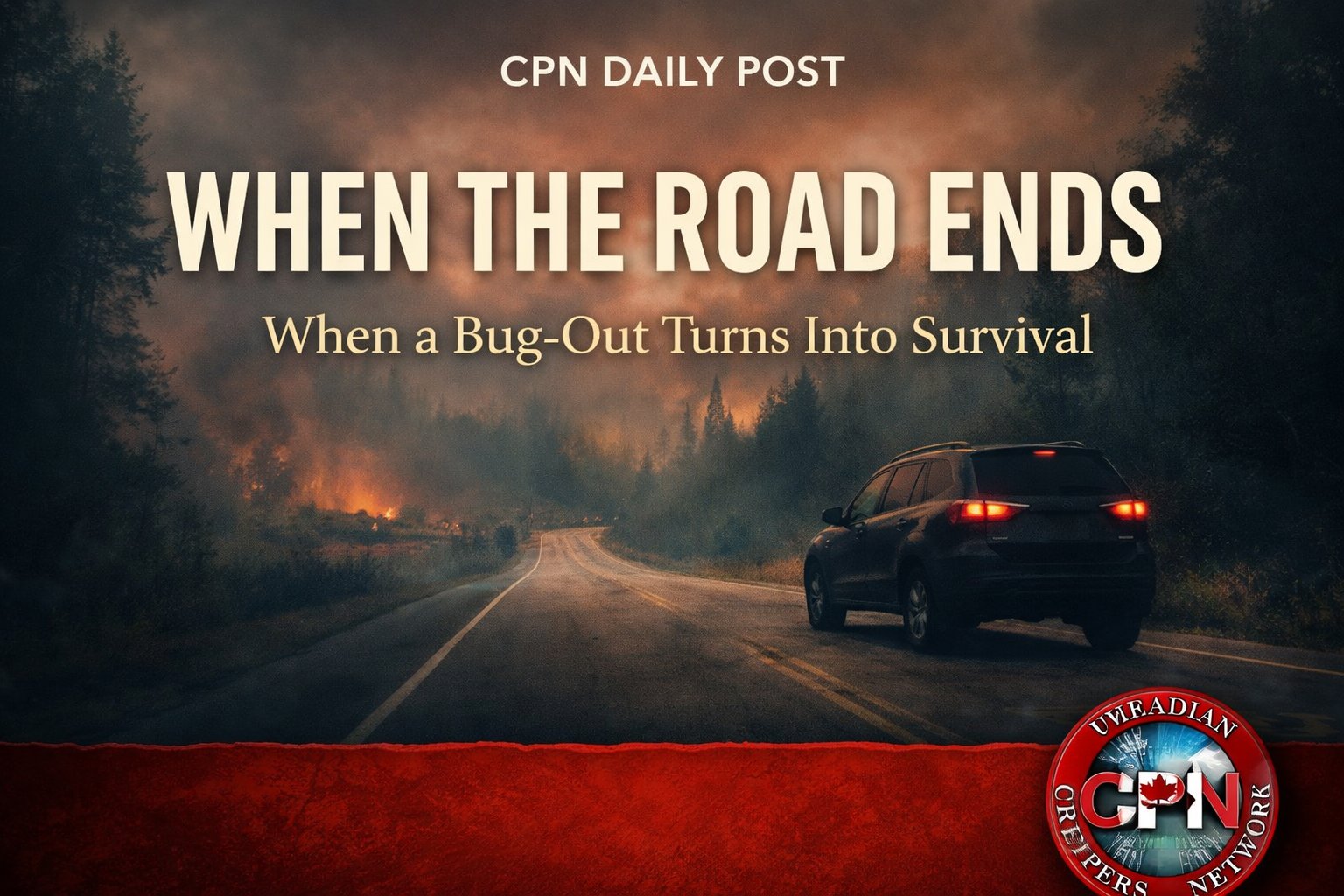
There’s a quiet assumption built into most bug-out plans: that movement equals safety.
You leave early, you follow your route, and you arrive where you’re supposed to be.
But across Canada—whether it’s wildfire evacuations in British Columbia, washed-out roads in Quebec, or sudden highway closures in Northern Ontario—there’s a growing pattern. People don’t fail because they didn’t leave. They fail because they couldn’t finish the trip.
The road ends. Traffic stops. Routes disappear. And suddenly, you’re not evacuating anymore—you’re surviving.
The Moment It Changes
It rarely feels like a dramatic turning point.
You sit in traffic longer than expected. You burn more fuel than planned. You try a secondary route, then another. Each decision feels reasonable at the time.
But there’s a moment—often missed—where the situation has already shifted:
You are no longer getting out.
You are now stuck between places.
Most people recognize this too late. They keep pushing forward when they should be conserving. They assume help will arrive quickly. They hesitate to change plans because they’ve already invested time and fuel into the original one.
Preparedness starts with recognizing failure early. Not emotionally—but practically.
The Vehicle Is Your First Shelter (Until It Isn’t)
When movement stops, your vehicle becomes your greatest asset.
It provides shelter from wind and precipitation, a degree of insulation, visibility to rescuers, and a place to organize your supplies.
The instinct to abandon a vehicle too quickly is one of the most common mistakes. On foot, your world shrinks fast. Distances become harder. Terrain slows you down. Every calorie matters.
Stay with the vehicle unless something forces you out.
Those triggers are not subtle: advancing fire, rising water, immediate security risk, or absolute certainty that no help is coming.
If none of those are present, the vehicle is not your problem—it’s your lifeline.
What You Packed vs What You Actually Need
A lot of bug-out gear looks good laid out on a table. It looks far less impressive when you have to carry it.
When a vehicle is no longer usable, priorities shift fast.
Water becomes critical within hours. Insulation becomes critical the moment you stop moving. Calories matter, but not immediately.
This is where simple, reliable gear proves its worth. A compact filter like the Sawyer Mini Water Filter can make the difference between using nearby water safely or taking a risk that could end your situation early:
https://www.amazon.ca/s?k=Sawyer+Mini+Water+Filter&tag=canadianprep-20
Likewise, insulation is not optional. An emergency bivvy or thermal sleeping bag can trap body heat when you’re exhausted and exposed—something most people underestimate until it’s too late:
https://www.amazon.ca/s?k=emergency+bivvy+sleeping+bag&tag=canadianprep-20
Movement Is the Most Dangerous Decision
Leaving your vehicle is not just a change in position—it’s a commitment.
Once you’re on foot, every kilometre costs energy and hydration. Terrain will slow you more than expected. Injury risk increases with every step.
People consistently overestimate how far they can travel under stress.
If you move, it should be for a reason—not just discomfort.
Following roads increases your chances of contact and rescue. Following water can lead to habitation, but may also pull you into difficult terrain. Climbing for visibility comes at a steep energy cost.
And the hardest truth:
Staying put is often the safer option—if you’re not in immediate danger.
That runs against instinct. But unnecessary movement is one of the fastest ways to turn a manageable situation into a critical one.
Exposure Will Kill You Before Hunger Does
In Canadian conditions, exposure is the real threat.
Not hunger. Not even dehydration at first.
Exposure.
Spring and fall bring cold rain and wind that strip heat quickly. Summer introduces dehydration and heat exhaustion. Winter reduces mobility the moment your core temperature drops.
Once you stop moving, your body cools rapidly—especially if you’re already fatigued.
This is where controlled heat and water access matter. A simple portable butane stove gives you the ability to boil water and create a controlled heat source when conditions allow:
https://www.amazon.ca/s?k=portable+butane+stove&tag=canadianprep-20
Layering, staying dry, and blocking wind will always matter more than pushing forward blindly.
Signalling vs Staying Hidden
There’s a mindset in the prepper community that values staying unnoticed. In some situations, that’s justified.
In a failed bug-out scenario, it can work against you.
If you’re not under a direct threat, your priority should shift:
You want to be found.
That means visibility and repetition. Movement, contrast, and sound.
A simple emergency whistle carries far farther than your voice and requires far less energy—especially when you’re already fatigued:
https://www.amazon.ca/s?k=emergency+survival+whistle&tag=canadianprep-20
Subtle signals don’t work. Most people who are missed aren’t hidden—they’re simply not visible enough.
The Hard Truth About Failed Evacuations
Most failures don’t look dramatic.
They don’t happen in a single moment.
They happen in layers. Leaving later than planned. Choosing the wrong route. Burning more fuel than expected. Carrying the wrong gear. Moving when you should have stayed.
And then, gradually, the margin disappears.
Preparedness isn’t just about having a plan that works when everything goes right.
It’s about having a mindset that adapts when it doesn’t.
Because when the road ends, you’re not bugging out anymore.
You’re surviving.