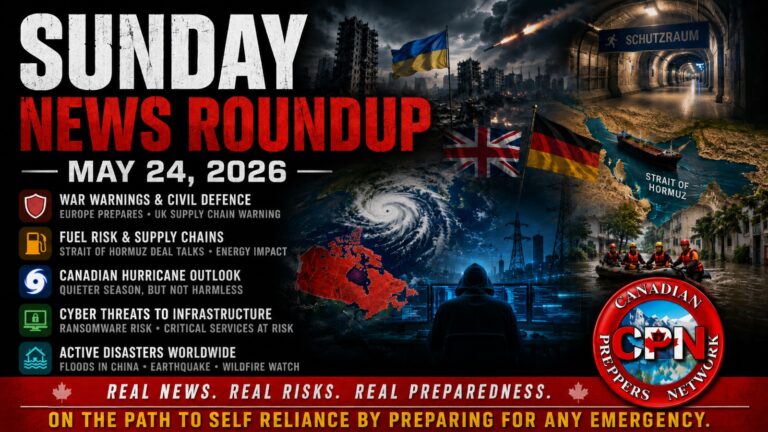
The news cycle this week feels quieter than it has in recent months. Fewer dramatic headlines. Less urgency in the tone. But that calm is misleading. Beneath the surface, the same pressures that concern preppers—energy instability, food cost creep, infrastructure vulnerability, and environmental volatility—continue to build.
This is the kind of week that tests awareness. Not because everything is falling apart, but because nothing appears to be.
Energy Instability: A Ceasefire That Changes Very Little
Reports of a short-term ceasefire involving Iran have taken some immediate pressure off global oil markets. Prices have steadied—for now. But this is not stability in any meaningful sense.

The underlying issue remains unchanged: a significant portion of the world’s oil supply still passes through vulnerable choke points like the Strait of Hormuz. Any disruption—political, military, or accidental—can ripple outward in days.
In Canada, that translates to something very simple: unpredictable fuel pricing and availability. Even without a direct shortage, volatility makes planning difficult. And when planning becomes difficult, most people stop doing it.
Preparedness doesn’t assume the worst-case scenario—it accounts for inconsistency. Stored fuel, safe rotation practices, and reducing dependence on daily refuelling are still among the most practical steps a household can take.
Food Prices: The Slow Burn That Gets Ignored
There’s no headline declaring a food crisis in Canada this week. And yet, anyone who shops regularly can see the pattern: prices edge higher, portions shrink, and availability shifts without warning.
This is not panic inflation—it’s erosion.

Staples like meat, dairy, and fresh produce continue to fluctuate in both cost and consistency. Regional differences are becoming more noticeable, especially in rural or supply-sensitive areas. The system is still functioning, but it’s doing so under strain.
The danger here is psychological. Sudden spikes trigger action. Slow increases do not.
Prepared households respond differently. They build depth over time—dry goods, preserved foods, and systems that reduce reliance on just-in-time supply. Skills like canning, dehydration, and bulk storage aren’t old-fashioned. They are stabilizers in an unstable system.
Cyber Threats: The Quiet Front Line
There have been no widely publicized catastrophic cyberattacks this week—but that doesn’t mean activity has slowed. Quite the opposite. Ongoing reporting continues to point to increased probing of North American infrastructure, including energy grids, healthcare systems, and municipal networks.
These are not random attacks. They are tests. Reconnaissance. Positioning.

The challenge with cyber threats is timing. When disruption comes, it is immediate. There is no gradual decline—systems simply stop working.
For Canadian households, the implications are practical. Temporary outages can affect fuel distribution, payment systems, communications, and emergency services. Even a short disruption can cascade quickly.
Preparedness at the household level means thinking analog where possible. Backup power that doesn’t rely on the grid. Printed copies of critical information. Communication options that don’t depend entirely on cellular networks.
These are not extreme measures. They are quiet redundancies.
Extreme Weather: An Early Start to a Volatile Season
Spring is arriving unevenly across Canada, and with it, the first signs of another unpredictable weather year.
Flooding has already affected some regions due to rapid snowmelt and heavy rainfall, while other areas are reporting early indicators of wildfire risk. This kind of split pattern—too much water in one place, not enough in another—is becoming more common.

Seasonal assumptions are no longer reliable.
For preppers, this reinforces a simple principle: plans must be flexible. Flood readiness and fire readiness are no longer separate concerns tied neatly to geography or calendar dates. They can overlap, and they can shift quickly.
Evacuation planning, temporary shelter options, and the ability to move essential supplies on short notice are becoming baseline requirements, not advanced preparation.
Civil Unrest: Pressure That Travels
Economic protests and civil unrest continue to surface in parts of Europe and elsewhere. While these events may feel distant, recent Canadian experience has shown how quickly similar tensions can emerge domestically under the right conditions.
Unrest doesn’t require collapse. It requires pressure.

Rising costs, reduced trust in institutions, and sudden policy shifts can all act as triggers. And when they do, the effects are often localized but intense—road blockages, supply interruptions, and strained emergency response.
Preparedness here is less about predicting events and more about maintaining awareness. Knowing what’s happening beyond your immediate surroundings. Understanding how quickly conditions can change in urban and suburban areas.
At the household level, this translates to something straightforward: maintain a degree of self-sufficiency and avoid being caught dependent during moments of disruption.
The Week in Perspective
Nothing in this week’s news demands panic. That’s precisely the point.
The systems Canadians rely on—energy, food, infrastructure, and social stability—are still functioning. But they are doing so under visible and ongoing strain. The pattern is no longer one of sudden crisis, but of accumulating pressure.
Preparedness, at its core, is not about reacting to headlines. It is about recognizing patterns before they become problems.
This week offered a clear reminder of that.
Stay ready, stay aware, and keep building the kind of resilience that doesn’t depend on things staying calm.