Most people don’t think about their vehicle until something goes wrong.
A breakdown. A long delay. A closed highway. A situation that was supposed to take an hour suddenly takes half a day—or longer.
In Canada, distance works against you. Services aren’t always close. Cell coverage isn’t always reliable. And when things slow down, they don’t always recover quickly.
What you keep in your vehicle determines whether you wait—or manage.
Why Summer Still Carries Risk
Winter gets the attention. Summer gets overlooked.
But summer travel introduces its own problems.
Longer distances. Higher traffic. Road construction. Heat. Unexpected closures. Situations where you’re stuck—not in danger, but not moving either.
And when that happens, you’re relying entirely on what you brought with you.
Most people bring nothing.
The Goal Isn’t Survival—It’s Stability
You’re not preparing for extreme scenarios.
You’re preparing for inconvenience that lasts longer than expected.
A few extra hours becomes the night. A short delay becomes a full stop. A simple issue becomes something you have to manage.
The right items don’t turn your vehicle into a bunker.
They give you control.
Insert after supplies:
A vehicle kit fills the gaps—but your core stability comes from what you’ve built at home, especially food and water:
👉 https://canadianpreppersnetwork.com/how-to-build-a-30-day-food-supply-in-canada/
👉 https://canadianpreppersnetwork.com/water-storage-and-filtration-for-canadian-households/
Start With Water
Water is the simplest upgrade—and the one people forget most often.
A few bottles in your vehicle don’t take up space, but they change how you handle delays immediately.
Heat, waiting, stress—all of it becomes easier to manage when water isn’t a concern.
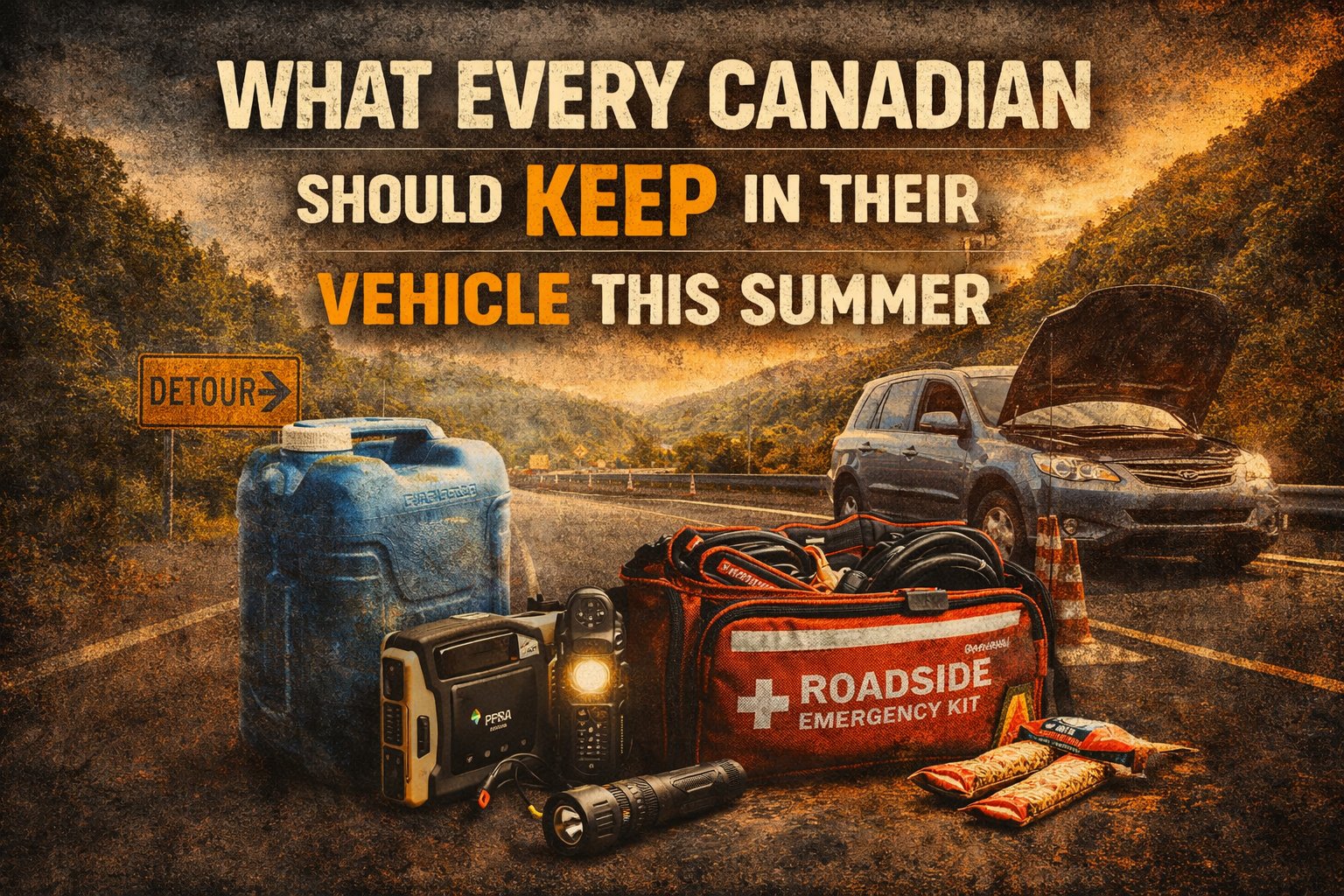
For longer trips or regular travel, a durable water container makes more sense than loose bottles. Something like this BPA-free water jug is built for storage and repeated use:
https://www.amazon.ca/dp/B08V1FJ6Z6/?tag=canadianprep-20
It’s not about carrying more.
It’s about having enough when you need it.
Power and Communication
Phones are useful—until they’re not.
Battery drain happens faster than people expect, especially when you’re using your phone for navigation, updates, and communication at the same time.
A compact car battery charger or power bank gives you a simple way to keep essential devices running when you can’t rely on your vehicle alone:
https://www.amazon.ca/dp/B08LH26PFT/?tag=canadianprep-20
It removes one of the most common points of failure.
Light When You Need It
Most vehicle issues don’t happen in ideal conditions.
They happen at dusk. At night. In low visibility.
A small flashlight in your glove box or console gives you immediate control when visibility drops. You’re not relying on your phone or guessing your way through a situation:
https://www.amazon.ca/dp/B07PHQF4HY/?tag=canadianprep-20
It’s a small addition—but it’s one you’ll use more often than you expect.
Basic Tools and Small Fixes
Not every situation requires a tow.
Sometimes the issue is simple. A loose connection. A minor repair. Something that just needs a quick adjustment.
A compact vehicle emergency kit gives you the basics without taking up space:
https://www.amazon.ca/dp/B07QXG6K9L/?tag=canadianprep-20
You may never need it.
But if you do, it’s the difference between solving the problem and waiting for someone else to.
Your vehicle should reflect the same level of preparedness as your home. If you haven’t built that foundation yet, start here:
👉 https://canadianpreppersnetwork.com/72-hours-is-where-most-people-stop/
Food: Keep It Simple
You don’t need full meals in your vehicle.
But you do need something.
A few non-perishable items—energy bars, simple snacks—give you options when delays stretch longer than expected.
This isn’t about stocking your car.
It’s about removing the edge when things don’t go as planned.
The Situations You Can’t Predict
Most problems don’t announce themselves.
You don’t plan to be stuck. You don’t expect delays to last. You assume things will move again soon.
And most of the time, they do.
But when they don’t, you’re left with whatever you have on hand.
That’s the difference.
What Most People Get Wrong
They treat their vehicle as temporary space.
Something they pass through.
Not something they might need to rely on.
So they keep nothing in it.
And when something happens, they’re forced to improvise.
Build Once, Maintain Occasionally
You don’t need to think about this every day.
Set it up once.
Check it occasionally.
Replace what you use.
That’s it.
Preparedness doesn’t need to be constant to be effective.
It just needs to be in place before you need it.
Final Thought
Your vehicle is one of the few places you can prepare quietly, without changing anything about your daily life.
A few small additions.
A small amount of space.
And a significant difference when something doesn’t go as planned.
Most people wait.
You don’t have to.
Most delays don’t stay isolated. What starts on the road can quickly connect to broader disruptions:
👉 https://canadianpreppersnetwork.com/your-first-7-days-without-normal-supply-chains/