There’s a moment in almost every real-world failure scenario when something simple breaks—a strap snaps, a tarp comes loose, a pack seam gives out. It’s rarely dramatic. It’s small, inconvenient, and easy to ignore—until it isn’t.
Cordage is what holds systems together. When it fails, everything else begins to unravel.
In the wilderness, you don’t have the luxury of digging through a bin for spare rope. And at home, if your stored gear runs out or degrades over time, you’re in the same position. This is where natural cordage stops being a bushcraft hobby and becomes a practical, repeatable skill.
This is not about making decorative rope. It’s about building something that works when nothing else does.
Why Natural Cordage Still Matters
Modern rope is excellent—strong, lightweight, and reliable. But it is also finite. It breaks, it burns, it gets lost, and in a long-term scenario, it will not be replaced.
Natural cordage gives you something different: continuity.
If you understand how to produce it, you’re no longer dependent on stored materials. You can repair gear, secure shelter, lash tools, and improvise systems indefinitely using what’s around you.
This ties directly into broader resilience planning. If you’ve worked through systems like Acres of Preparedness: Planning the Last Safe Place, you already understand that sustainability matters more than convenience.
The Best Natural Cordage Materials in Canada
Basswood (Linden) – The Gold Standard
Basswood is one of the most reliable sources of high-quality natural fiber in Canada.
- Inner bark (bast) separates into long, flexible strands
- Strong enough for shelter building and load-bearing lashings
- Best harvested in late spring to early summer
If you find basswood, you’ve found a renewable cordage supply worth remembering.
Spruce Root – Strength with Structure
Used traditionally across northern regions, spruce roots offer durability and rigidity.
- Ideal for lashings, framework, and repairs
- Naturally curved—good for binding rather than long rope
- Requires cleaning and splitting
This is less about twisting rope and more about structural binding.
Milkweed and Dogbane – Lightweight but Strong
Often overlooked, these plants produce surprisingly strong fibers.
- Found in open fields and disturbed areas
- Excellent for fine cordage (fishing line, light bindings)
- Harvest in late summer when stalks are dry
These are ideal when you need precision more than brute strength.
The Basic Cordage Method (That Actually Works)
There are many ways to make cordage, but one method stands above the rest for reliability: the reverse wrap.
It’s simple, scalable, and produces consistent strength.
Start by preparing your fibers so they run parallel. Divide them into two equal bundles. Twist one bundle away from you to build tension, then wrap it over the second bundle. Repeat this pattern continuously—twist away, wrap over—maintaining even tension throughout.
When you run out of material, splice in new fibers by overlapping them gradually. If done properly, the transition point will be nearly as strong as the rest of the line.
What matters here is consistency. Uneven twist is where failures begin.
How Strong Is It, Really?
This is where most people get it wrong.
Natural cordage is not paracord—but it doesn’t need to be.
Well-made basswood cordage can:
- Secure shelter frames
- Repair pack straps
- Hang food caches
- Bind tools under moderate stress
It will not:
- Replace climbing rope
- Handle shock loads
- Perform well if rushed or poorly made
Strength comes from fiber quality, twist consistency, and diameter. If you need more strength, you build thicker cord—not wish for better results.
Real-World Uses That Matter
This is where the skill proves itself.
Shelter Construction
Without cordage, your shelter is temporary. Lash ridge poles, secure debris, reinforce structure.
Gear Repair
Broken straps and failed stitching are common. Cordage restores function quickly.
Tool Making
Attach blades, reinforce handles, and build improvised tools when hardware fails.
Food Systems
From simple snares to hanging food caches, cordage becomes part of your food security system.
This ties directly into field repair strategies already covered here:
https://canadianpreppersnetwork.com/using-natural-materials-to-repair-gear-in-the-field/
When Natural Cordage Fails
It’s not perfect.
Natural cordage:
- Weakens when wet
- Degrades over time
- Can slip under load if poorly tied
This is why redundancy matters. Double critical lines. Inspect often. Replace before failure—not after.
The Smart Prepper Approach
This isn’t about replacing modern gear—it’s about backing it up.
Carry cordage. But also carry the ability to replace it.
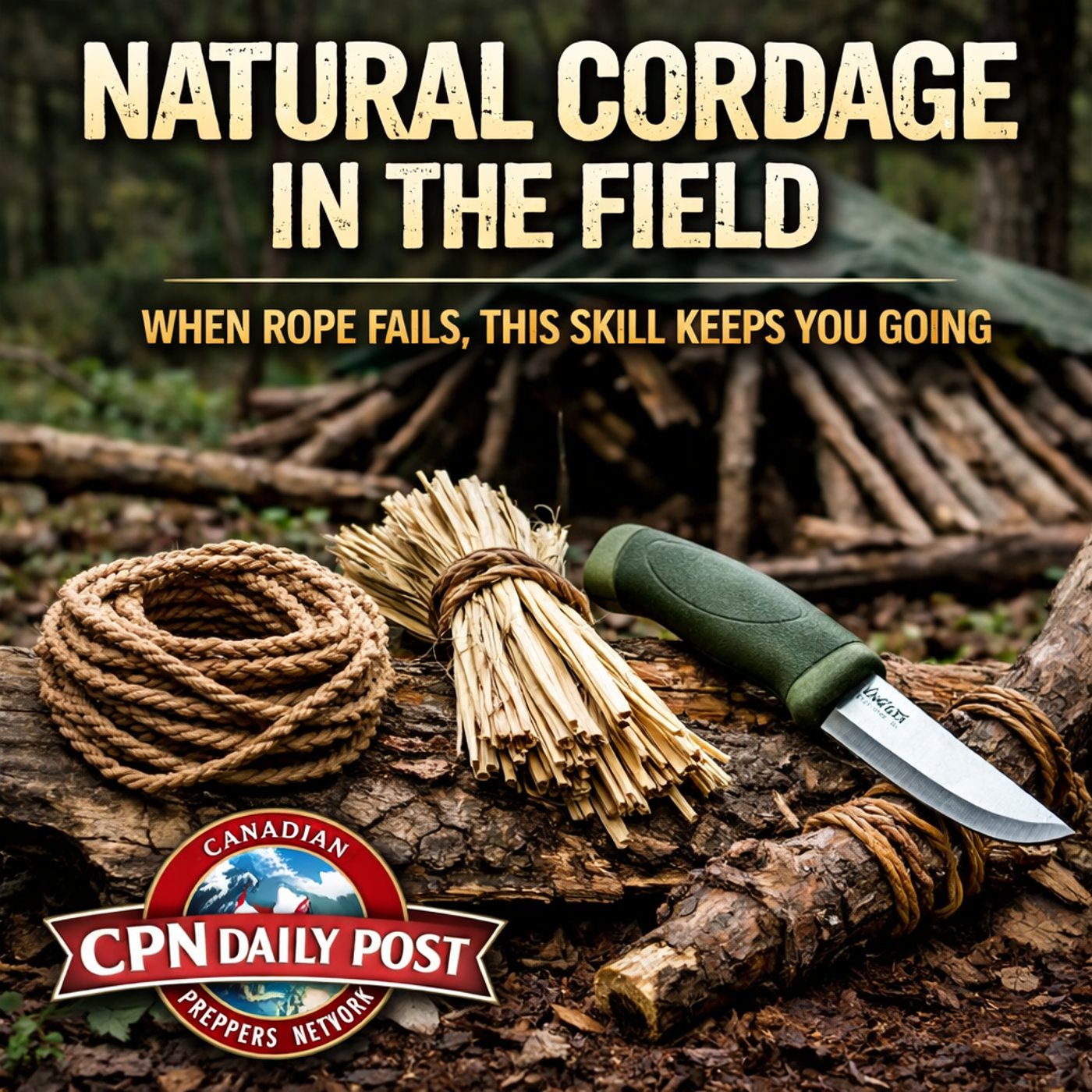
A reliable knife is what makes this practical in the field. Something like the
Morakniv Companion Fixed Blade Knife
(https://www.amazon.ca/dp/B00EAL9X0Y?tag=canadianprep-20)
gives you the control needed to strip bark, split roots, and process fibers cleanly.
For stored cordage, a dependable reserve like
TOUGH-GRID 550 Paracord 100ft
(https://www.amazon.ca/dp/B01N4KQK6Z?tag=canadianprep-20)
acts as your first line—used until it runs out or fails.
The strategy is simple:
Use modern gear first. Replace it with natural systems when necessary.
Final Thought
Cordage is rarely the focus of preparedness planning. It’s too simple. Too basic.
But it’s also one of the few skills that lets you rebuild capability from nothing.
When gear fails—and eventually it will—the person who can still tie, bind, repair, and secure will always have the advantage.
📘 Featured Resource
Acres of Preparedness: Planning the Last Safe Place
A practical framework for building a self-reliant system that doesn’t depend on fragile infrastructure.