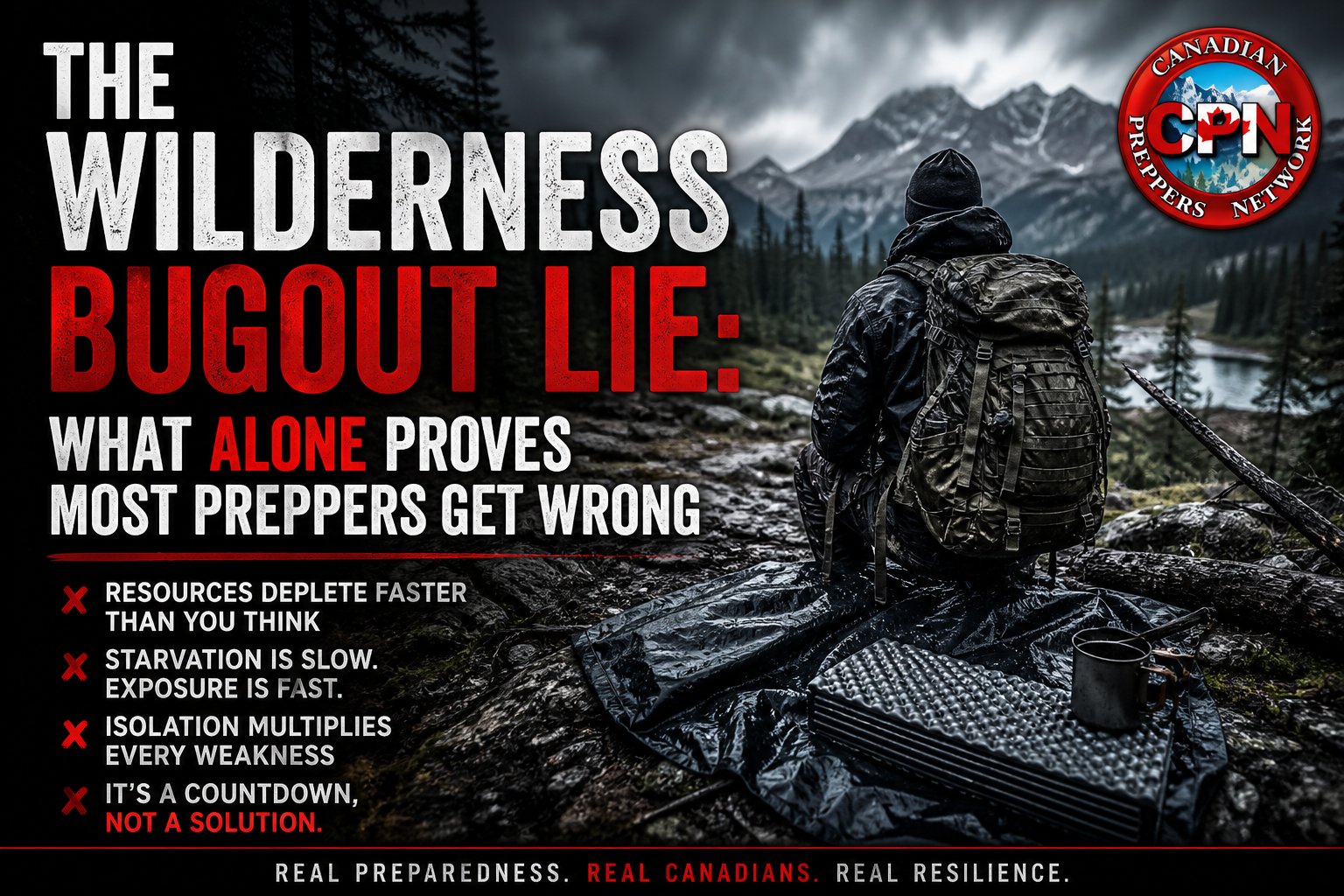
For years, the idea has been pushed that when things go bad, you grab your pack and head into the wilderness.
It sounds logical. It feels independent. It fits the image of self-reliance.
And in most cases, it’s the wrong move.
Not because survival in the wilderness is impossible—but because most people fundamentally misunderstand what it costs to stay alive there.
If you want a real-world example, you don’t need theory.
Watch Alone.
Highly skilled individuals. Controlled conditions. Known environments.
And still—they fail.
The Controlled Experiment Most People Ignore
Alone is as close as you get to a real survival test without dying.
Participants are experienced. Prepared. Equipped.
And yet the majority tap out early.
Not because they can’t build shelter.
Not because they can’t start fire.
They leave because of resource depletion.
Energy drops. Weight drops. Output drops.
And that’s without movement.
A wilderness bugout adds movement—and movement accelerates failure.
You Bring Everything You’ll Ever Have
When you bug out into the wilderness, your pack is your entire system.
There is no resupply. No fallback.
Everything you need has a lifespan.
Food runs out.
Fuel runs out.
Gear fails.
People talk about “living off the land,” but Alone shows how unreliable that is—even for skilled individuals.
You are not entering a system that feeds you.
You are entering one that drains you.
Calorie Deficit Is Guaranteed
Watch any season of Alone and you’ll see the same pattern: rapid weight loss.
Even when stationary.
Now add:
- Movement
- Load
- Navigation errors
- Exposure
You are not just in a deficit—you are accelerating it.
Carrying something like Mainstay Emergency Food Ration Bars (https://www.amazon.ca/s?k=Mainstay+Emergency+Food+Ration+Bars) might stretch your timeline slightly, but it doesn’t solve the problem.
You are still burning more than you can replace.
Water Controls Your Movement
Water looks abundant on a map.
In reality, it dictates everything.
You don’t just “find water.” You:
- Locate it
- Reach it
- Treat it
And every step costs energy.
A compact system like the Sawyer Mini Water Filtration System (https://www.amazon.ca/dp/B00FA2RLX2) reduces the effort required to make water safe—but it doesn’t remove the need to find it or the time it takes to process it.
If your route depends on water you haven’t confirmed, your plan is already unstable.
Exposure Will Break You First
Starvation is slow.
Exposure is immediate.
Wind, damp ground, and temperature swings strip heat constantly—and most people underestimate how fast that happens.
This is where failure accelerates:
- You lose heat
- You burn more calories
- You recover less overnight
A simple shelter system like the FREE SOLDIER Waterproof Camping Tarp (https://www.amazon.ca/s?k=FREE+SOLDIER+Waterproof+Camping+Tarp) can reduce exposure—but only if it’s deployed early, before fatigue sets in.
And without insulation, you’re losing heat all night. A closed-cell pad like the Therm-a-Rest Z Lite Sol Sleeping Pad (https://www.amazon.ca/Therm-Rest-Ultralight-Backpacking-Mattress/dp/B08SR6HCW4) isn’t comfort—it’s calorie preservation.
Fire alone won’t fix poor shelter.
Fire Is Not a Reliable Backup
People assume fire is always available.
It isn’t.
Wet wood. Wind. exhaustion.
Even skilled participants on Alone struggle with fire under bad conditions.
And here’s the problem:
Fire requires effort.
Effort requires energy.
Energy is already declining.
This is how resource depletion compounds.
Isolation Multiplies Every Weakness
One of the clearest takeaways from Alone is psychological strain.
Even trained individuals struggle with:
- Isolation
- Decision fatigue
- Motivation collapse
Now remove the safety net.
No check-ins.
No extraction.
No timeline.
Isolation doesn’t make you stronger—it removes redundancy.
Every mistake is yours alone.
Every task pulls from the same limited energy reserve.
The Countdown Effect
A wilderness bugout is not a stable situation.
It is a countdown.
Each day:
- Supplies decrease
- Energy declines
- Risk increases
You are not building sustainability.
You are managing decline.
Unless you are moving toward a known, prepared destination, you are not bugging out.
You are delaying failure.
Final Thoughts
Alone is not entertainment for preppers—it’s a warning.
It shows what happens when skilled individuals try to sustain themselves in the wilderness under controlled conditions.
And even then, most fail.
A wilderness bugout removes control and adds pressure.
That doesn’t improve your odds—it destroys them.
Because the hard truth is this:
Bugging out into the wilderness isn’t a survival plan—it’s a resource drain in a different location.
If you’re serious about preparedness, the focus shouldn’t be escape—it should be sustainability. Acres of Preparedness: Planning the Last Safe Place is built around that principle: systems that hold, instead of plans that run out.