
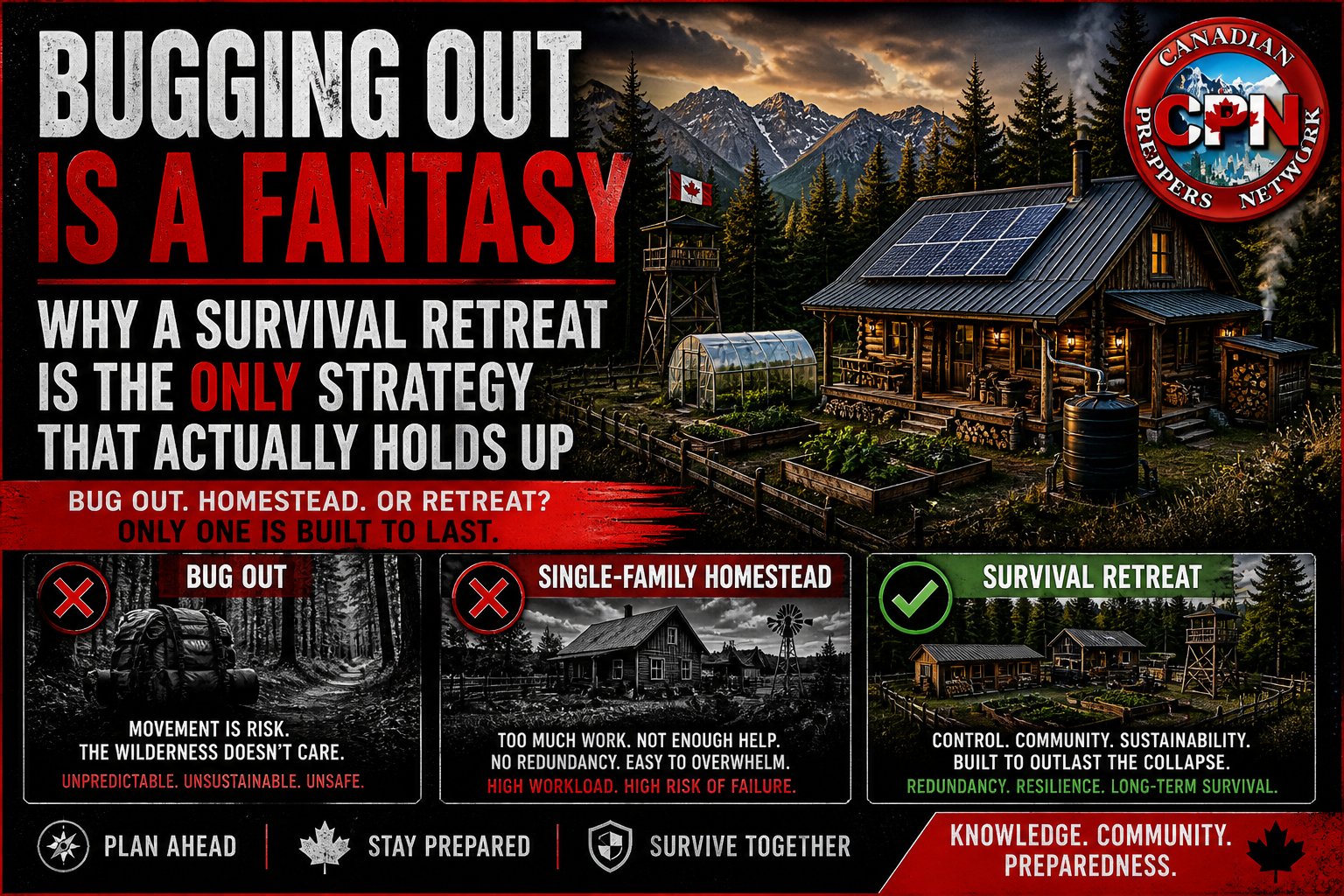
There’s a persistent idea in the preparedness world that when things go bad, you grab your gear and head for the woods.
It’s dramatic. It’s simple. And it’s dangerously wrong.
The reality is this: bugging out is a short-term reaction, not a long-term survival strategy.
If the grid goes down for weeks, months, or longer, the people who survive won’t be the ones moving.
They’ll be the ones already established.
They’ll be the ones at a survival retreat.
Movement Is Risk
Every kilometre you travel during a collapse multiplies your exposure.
You burn calories.
You expose yourself to other people.
You rely on routes that may be blocked, monitored, or dangerous.
In Canada, you add another layer:
- Cold exposure
- Unpredictable terrain
- Seasonal limitations
A bugout assumes:
- You can move fast enough
- You won’t be intercepted
- Your destination is viable
- You’ll arrive with enough strength and supplies to continue
That’s a stack of assumptions that collapses quickly under real conditions.
A survival retreat removes that uncertainty.
The Wilderness Doesn’t Care About You
There’s a reason shows like Alone are so hard to watch.
These are skilled people. Trained. Equipped. Mentally prepared.
And they still struggle—badly.
Because wilderness survival is not sustainable for most people over the long term.
You’re dealing with:
- Caloric deficits that compound daily
- Limited and unpredictable food sources
- Exposure to weather and injury
- Mental fatigue and isolation
Even experienced individuals lose weight rapidly and are eventually forced out.
Now compare that to a family, or a small group, trying to survive months or years in the same conditions.
It doesn’t scale.
A survival retreat isn’t about surviving the wilderness.
It’s about removing the need to fight it every day.
The Single-Family Homestead Problem
A lot of people recognize that bugging out won’t work—and shift toward the idea of a self-sufficient homestead.
On paper, it sounds like the perfect middle ground.
Stay in place. Grow food. Live off the land.
But a single-family homestead has serious limitations in a true long-term collapse.
The problem isn’t the land—it’s the scale.
A single household is responsible for everything:
- Food production and preservation
- Water sourcing and treatment
- Heating and fuel
- Maintenance and repairs
- Medical care
- Security
That’s a full-time workload across multiple disciplines.
Now add reality:
- Someone gets injured
- Someone gets sick
- Equipment fails
- Crops underperform
- Weather hits hard
There’s no redundancy.
Security alone becomes a breaking point. You cannot maintain 24/7 awareness, defend property, and still manage food production and daily survival tasks with a handful of people.
Over time, fatigue sets in. Corners get cut. Systems start to fail.
A single-family homestead can work in stable hardship.
It struggles in unstable, long-term collapse conditions.
A Retreat Is About Control
The biggest advantage of a survival retreat is not comfort—it’s control.
Control over:
- Water sources
- Food production
- Shelter and heating
- Security and visibility
- Movement and exposure
Instead of reacting to problems, you’re shaping the environment before they happen.
A properly established retreat includes:
- Reliable water (well, gravity-fed, or stored systems)
- Established food production (gardens, livestock, preserved stores)
- Hardened shelter designed for your climate
- Layered security and observation
- Redundant heating and energy systems
This isn’t theory. It’s infrastructure.
And infrastructure is what turns survival into sustainability.
Community Beats Isolation
Lone-wolf survival is another popular myth.
It sounds appealing—no one to rely on, no one to betray you.
But it fails under pressure.
At a survival retreat, even a small group creates:
- Skill diversity (medical, mechanical, agricultural)
- Rotational workload (security, food, maintenance)
- Redundancy in case of injury or illness
- Psychological stability
One person gets sick in the wilderness, and everything stops.
On a single-family homestead, it strains the entire system.
In a retreat environment, the system keeps functioning.
That’s the difference between surviving an event and living through a collapse.
Logistics Decide Outcomes
Long-term survival is not about toughness.
It’s about logistics.
- How many calories can you produce or store?
- How much fuel do you have—and can you replace it?
- How do you handle waste and sanitation?
- What happens when something breaks?
A bugout setup answers none of these long-term.
A single-family homestead struggles to sustain them under pressure.
A retreat is built around them.
This is where most people underestimate the problem.
They prepare to leave—or to live small—but never prepare to sustain a system.
The Hard Truth
If you wait until things go bad to find your “safe place,” you don’t have one.
By that point:
- Land is already contested
- Routes are compromised
- Resources are depleted
- You’re competing with everyone else who had the same idea
A survival retreat only works if it exists before the crisis begins.
That means planning, building, and thinking long-term now—not when you’re already behind.
Where Most People Go Wrong
They invest in:
- Gear instead of systems
- Mobility instead of stability
- Isolation instead of resilience
- Short-term survival instead of long-term sustainability
A bugout bag makes sense.
A homestead makes sense.
But neither is complete on its own.
A retreat is the end state.
Everything else is just how you get there.
Final Thought
Preparedness isn’t about escaping a crisis.
It’s about outlasting it.
And that requires more than movement, more than gear, and more than hope.
It requires a place that works when everything else doesn’t.
That place is a survival retreat.
And building that kind of place doesn’t happen by accident.
It takes planning. It takes structure. It takes understanding how every system—food, water, energy, shelter—works together over the long term.
That’s exactly what Acres of Preparedness: Planning the Last Safe Place was written to do.
Not to sell a fantasy—but to help you design something that actually holds up when everything else fails.
👉 https://www.amazon.ca/s?k=Acres+of+Preparedness+Planning+the+Last+Safe+Place
