Most people are waiting for a single moment. A blackout. A shortage. A headline that makes it obvious something has gone wrong.
That moment rarely comes.
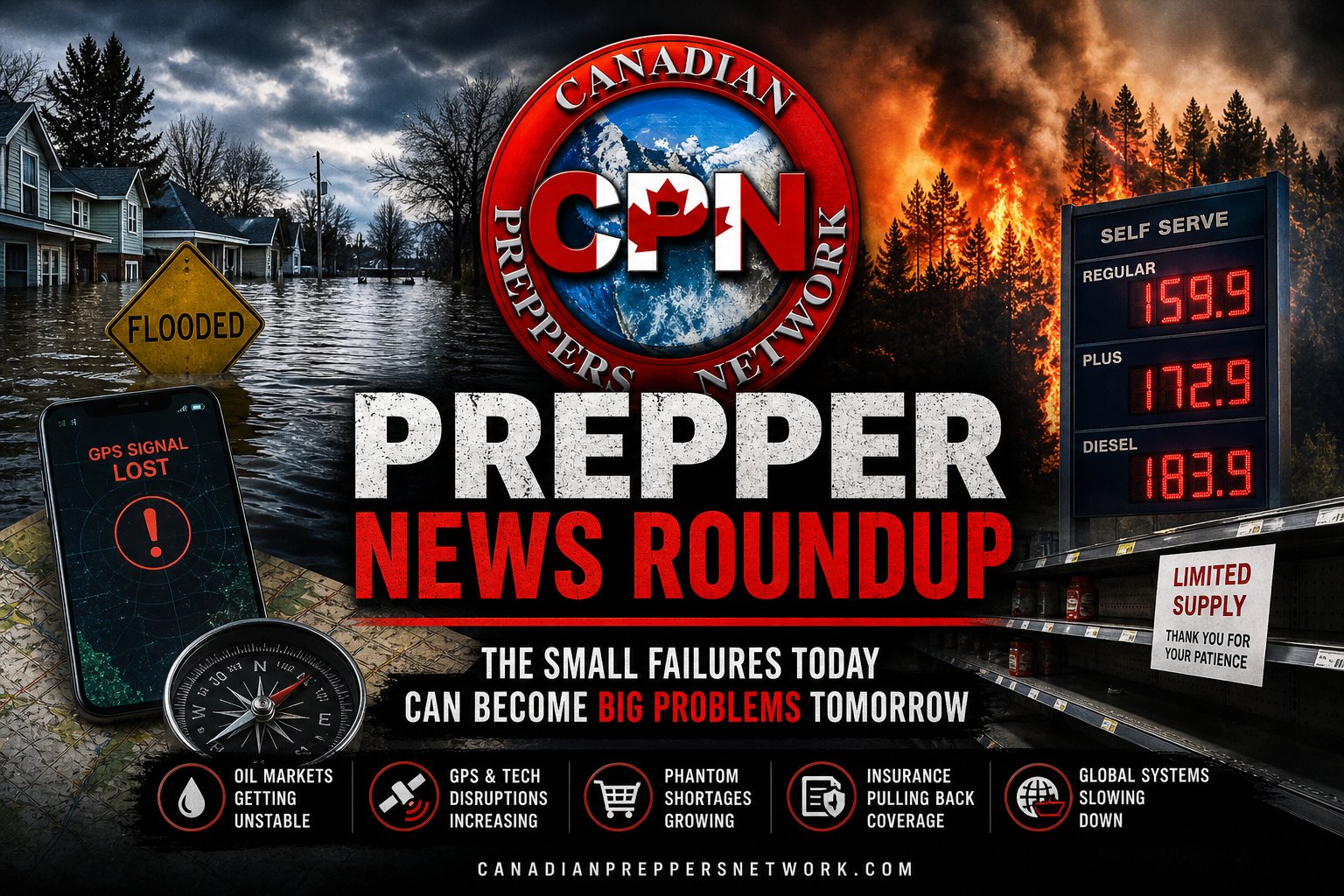
What we are seeing instead—right now—is something far more dangerous: systems that still function, but no longer reliably. Small failures are appearing across multiple sectors. Individually, they look like inconveniences. Together, they point to something deeper.
The system isn’t collapsing.
It’s slipping.
The Oil System Is Showing Cracks
There are increasing signs that cohesion within OPEC is weakening, with countries like the United Arab Emirates positioning themselves more independently.
That might sound like inside-baseball energy politics. It’s not.
OPEC only stabilizes oil markets when its members act in coordination. When that coordination starts to break down, you don’t get a clean shortage—you get volatility. Prices spike, drop, spike again. Supply becomes unpredictable. Planning becomes difficult.
For Canadians, the impact shows up quietly. Fuel prices shift faster than expected. Delivery costs fluctuate. Everything that depends on transportation becomes harder to price and harder to rely on.
Fuel shortages don’t begin at the pump. They begin with instability.
Navigation Systems Are Being Disrupted
There has been a growing number of reports globally of GPS interference and signal spoofing, particularly around conflict zones—but increasingly affecting civilian systems as well.
Aircraft have reported navigation anomalies. Ships have experienced positioning errors. These aren’t catastrophic events. Flights still land. Cargo still moves.
But accuracy is degrading.
This is the kind of failure modern systems are vulnerable to. Invisible, intermittent, and difficult to predict. Most infrastructure assumes GPS works all the time. When it doesn’t, even briefly, the effects ripple outward.
For preppers, the takeaway is straightforward: redundancy matters. The ability to navigate without relying on satellites is no longer just a wilderness skill—it’s a resilience skill.
The Rise of “Phantom Shortages”
We are no longer seeing widespread empty shelves. Instead, something more subtle is happening.
Specific items disappear.
One week it’s a particular type of canned good. Another week it’s a tool, a part, or a basic household item. The store is open. The shelves are stocked. But not with what you came for.
This is not a supply chain collapse. It is a supply chain losing precision.
For most people, this is frustrating. For those paying attention, it is a warning. Systems that once delivered exactly what was needed, when it was needed, are becoming inconsistent.
Preparedness in this environment is not about hoarding everything. It is about recognizing that availability can no longer be assumed.
Insurance Is Quietly Changing the Rules
Across North America, insurance companies are adjusting their risk models—and not in your favour.
Premiums are rising in flood-prone and fire-prone areas. Coverage is being reduced. In some cases, policies are simply not being renewed.
This is not getting the attention it deserves.
Insurance companies operate on data and probability. When they begin pulling back, it is because they no longer believe the risk is manageable within their model.
That has serious implications. It means recovery from disasters becomes more dependent on personal resources and less on institutional support.
For Canadians dealing with seasonal flooding or increasing wildfire risk, this is a shift worth paying attention to.
Global Systems Are Slowing Down
Even where there are no disruptions, there is friction.
Shipping routes are longer. Costs are higher. Delivery times are less predictable. The global system still functions, but it does so with less efficiency than it did even a few years ago.
Canada, with its reliance on long-distance transport and imported goods, feels this in delayed waves. Prices rise. Selection narrows. Certain products become harder to find.
Nothing disappears overnight.
But everything becomes a little harder to get.
What This Actually Means
None of these developments, on their own, represent a crisis. That is what makes them easy to ignore.
But taken together, they point to a system that is losing reliability.
Fuel is available, but unstable.
Navigation works, but not perfectly.
Stores are stocked, but inconsistently.
Insurance exists, but not where it matters most.
This is not collapse.
It is degradation.
And degradation is harder to respond to, because it does not trigger urgency. It does not create a single moment of action. It stretches problems out over time, making them easier to dismiss until they are no longer manageable.
The Window Most People Miss
There is still time to prepare. Supplies are available. Movement is unrestricted. Systems are functioning well enough to depend on—most of the time.
That is the window.
Preparedness built under these conditions is controlled, deliberate, and effective. Preparedness built after systems begin to fail is reactive, expensive, and often incomplete.
The difference is timing.
Final Thoughts
The danger right now is not that everything stops working.
It is that nothing works quite as well as it used to.
And when your life depends on systems you do not control—even small failures can leave you exposed.
Most people are waiting for a clear signal.
They won’t get one.
Because by the time the problem is obvious, the options are already limited.