
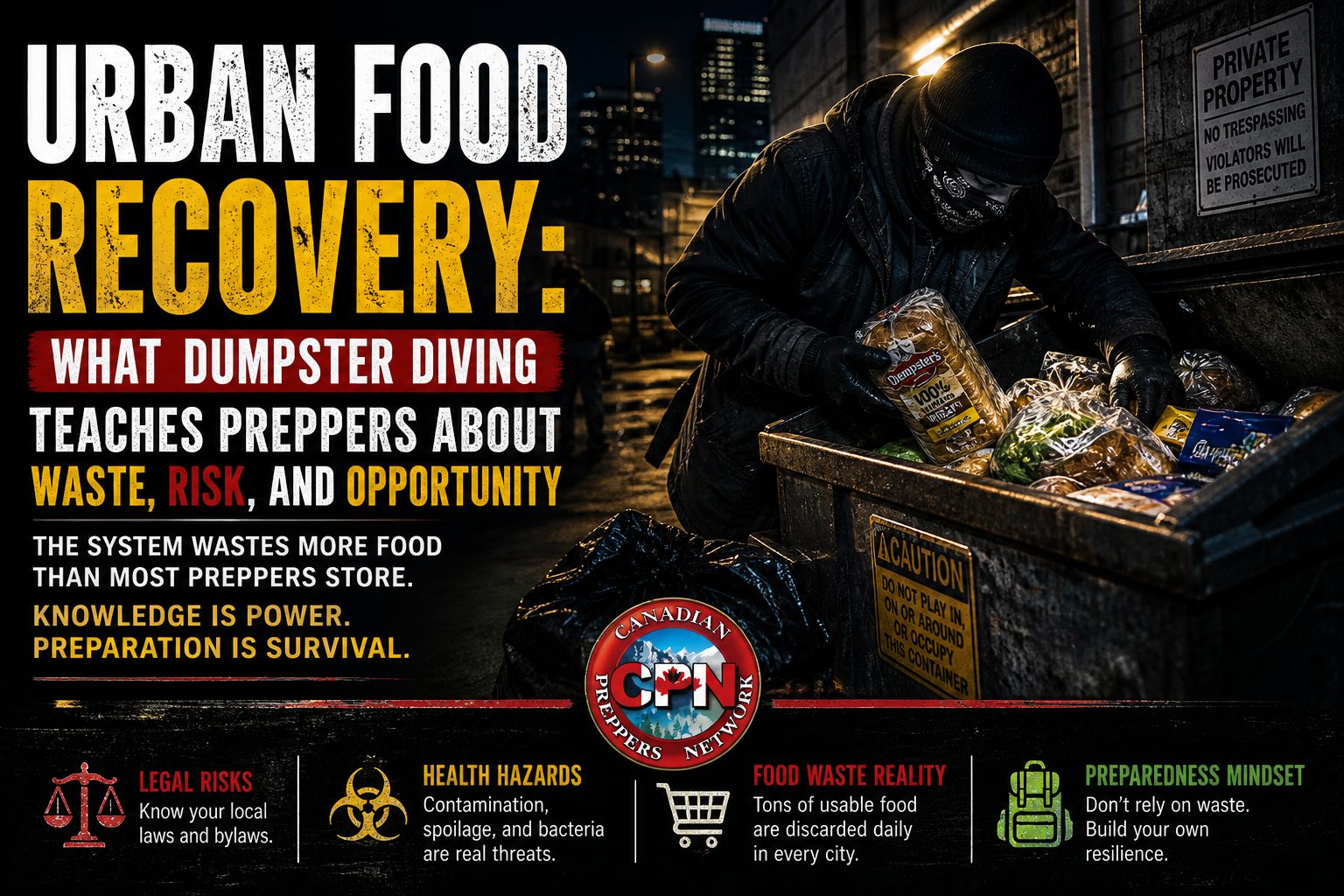
What Dumpster Diving Teaches Preppers About Waste, Risk, and Opportunity
Most preppers focus on storage. Buckets, Mylar, oxygen absorbers—the controlled side of preparedness.
But there’s another side to the food equation that gets almost no attention: waste.
In every Canadian city, usable food is discarded daily. Not because it’s unsafe, but because it no longer fits retail standards. Understanding that system isn’t about encouraging dumpster diving—it’s about recognizing how fragile and inefficient modern food distribution really is.
When supply chains strain, food doesn’t disappear overnight. It gets mishandled, delayed, rejected, and ultimately thrown away.
That gap—between usable and discarded—is where this conversation lives.
Where the Waste Comes From
Urban food waste follows predictable patterns.
Grocery stores cycle out “best before” items that are still perfectly edible. Bakeries discard same-day products by the evening. Restaurants overproduce to maintain consistency and presentation. Damaged packaging alone can condemn entire cases of food.
This isn’t occasional—it’s systemic.
The takeaway for preppers is not “go digging.” It’s this:
Even when shelves look empty, food may still exist elsewhere in the system—just inaccessible, mismanaged, or written off.
Why This Matters in a Disruption Scenario
In the early stages of a crisis—transport delays, fuel shortages, labour disruptions—food supply becomes uneven long before it stops completely.
Some locations experience shortages. Others experience surpluses they can’t move quickly enough.
Refrigeration failures accelerate spoilage. Panic buying distorts inventory. Staffing shortages prevent proper rotation.
The result is a strange reality: shortages and waste happening at the same time.
A prepared individual recognizes this as a sign of system stress—not opportunity to depend on it, but a warning that distribution is failing.
Legal Reality in Canada
Accessing commercial dumpsters is often considered trespassing or a violation of municipal bylaws, especially when bins are located on private property.
Preparedness takeaway:
Know your local rules before you ever need this knowledge.
Health Risk Is the Real Limiter
Once food enters a waste stream, it’s exposed to contamination, temperature swings, and handling risks.
Even sealed items can be compromised.
If someone ever had to rely on recovered food, they would need the ability to inspect properly, access to clean water for washing, and the ability to cook immediately and thoroughly.
Without that, the risk climbs fast.
Practical Preparedness Gear (If You Had No Choice)
This is where theory meets reality. If conditions ever forced you into relying on discarded resources, basic protective and sanitation gear becomes critical.
Heavy-duty hand protection is non-negotiable. A solid pair of cut-resistant gloves protects against sharp packaging and contaminated surfaces.
👉 https://www.amazon.ca/s?k=NoCry+Cut+Resistant+Gloves&tag=canadpreppn01-20
Keeping distance reduces direct exposure. A long reacher tool lets you inspect items before touching them.
👉 https://www.amazon.ca/s?k=RMS+34+inch+reacher+grabber&tag=canadpreppn01-20
Recovered items need to be isolated immediately from your main food stores. Gamma seal bucket systems are one of the most reliable options for this.
👉 https://www.amazon.ca/s?k=Gamma+Seal+Lid+Bucket&tag=canadpreppn01-20
Clean water is essential for any kind of sanitation or food prep. A compact filter gives you that capability anywhere.
👉 https://www.amazon.ca/s?k=LifeStraw+Personal+Water+Filter&tag=canadpreppn01-20
Working in low light is a reality in urban environments. A reliable headlamp keeps both hands free and improves safety.
👉 https://www.amazon.ca/s?k=LED+headlamp+rechargeable&tag=canadpreppn01-20
These aren’t “dumpster diving tools.” They’re general preparedness items that become critical when systems degrade.
What This Really Teaches You
Urban food waste exposes the weak points in the system.
It highlights how dependent modern supply chains are on presentation, timing, and liability policies—not actual food usability. It shows how quickly something can go from “for sale” to “discarded,” even when it still has value.
More importantly, it reinforces a reality most people ignore:
Distribution failure happens before total shortage.
And once you’re relying on what’s been thrown away, you’ve already lost control of your food security.
The Smarter Approach
Use this knowledge to strengthen your own system instead of relying on waste streams.
Store food that doesn’t depend on refrigeration. Build redundancy into your cooking methods. Understand real shelf life instead of blindly following printed dates. Reduce your own household waste so you’re already operating efficiently.
Because when things get tight, you don’t want to be reacting.
You want to be insulated.
Final Thought
When systems begin to fail, resources don’t disappear.
They shift, spoil, and scatter.
The unprepared chase what’s left behind.
The prepared never have to.

