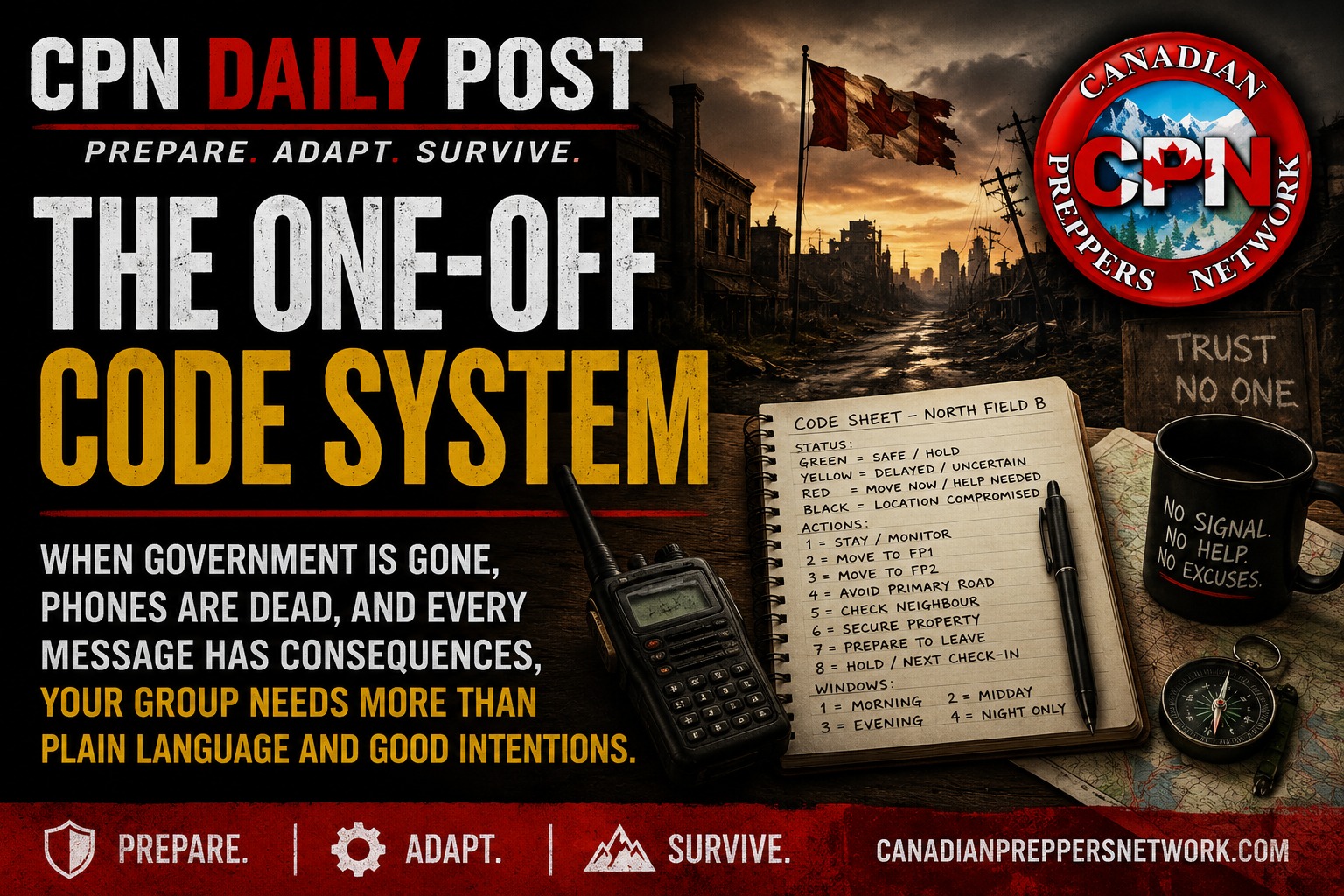
When government is gone, phones are dead, and every message has consequences, your group needs more than plain language and good intentions.
Most people think emergency communications means owning a radio.
It does not.
A radio is only a delivery method. A phone is only a delivery method. A written note is only a delivery method. A runner on foot, a neighbour at the gate, a text message, a vehicle horn, a whistle blast, or a message left at a fallback location are all delivery methods.
The real question is much harder:
What does the message actually mean?
That is where most preparedness plans fall apart. People buy radios, charge them once, put them in a drawer, and assume they now have communications. They do not. They have equipment. Equipment without procedure is just another object waiting to fail.
In a normal emergency, plain language may be enough. “The power is out.” “The road is blocked.” “Come home.” “Meet at the cottage.” “Go to Uncle Mike’s.” That works when the situation is limited, the people are calm, and the message does not expose anything important.
But preparedness is not only about normal emergencies.
A serious collapse changes the entire communications problem. The phones may be dead. The internet may be gone. Local authorities may be overwhelmed, absent, or irrelevant. Emergency services may not be coming. Rumours may be moving faster than facts. Roads may be blocked. People may be frightened, angry, desperate, or opportunistic.
In that world, every message matters.
You may not want every person within earshot to know that your family is leaving. You may not want to explain which route is still open. You may not want to broadcast which fallback location is being activated. You may not want a long discussion when the correct action has already been decided.
This is where a one-off code system earns its place.
Not as spy nonsense. Not as fantasy. Not as some overcomplicated secret language nobody can remember.
A one-off code system is a short, simple, prearranged message system that lets your family, retreat group, or mutual assistance group trigger action without confusion.
It does not replace the plan.
It activates the plan.
Canadian Preppers Network Communications Hub
Plain Language Fails When People Panic
The first failure in a crisis is not always silence.
Sometimes the first failure is too much noise.
Everyone wants information. Everyone is calling, texting, asking, forwarding, guessing, and repeating whatever they heard from someone else. One person says the road is closed. Another says it is open. Someone repeats an old update as if it just happened. Someone hears “go now” when the actual message was “get ready.” Someone assumes the first meeting point is still safe because nobody told them otherwise.
That kind of confusion can wreck a plan before the real danger even arrives.
A one-off code system removes debate at the worst possible moment.
The message “Maple 3” might mean: leave the house, use the secondary route, and move to the first fallback point.
The message “Lantern 2” might mean: stay in place, do not travel, and check in during the next evening window.
The message “Cedar Red” might mean: primary location is unsafe, move to the backup plan immediately.
The exact words do not matter. What matters is that every person holding the current code sheet knows what they mean before the emergency begins.
That is the difference between a communications plan and a conversation.
A conversation can wander.
A code triggers action.
Build The Communication Layer Before You Need It
A one-off code system is not useful if nobody remembers it, nobody has it written down, and nobody has a way to pass messages when phones stop working.
The real value is not just the code. It is the communication system around it: radios, printed contact cards, laminated instructions, notebooks, message drop locations, signal tools, charging plans, and agreed procedures that everyone understands before stress hits.
If your family or retreat group is serious about emergency communication, start building the physical layer now.
Energy Production and Blackout Power Buying Guide
Mental Resilience and Community Building Buying Guide
A code system should be simple, written, practiced, and supported by tools that still work when the phone network, internet, and normal messaging apps are gone.
Why It Must Be One-Off
A permanent code system eventually becomes a liability.
If the same phrase always means the same thing, it can be learned, guessed, overheard, repeated, or misused. Maybe a neighbour hears it. Maybe a casual member of the group leaves on bad terms. Maybe an old sheet gets lost. Maybe someone repeats a phrase in front of the wrong person. Maybe a child says more than they should.
A one-off system limits the damage.
The code sheet is valid for one period, one drill, one trip, one storm, one movement plan, one retreat exercise, or one elevated-risk window. After that, it expires.
The next sheet uses different words.
This does not need to be complicated. It only needs to be disciplined.
A code sheet might be created for a winter storm weekend, a planned trip to the retreat, a wildfire evacuation season, a period of civil unrest, a family bugout drill, a rural security rotation, or a multi-family retreat exercise.
The sheet should have a name, a version number, an issue date, and an expiry date.
For example:
Spring Storm Sheet A
Issued: May 12
Expires: May 19
Valid for: immediate family only
That might look simple, but simple is the point. If two people are using different versions, the plan can fail. If an old sheet is still floating around months later, the system becomes sloppy.
One-off means limited life.
Limited life means less damage when something leaks, gets lost, or becomes outdated.
Normal Rules vs Collapse Reality
In normal times, follow the law. If you are using amateur radio, know the rules, get properly certified, and operate responsibly. Public emergency communication channels are not your private playground, and ordinary preparedness does not require acting like an idiot on the air.
But preparedness is not only about normal times.
If government is gone, if emergency services are absent, if infrastructure has collapsed, and if your people are on their own, the communications problem becomes older and harder. It is no longer about convenience. It is about coordination, trust, timing, movement, and survival.
In that kind of reality, you may not be able to call for help. You may not be able to verify rumours. You may not be able to explain the entire situation over an open channel. You may not want outsiders knowing that the primary location has been abandoned, that a family member is alone, that a route is still open, or that supplies are being moved.
That is not paranoia.
That is basic operational discipline.
The code system is not about hiding wrongdoing. It is about preventing confusion from killing the plan.
There is a massive difference between a family using short prearranged messages to stay coordinated and people using communications to cause trouble. Keep that line clear. A serious preparedness group does not need criminal thinking. It needs order, restraint, and the ability to act when the normal system is no longer there.
The Three Jobs of a Code System
A good one-off code system has three jobs.
First, it confirms that the message belongs to the current plan.
Second, it compresses the message.
Third, it triggers action.
That is it.
Do not turn this into a puzzle. Do not build a system that requires flipping through ten pages, doing math, memorizing symbols, or decoding long strings of nonsense. The more clever it looks, the more likely it fails under stress.
A tired person should be able to use it.
An older parent should be able to use it.
A spouse who does not care about radios should be able to use it.
A scared teenager should be able to use it.
Someone reading by flashlight in a cold vehicle should be able to use it.
That means large print, short words, plain meanings, and no clutter.
Think in four categories:
Status.
Location.
Action.
Time.
That is enough.
Status says what condition you are in.
Location says where the issue is or where people should go.
Action says what to do.
Time says when to move, wait, or check in again.
If your code sheet does those four things clearly, it is already better than most so-called communications plans.
Family Communications Plans: Urban vs Rural Reality in Canada
Build the Sheet Like It Has to Work in the Dark
A one-off code sheet should fit on one page.
Not a binder. Not a manual. Not a beautiful colour-coded document nobody wants to carry.
One page.
Laminate it or seal it in a waterproof sleeve. Keep copies in the home communications binder, the vehicle, the retreat binder, the radio kit, and the go-bag. Everyone who may need to act on the message must have the same current version.
The top of the sheet should show the version block.
Example:
Code Sheet: North Field B
Issued: Friday 1800
Expires: Monday 1800
Valid for: household and retreat group only
Below that, add a simple challenge-response pair.
Example:
Challenge: North
Response: Lantern
This is not magic. It is just a basic way to confirm that the person passing the message is working from the current sheet. If a message comes through a third party, or someone arrives at the gate claiming to carry instructions, a challenge-response pair gives your group one more layer of confirmation.
Then add a short status list.
Green: safe and holding position
Yellow: delayed or uncertain
Red: help needed or immediate movement required
Black: location compromised or no longer usable
Use whatever words fit your group, but keep the list short. Four levels are plenty.
After status, add the action list.
This is the heart of the system.
Action 1: Stay where you are and monitor.
Action 2: Move to the first fallback point.
Action 3: Move to the second fallback point.
Action 4: Avoid the primary road.
Action 5: Send one person to check the neighbour.
Action 6: Secure animals, tools, fuel, and outdoor equipment.
Action 7: Prepare to leave, but do not leave yet.
Action 8: Stop movement and wait for the next check-in.
Notice the structure. Every action means something real. Nobody has to interpret a paragraph. Nobody has to guess what “be careful” means. The code points to a decision that was already made before the pressure started.
Finally, add the time windows.
Window 1: morning check-in
Window 2: midday check-in
Window 3: evening check-in
Window 4: night check-in only, no movement unless already ordered
A message like “Cedar Yellow, Action 7, Window 3” now has a clear meaning.
The person receiving it knows the status, the instruction, and the next check-in window.
That is how you turn a short message into a plan of action.
The Code Is Useless Without Real Plans Behind It
This is where people get exposed.
If you do not already have fallback locations, routes, printed maps, spare keys, fuel plans, family roles, and basic supplies in place, the code system will not save you.
“Action 2” means nothing if nobody knows where the first fallback point is.
“Avoid the primary road” means nothing if nobody has driven the secondary route.
“Prepare to leave” means nothing if the vehicle is empty, the fuel tank is low, the go-bags are half-packed, and nobody knows who grabs what.
A one-off code system does not make an unprepared family prepared.
It makes a prepared family faster.
That distinction matters.
Before you build the code sheet, build the decisions. Choose the locations. Walk the routes. Drive the back roads. Print the maps. Decide who contacts whom. Decide who checks on older relatives. Decide who secures animals. Decide who locks down the property. Decide what gets loaded first.
Then use the code sheet to trigger those decisions.
Otherwise, you are just giving names to chaos.
Group Retreats Need This Even More
For a single household, a one-off code system is useful.
For a multi-family retreat, it becomes critical.
A retreat is not just land. It is a coordination problem. Six families can all believe in preparedness and still fall apart if they interpret the same event six different ways.
One family leaves too early.
One waits too long.
One brings the wrong supplies.
One takes the wrong route.
One keeps calling for updates when silence was part of the plan.
One shows up with extra people nobody approved.
One household assumes the retreat is active while another thinks everyone is still standing by.
This is how group plans fracture.
A one-off code sheet gives the group a shared language before the situation turns ugly. It can tell members whether the retreat is active, which gate is staffed, which route is compromised, whether outside travel is suspended, whether a supply movement is delayed, whether the primary location is unsafe, or whether the next check-in window has changed.
This is not about being theatrical.
It is about avoiding six separate arguments during a crisis.
If your group is serious enough to talk about retreats, shared land, mutual assistance, or long-term grid-down planning, it is serious enough to have a one-page code system.
Signaling Your MAG Group to Assemble After a Disaster
Paper Still Matters
Do not make this digital-only.
Digital-only preparedness is fragile.
Phones die. Screens crack. Apps fail. Files disappear. Passwords are forgotten. Cloud storage is useless without access. A person under stress may not remember where the document is saved. A device may be lost, stolen, or out of power.
Paper still works.
Print the sheet. Laminate it. Put it in a waterproof sleeve. Keep it with the maps, radios, notebooks, and written contact lists.
Use pencil or waterproof marker for temporary notes. Keep spare copies sealed. Destroy expired sheets instead of letting them pile up in drawers, glove boxes, and bags.
The more serious the situation, the more valuable boring paper becomes.
People love electronics because electronics feel advanced. But in a long emergency, the humble clipboard may outlast half the technology in your kit.
Communications When the Grid Goes Silent
Test It Before the World Tests It for You
A code system that has never been tested is just theory.
Run a drill.
Hand someone the current sheet and send a short message. See if they know what to do. Do not explain it twice. Do not coach them through it. If they cannot understand the message under calm conditions, the system is too complicated.
Then test it under realistic inconvenience.
Try it during a power outage drill. Try it during a weekend trip. Try it when one family member is away from home. Try it with a handwritten note. Try it by radio where appropriate. Try it with someone acting as a message runner.
You are not testing whether the code looks clever.
You are testing whether it produces the right action.
A good drill should reveal weaknesses. Maybe the action list is too vague. Maybe the fallback locations are not understood. Maybe the time windows are too narrow. Maybe the print is too small. Maybe one person keeps forgetting where the sheet is stored. Maybe the group never agreed on what “leave” actually means.
Good.
Find that out now.
Fix it now.
The middle of a blackout, evacuation, riot, wildfire, ice storm, or infrastructure failure is a terrible time to discover that your communications plan was just a conversation you meant to finish later.
Keep Outsiders Out of the Plan
Not everyone needs the sheet.
That may sound obvious, but it is worth saying.
A one-off code system is only useful if distribution is controlled. Every extra copy is another point of failure. Every casual participant is another person who can lose it, misunderstand it, photograph it, repeat it, or show it to someone else.
For a family, distribution is simple.
For a group, it needs discipline.
Only people with a real role should have the current sheet. Expired sheets should be collected or destroyed. New sheets should be clearly dated. Changes should not be made casually. If the plan changes, the sheet changes.
Do not let your code system become camp gossip.
The moment everyone has it, nobody controls it.
What This Really Buys You
A one-off code system does not make you invisible. It does not make you invincible. It does not replace radios, maps, training, fuel, food, water, security, or relationships.
What it buys you is speed and clarity.
It lets a short message carry a big decision.
It lets a family move without a long explanation.
It lets a retreat group shift posture without debate.
It lets someone say “wait,” “move,” “avoid,” “hold,” “check,” or “fallback” without spelling out every detail to every person who might be listening, watching, or repeating the message.
In normal life, that may seem excessive.
In a collapse, it may be the difference between coordination and panic.
Buying Box: Building a One-Off Code Kit
This system does not require expensive gear. It requires paper, discipline, and a few durable tools that still work when the easy systems fail.
Weatherproof notebooks
https://www.amazon.ca/s?k=weatherproof+notebook&tag=canadpreppn01-20
Laminating pouches
https://www.amazon.ca/s?k=laminating+pouches&tag=canadpreppn01-20
Fine-tip permanent markers
https://www.amazon.ca/s?k=fine+tip+permanent+markers&tag=canadpreppn01-20
Waterproof document bags
https://www.amazon.ca/s?k=waterproof+document+bag&tag=canadpreppn01-20
Clipboards with storage
https://www.amazon.ca/s?k=storage+clipboard&tag=canadpreppn01-20
Canada road atlas and paper maps
https://www.amazon.ca/s?k=canada+road+atlas&tag=canadpreppn01-20
Rechargeable AA and AAA batteries with charger
https://www.amazon.ca/s?k=rechargeable+aa+aaa+batteries+charger&tag=canadpreppn01-20
Battery-powered emergency radio
https://www.amazon.ca/s?k=battery+powered+emergency+radio&tag=canadpreppn01-20
Waterproof map case
https://www.amazon.ca/s?k=waterproof+map+case&tag=canadpreppn01-20
Final Thought
A collapse does not begin with everyone calmly gathering around the kitchen table to review the binder.
It begins with confusion.
Someone is not answering. A road is blocked. A rumour spreads. The power is out. A family member is away from home. The weather is getting worse. The phones are dead. The radio is busy. The neighbour says one thing. The internet, if it still works, says another.
That is when weak plans break.
A one-off code system gives your people a way to cut through confusion with one short message that has already been understood, agreed on, and rehearsed.
Not because it is dramatic.
Because it is boring, clear, and useful.
Your radio is not the plan.
Your phone is not the plan.
Your plan is the people, the routes, the fallback locations, the decisions made in advance, and the short message that tells everyone what happens next.