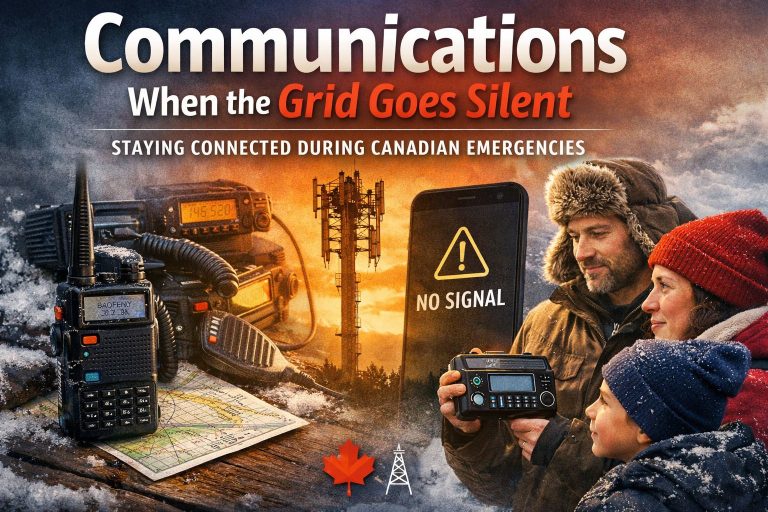
When communications fail, panic spreads faster than any storm. In Canada — where we deal with everything from dense high-rise cores to isolated acreages buried in snow — your family communications plan must reflect geography, infrastructure, and distance. An urban plan that works in Toronto will not necessarily work in rural Ontario bush country or prairie farmland outside Regina.
Urban families face congestion. Rural families face isolation. Both face the same question:
How does everyone reconnect when the phones don’t work?
Urban Families: Congestion Is the Enemy
In major Canadian cities, the infrastructure is dense — but fragile under load. During storms, civil emergencies, or high-profile incidents, cell networks don’t always “go down.” They clog. Voice calls fail first. Data slows. Text messages often slip through because they require far less bandwidth.
That reality shapes the first layer of an urban family communications plan.
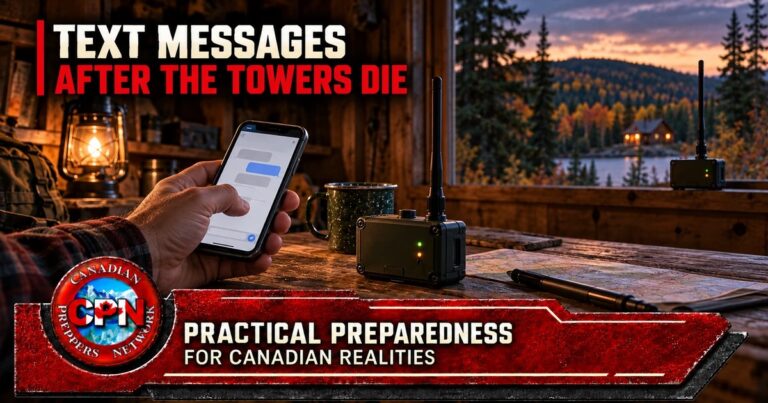
Instead of assuming you’ll be able to call home, build a text-first protocol. Every family member should know that during an emergency, they send a short pre-agreed message: “SAFE – heading home” or “SAFE – staying put.” No essays. No repeated calling.
Power redundancy is just as critical. A dead phone is a silent phone. A high-capacity battery bank like the Anker PowerCore 26800 Portable Charger keeps multiple devices running through extended outages.
Amazon.ca: https://www.amazon.ca/dp/B01JIWQPMW?tag=canadianprepper-20
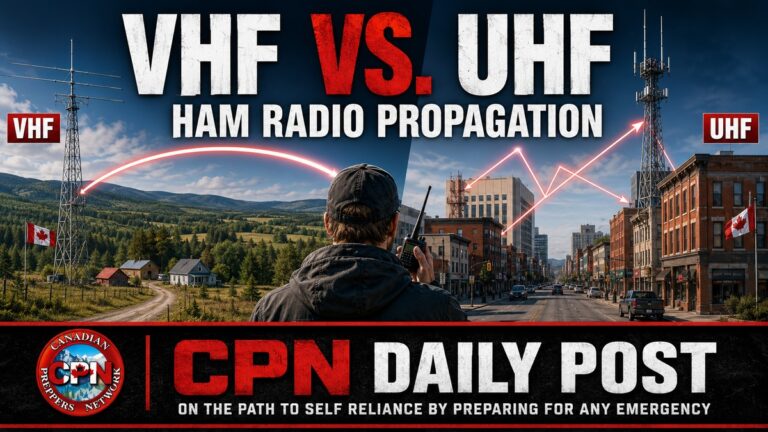
Urban families should also assume short travel distances. That changes radio requirements. You don’t need 20 km of range — you need building penetration. UHF performs better indoors and around concrete. Simple licence-free radios such as the Motorola Talkabout T600 FRS Two-Way Radios are ideal for condo towers, neighbourhood coordination, or walking home if transit shuts down.
Amazon.ca: https://www.amazon.ca/dp/B01DM7A8ZI?tag=canadianprepper-20
For licensed operators, stepping up to a dual-band handheld like the Baofeng UV-5R opens access to local repeaters, many of which remain operational during outages thanks to backup power.
Amazon.ca: https://www.amazon.ca/dp/B00MAULSOK?tag=canadianprepper-20
If you want a deeper dive into amateur radio readiness, revisit our breakdown of emergency nets here:
https://canadianpreppersnetwork.com/amateur-radio-emergency-nets-in-canada/
Urban communications planning is about reducing friction during congestion. Keep messages short. Keep devices powered. Keep distances realistic.
Rural Families: Distance Is the Enemy
In rural Canada, the problem isn’t network overload. It’s coverage gaps and long distances. Cell service may be weak on a good day. In winter storms, lines come down and towers lose power.
Here, the communications plan must extend range — not just survive congestion.
A mobile VHF/UHF radio installed in a vehicle dramatically increases reliable range compared to handhelds. Units like the Radioddity DB25 Pro Dual Band Mobile Radio paired with a properly mounted external antenna can cover several kilometres consistently.
Amazon.ca: https://www.amazon.ca/dp/B08C2V9M2L?tag=canadianprepper-20
For families living on multi-acre properties, even a modest base antenna mounted 20–30 feet high can transform coverage between house, barn, and outbuildings.
Beyond local range, serious rural resilience requires regional communication capability. This is where HF radio comes in. Using 40m or 80m bands with NVIS (Near Vertical Incidence Skywave), operators can maintain reliable communication within 100–500 km — ideal for Canadian winter conditions when highways are impassable.
A compact HF rig such as the Yaesu FT-891 HF Transceiver provides a strong entry point for rural families building long-range redundancy.
Amazon.ca: https://www.amazon.ca/dp/B01M9I6V3Q?tag=canadianprepper-20
And for those in truly remote regions — Northern Ontario, northern Manitoba, interior BC — satellite messaging adds another layer. Devices like the Garmin inReach Mini 2 allow text communication through satellite networks when terrestrial infrastructure fails entirely.
Amazon.ca: https://www.amazon.ca/dp/B09PSKG7C8?tag=canadianprepper-20
Rural planning isn’t about convenience. It’s about independence from centralized infrastructure.
Where Urban and Rural Plans Overlap
Despite the differences, strong family communications plans share the same foundation.
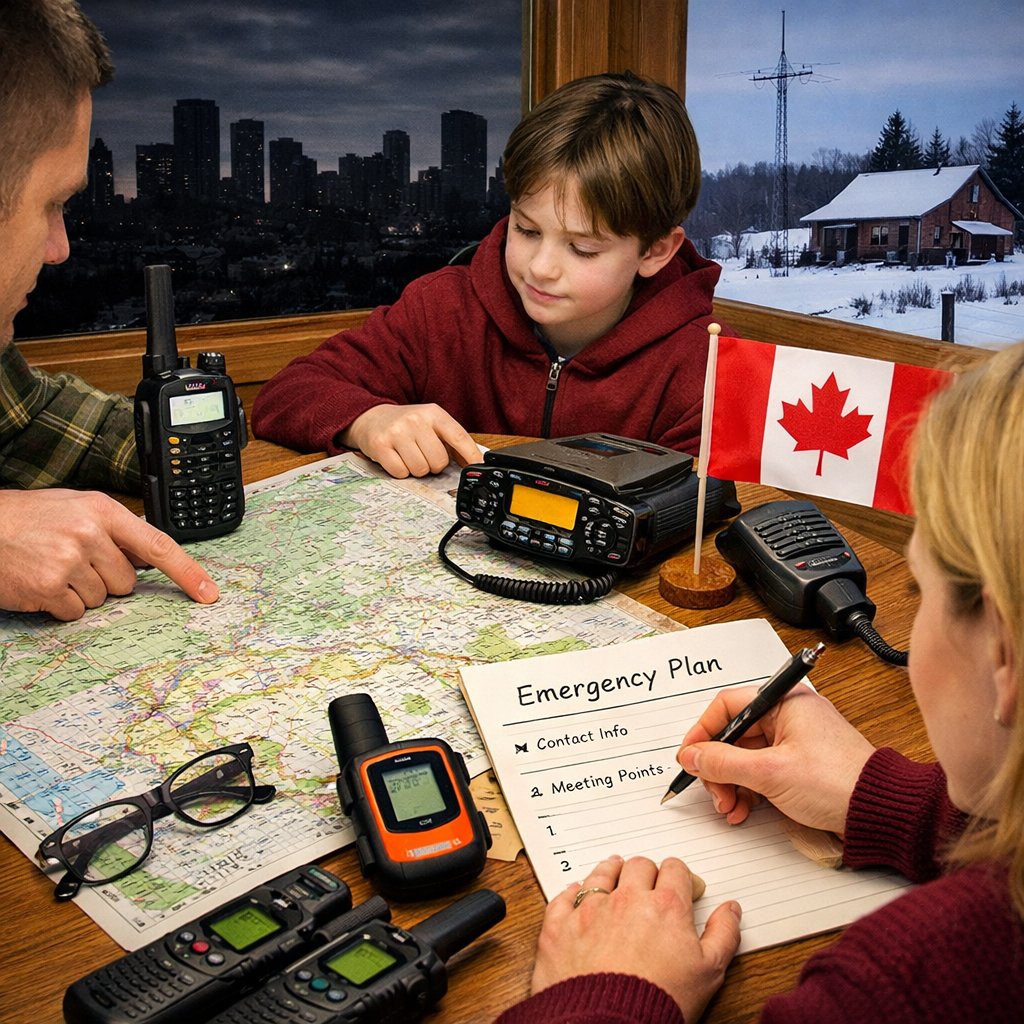
Every family should have a written plan — not just a conversation. It should identify a primary method (cell text protocol), a secondary local method (radio), and at least one physical rally point. Printed contact sheets should live in vehicles and emergency kits. Paper maps should backstop GPS.
If you’re building grid-down resilience, our power redundancy article complements this planning:
https://canadianpreppersnetwork.com/home-power-generation-guide/
A Canadian Perspective
Canada’s scale forces us to think differently than many U.S. preparedness guides. Urban density creates fragility through congestion. Rural geography creates fragility through isolation. Winter amplifies both.
Your family communications plan should reflect your terrain, your travel distances, and your infrastructure reality — not someone else’s.
If you’re serious about layered communications planning, our communications archive is here:
https://canadianpreppersnetwork.com/blog/