When the Sun gets rowdy, hams feel it.
Right now we’re in an active part of Solar Cycle 25, and the last few days have been spicy: NOAA’s Space Weather Prediction Center (SWPC) has posted geomagnetic storm watches from G2 (moderate) up to G4 (severe) for November 11–13, 2025, driven by multiple Earth-directed coronal mass ejections (CMEs). NOAA Space Weather Prediction Center+2NOAA Space Weather Prediction Center+2
These storms have already produced intense auroras at unusually low latitudes and triggered radio blackout warnings after powerful X-class flares, including an X5.1 “cannibal” solar event that caused HF blackouts across parts of Europe and Africa. The Sun+1
If you’re an amateur radio operator, this isn’t just pretty skies—it’s your RF environment getting flipped upside down. Let’s break down what geomagnetic storms actually do to ham radio, and how it differs between HF and VHF/UHF.
Quick Primer: What Is a Geomagnetic Storm?
A geomagnetic storm happens when a CME or high-speed solar wind stream slams into Earth’s magnetic field, disturbing the magnetosphere and ionosphere. NOAA summarizes storm strength using the G-scale (G1–G5) tied to the planetary Kp index (0–9):
- G1: Kp=5 (minor)
- G2: Kp=6 (moderate)
- G3: Kp=7 (strong)
- G4: Kp=8–9- (severe)
- G5: Kp=9o (extreme) NOAA Space Weather Prediction Center+1
The ionosphere—the layers of charged particles that make HF skywave possible—gets distorted, heated, and sometimes partially stripped. That’s why HF can go from “worldwide DX” to “dead band” in a matter of minutes.
On top of that, solar flares (often associated with CMEs) cause R-scale “radio blackouts” on the sunlit side of Earth, mainly affecting HF. NOAA Space Weather Prediction Center
HF (3–30 MHz): The Drama Queen of Space Weather
HF is where geomagnetic storms really flex. Depending on timing and storm phase, you can get both awful and amazing conditions.
1. Immediate Effects: X-Class Flares & HF Blackouts
When a strong X-class flare erupts, it floods the dayside ionosphere with X-rays and extreme UV. That super-charges the D-layer, which absorbs HF instead of reflecting it.
NOAA classifies these as R1–R5 radio blackouts. Even an “minor” R1 can mean:
- Weak or intermittent HF on the dayside
- Complete HF loss on some paths at lower frequencies during stronger events
- Impact mainly on 3–30 MHz, especially below ~20 MHz NOAA Space Weather Prediction Center+2NOAA Space Weather Prediction Center+2
The recent X5.1 flare that accompanied this week’s storms caused documented HF blackouts across Europe and Africa—exactly what you’d expect from an R-scale event. The Sun
2. Main Storm Phase: Disturbed, Noisy, and Unpredictable
Once the CME hits and the geomagnetic storm ramps up (high Kp and G-level warnings), HF propagation often becomes:
- Highly disturbed: Deep QSB (fading), fluttery signals, and unstable paths
- Shifted MUF: The maximum usable frequency may drop unexpectedly, killing higher HF bands
- Polar cap absorption: HF paths over polar regions can go completely silent during severe storms
Commercial and critical-infrastructure studies note that during “severe” geomagnetic storms, HF can become unreliable or impossible over some regions for hours to days. Tait Communications
For hams, that translates to:
- 20 m and up going soft or closing early
- 40 m / 80 m getting noisy and lossy, especially on longer paths
- NVIS links (like regional emergency nets on 40/80 m) sometimes working but with elevated noise and fading
3. Recovery Phase: The Surprise “Magic” Conditions
Here’s the nice part: after the worst of the storm, the ionosphere can “ring” in a way that produces excellent HF propagation:
- Lower background noise
- Enhanced F-layer support on some mid-latitude paths
- Short-skip and long-haul openings that weren’t there pre-storm
Operators often see fantastic DX in the 1–3 days following major storms—if they know to jump on the air and exploit it. Historical severe events in 2024, including the strongest geomagnetic storm in over 20 years in May, produced both radio blackouts and later spectacular HF openings as the ionosphere recovered. SpaceWeatherLive.com+1
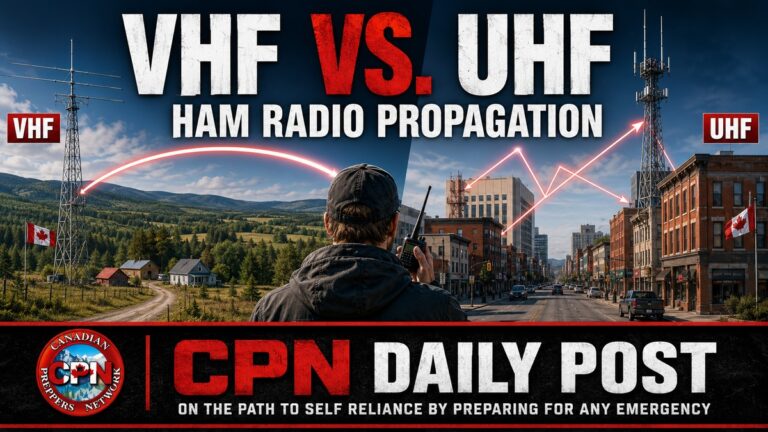
VHF/UHF (50 MHz and Up): Less About Blackouts, More About Aurora
VHF and UHF are mostly line-of-sight and tropospheric, so they’re not affected the same way HF is—but geomagnetic storms still matter.
1. Why VHF/UHF Largely Ignore “Normal” Storms
Under ordinary conditions:
- 2 m, 70 cm, and higher bands don’t rely on ionospheric reflection for everyday contacts.
- Local repeaters, simplex, and satellite work generally fine through G1–G2 storms.
You might see small effects via:
- Satellite scintillation (signal fading or dropouts on sat passes)
- Occasional GPS/GLONASS accuracy issues, which can affect APRS or time-synchronized modes Tait Communications+1
But most local VHF/UHF voice contacts will keep trucking while HF is in pain.
2. Aurora Propagation: When the Sky Becomes a Reflector
During stronger storms—like the current G3–G4 levels NOAA is warning about—mid- and high-latitude stations can work impressive aurora-enhanced VHF. NOAA Space Weather Prediction Center+2NOAA Space Weather Prediction Center+2
Key points for aurora on 6 m & 2 m:
- Signals reflect off the auroral curtain, not the F-layer.
- Audio becomes raspy or “buzz-saw” like due to Doppler spread.
- Best headings are often toward the auroral arc, not the distant station.
- Modes: CW and some digital (e.g., FT8 with wider tolerances) work better than SSB voice.
For Canadian and northern U.S. hams, current and recent Kp=7–8 (G3–G4) conditions are exactly what you’d look for to try VHF aurora, with auroras reported far from the poles this week. Out N’ Aboot+4The Guardian+4AP News+4
3. When VHF/UHF Do Suffer
Serious issues show up when storms are extreme (G4–G5) or combined with big X-class flares:
- Space-based systems (GNSS, satellites, some high-altitude relay platforms) can experience RF noise, scintillation, or temporary outages. The Sun+1
- Satellite-based ham contacts (FM birds, linear transponders) may show unstable uplink/downlink paths, shifting Doppler, or decoding problems.
Local, ground-wave, and repeater VHF/UHF generally remain your most reliable fallback when HF is trashed.
Real-World Example: This Week’s Storms
Here’s how you might read current activity as a ham operator:
- NOAA SWPC has G4 (Severe) watches in place for November 11–13, 2025, with CMEs arriving in succession and Kp values forecast as high as ~8.3. NOAA Space Weather Prediction Center+2NOAA Space Weather Prediction Center+2
- Strong G3 activity has already been observed, and more elevated storming is expected as the 11 November CME arrives. NOAA Space Weather Prediction Center+1
- Multiple powerful X-class flares over the past few days have already caused HF radio blackouts on the sunlit side and driven auroras into unusual latitudes. The Sun+2AP News+2
What that means on the air right now:
- Expect intermittent HF outages, especially on daylit paths and polar routes.
- Keep an eye on 40 m & 80 m for regional comms, but anticipate extra noise and fading.
- Watch 6 m and 2 m if you’re in mid to high latitudes—aurora contacts are very possible during Kp 7–8 conditions.
Practical Tips for Hams During Geomagnetic Storms
1. Watch the Right Space-Weather Tools
Bookmark:
- NOAA SWPC Alerts, Watches, and Warnings for G- and R-scale events NOAA Space Weather Prediction Center
- Planetary Kp index and aurora dashboards on NOAA and SpaceWeatherLive to know when Kp is spiking. SpaceWeatherLive.com+2NOAA Space Weather Prediction Center+2
For emergency communications planning, build a habit:
- If Kp ≥ 5 (G1+), expect HF to be “different.”
- If Kp ≥ 7 (G3+), assume polar paths are unreliable and consider backup routes or bands.
2. Plan HF EmComm With Storms in Mind
For emergency / prepper-style operation:
- Have alternate bands pre-planned.
- If 40 m long-haul is dead, try 20 m or 80 m for regional NVIS.
- Use robust modes.
- CW, JS8Call, FT8, and VARA/WINLINK often punch through when SSB is marginal.
- Log conditions.
- Keep a notebook or digital log of band conditions vs. Kp and solar data; over time you’ll predict local behaviour better than any generic forecast.
3. Treat VHF/UHF as Your “Storm-Proof” Backbone
When HF melts down:
- Lean on 2 m and 70 cm: local repeater nets, simplex check-ins, cross-band repeat from HF-less stations.
- Consider simplex contingency plans if your key repeaters are on tower sites with vulnerable power/links.
- If you’re far enough north (or south), experiment on 6 m and 2 m during Kp≥6 to catch auroral propagation—great practice for handling distorted signals under stress. Out N’ Aboot
Takeaway
Geomagnetic storms are not just pretty lights in the sky—they’re a major factor in whether your HF nets connect or collapse, especially during emergencies.
- HF: Most affected. Expect blackouts, fading, and unpredictable MUF changes during big storms, followed by sometimes spectacular post-storm conditions.
- VHF/UHF: Generally reliable for local work, but storms can enhance 6 m/2 m via aurora and occasionally disturb satellite-based comms.
If you treat space weather like hams treat regular weather—check the forecast, know what the numbers mean, and plan your operations accordingly—you’ll be miles ahead when the next G4 storm rolls in.