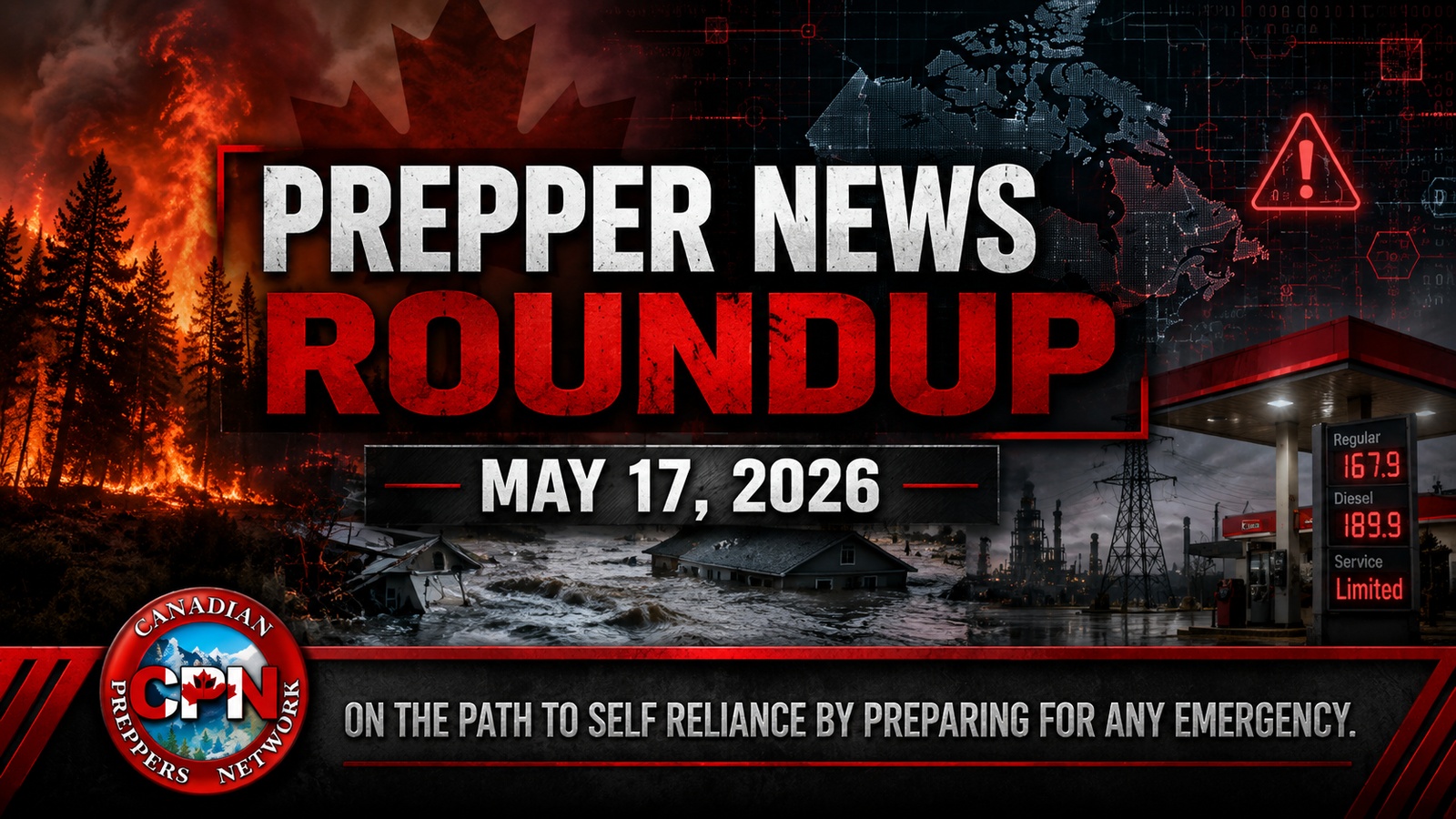
Wildfire Alerts, Flood Signals, Cyber Threats, Fuel Pressure, and a Public Health Reminder
Canada is not in full-blown disaster mode this week, but the warning lights are definitely on. The pattern is familiar: one region too dry, another too wet, critical infrastructure increasingly digital and vulnerable, food prices under renewed pressure, and global conflict feeding directly into fuel and fertilizer markets. This is the kind of week that separates people with household resilience from people simply hoping the system keeps working.
The biggest Canadian preparedness story remains the opening stretch of wildfire and flood season. Federal, provincial, and territorial emergency ministers met in late April to review the 2026 wildfire and flood outlook. Their assessment was blunt: wildfire risk will be uneven across Canada, while local flood risk will depend heavily on variable temperatures and above-normal precipitation in parts of British Columbia, the Prairies, Yukon, Ontario, and Quebec. The same meeting also flagged public alerting, preparedness, response capability, risk reduction, and recovery as national priorities for the year. Source: Canadian Intergovernmental Conference Secretariat.
Alberta has already provided the week’s clearest wildfire reminder. Clearwater County remained under an evacuation alert after an out-of-control wildfire northwest of Sundre, near Highway 40 and Highway 584. The May 15 alert said the area remained on evacuation alert, with the public cleared out so firefighting operations could continue. There was no mandatory resident evacuation at that time, but the alert made clear that residents needed to be ready if conditions changed. Source: Government of Alberta emergency alert.
That is exactly the lesson for preppers: evacuation is not a theory. It is a logistics problem. The time to find papers, fuel the vehicle, sort medication, check pet carriers, download maps, and decide where the family is going is not when smoke is already visible. Wildfire alerts do not wait for convenience. Neither should your exit plan.
Flooding is the other side of the same Canadian coin. The Canadian Drought Monitor reported that April brought major moisture improvements across Ontario, but also noted that increased precipitation and rapid snowmelt raised water levels and prompted flood watches in many areas. Source: Canadian Drought Monitor. Muskoka has also been pointing residents and seasonal property owners toward flood-mapping tools, lake-level checks, and shoreline-impact information. Source: District Municipality of Muskoka emergency information.
Northern and Indigenous communities continue to show why “just evacuate” is an easy phrase and a hard reality. Record spring flooding in Saskatchewan forced evacuations involving Red Earth Cree Nation, Shoal Lake Cree Nation, and Sturgeon Lake First Nation. This is not just a weather story; it is a road access, housing, fuel, communications, medical continuity, and mutual-aid story. Source: APTN News.
The long weekend also brought a smaller but useful reminder from Manitoba: even recreational travel can expose weak assumptions. Manitoba said most provincial park campgrounds were open for the May long weekend, but many had limited water services because of colder spring weather, while some northern campground openings were delayed by snow cover. In plain language: even in mid-May, Canadian outdoor plans still need independent water, clothing, heat, and route planning. Source: Government of Manitoba.
The infrastructure story of the week is cyber resilience. Canada’s Cyber Centre launched the Critical Infrastructure Resilience and Escalated Threat Navigation initiative in April, warning that energy, telecommunications, transportation, and water systems face growing cyber threats from state-sponsored actors, criminals, and AI-enabled attacks. The Cyber Centre specifically told critical infrastructure operators to prepare to isolate critical systems for up to three months, test plans to operate independently, and plan for rebuilding after severe cyber incidents. Source: Government of Canada.
That should get every prepper’s attention. When the government’s cyber agency is talking about three-month isolation planning for critical infrastructure, households should not be patting themselves on the back for a flashlight and a case of water. The household version is simple: offline copies of contacts and documents, backup power for communications, cash on hand, stored water, a way to cook, and the ability to function when apps, payment systems, pumps, or local networks stop behaving normally.
Food pressure is building again, and not just because of grocery-store greed. A TD analysis warned that disruption around the Strait of Hormuz has blocked roughly one-third of global seaborne fertilizer trade, with nitrogen and phosphate supply especially exposed. Canada may be better positioned than some countries in the short run, but global fertilizer disruption still feeds into wider food-price pressure. Source: TD Economics.
The fertilizer angle matters because fertilizer trouble today becomes food-price trouble later. Canada may be buffered by domestic production and lower direct dependence on Gulf-region imports, but Canadian food prices do not exist in a sealed box. Global commodity prices, replacement supply demand, fuel costs, transportation, and farm input costs all eventually work their way toward the grocery shelf.
Fuel is the other pressure point. Reuters reported that Ukrainian drone attacks knocked out about 700,000 barrels per day of Russian refining capacity between January and May across 16 refineries, with attacks on energy facilities increasing as peace talks failed to make progress. Source: Reuters. For preparedness, fuel pressure is not just about commuting. It affects food transport, farm costs, construction materials, delivery services, generator use, and rural travel.
Anyone with a retreat, homestead, RV, generator, tractor, chainsaw, or long-distance family evacuation plan should be treating fuel as a managed supply, not an afterthought. You do not need panic buying. You need rotation, storage discipline, safe handling, and a realistic understanding of how fast normal life gets expensive when diesel, gasoline, and transport costs start moving.
Public health also made the list this week. Canada’s Public Health Agency says the overall risk to the general Canadian population from the Andes hantavirus outbreak linked to the MV Hondius cruise ship remains low, with significant onward spread in Canada not expected. Reuters also reported that a Canadian from Yukon tested positive after disembarking from the vessel, while health officials continued to stress that the risk of further spread remained low. Sources: Public Health Agency of Canada and Reuters.
The practical takeaway is not panic. It is hygiene and rodent control. Stored food, cabins, sheds, barns, trailers, and seasonal camps all need attention before summer use. Any prepper who stores grain, pet food, animal feed, paper goods, or long-term food buckets already knows the rule: if rodents can get in, they eventually will.
Avian influenza is still worth watching as a food-system issue. CFIA says it is responding to detections of highly pathogenic and low pathogenic avian influenza in domestic birds in Canada and reminds bird owners to practise enhanced biosecurity. Alberta also recorded its first commercial avian influenza cases of 2026, with detections confirmed on May 11 at commercial poultry operations. Source: Canadian Food Inspection Agency.
This is not a reason to panic over poultry or eggs. It is a reason for homesteaders, small-flock owners, and anyone thinking about backyard birds to take biosecurity seriously. Feed storage, wild-bird contact, shared equipment, footwear, visitors, and coop sanitation are not side details. They are the difference between a resilient food system and a fragile one.
The broader civil-defence trend continues to move in the prepper direction, even when governments use softer language. Canada’s Emergency Preparedness Week used the theme “Be Prepared. Know Your Risks,” encouraging households to understand local hazards, take protective action, and prepare before emergencies happen. Source: Government of Canada.
Here is the hard truth: 72 hours is the government’s public-facing starting point, not the finish line for serious preparedness. A household that can only function for three days is still dependent on the system returning quickly. The deeper lesson from this week’s news is that emergencies now stack: wildfire plus evacuation, flood plus road closure, cyberattack plus water disruption, fuel spike plus grocery inflation, disease alert plus supply-chain stress.
This week’s action list should be practical. Check local fire bans and evacuation routes. Refresh vehicle fuel and go-bags before wildfire smoke is in the forecast. Walk the property for flood paths, clogged culverts, basement seepage, and sump-pump dependence. Store more water than the minimum. Print critical contacts. Check backup power. Inspect stored food for pests. Review poultry or livestock biosecurity. Add a fuel-price shock to the household budget before it arrives as a surprise.
Canada is not collapsing this week. But the systems Canadians depend on are showing the usual weak points: distance, weather, power, water, food, fuel, communications, and public health. That is the real news. Not panic. Not fantasy. Just another reminder that self-reliance is no longer fringe thinking. It is basic risk management.