When fuel deliveries stop and the grid stays down, real power comes from systems you can repair, feed, and protect.
Most people think of emergency power in terms of a generator, a solar panel, or a battery pack sitting in the basement. That is fine for a weekend outage. It might even carry a family through a bad ice storm, a wind event, or a few days of rolling blackouts.
But that is not the same thing as long-term energy resilience.
In a real collapse, the problem is not simply that the lights go out. The problem is that the entire support system behind electricity disappears with them. Fuel deliveries stop. Replacement parts become scarce. Batteries wear down. Charge controllers fail. Inverters burn out. The local hardware store is no longer a reliable backup plan. The neighbour who knew small engines may be gone, overwhelmed, or guarding his own resources.
That is when energy stops being a convenience and becomes a survival system.
The first weeks of collapse belong to the people with generators. The first months belong to the people with stored fuel. The first years belong to the people who can make use of what still exists around them: moving water, wind, wood, gravity, hand tools, mechanical advantage, and disciplined energy use.
A serious retreat or homestead cannot depend on one shiny solution. It needs layers. It needs systems that can survive neglect, weather, scarcity, and hard use. Most of all, it needs a mindset shift. The goal is not to keep modern suburban life running. The goal is to keep water moving, radios charged, tools working, food preserved, and essential tasks possible after the easy answers are gone.
Related CPN Hub:
Canadian Preppers Network Energy Production Hub
The Generator Is A Countdown Clock
A generator is useful. No serious prepper should pretend otherwise. It can run tools, charge batteries, keep freezers cold, pump water, and carry a household through the early stages of a crisis.
But a generator is not a long-term power system. It is a countdown clock.
Every hour it runs burns fuel. Every tank of gasoline, diesel, or propane brings you closer to the day when the machine becomes dead weight. Stored fuel has limits. It takes space. It requires proper containers. It degrades. It attracts attention. In a serious breakdown, fuel becomes one of the first resources people start looking for, trading for, stealing, and fighting over.
There is also the noise problem. A running generator announces that someone nearby still has resources. In a short outage, that may not matter. In a long collapse, sound carries meaning. Light, engine noise, heat signatures, cooking smells, and visible activity all tell a story. A loud generator tells the wrong story.
That does not mean generators should be dismissed. It means they should be used as bridges, not foundations. A generator is best reserved for short, controlled jobs: topping up battery banks, running power tools, pumping water, or handling temporary heavy loads that smaller systems cannot manage. It should not be treated as the heart of the retreat.
If your entire energy plan depends on fuel deliveries returning, you do not have a collapse plan. You have a waiting plan.
Solar Is Useful, But Fragile
Solar power earns its place in preparedness. It is quiet, scalable, and practical. For many Canadians, a modest solar setup can charge radios, AA and AAA batteries, LED lighting, small electronics, power-tool batteries, and low-draw DC systems. It can keep communication alive when the grid is gone. It can reduce generator use. It can make a retreat less dependent on stored fuel.
But solar is not magic.
In Canada, solar production drops hard when you need power most. Winter brings short days, low sun angles, snow cover, ice, heavy cloud, and long nights. A system that looks impressive in July may feel painfully small in January. Panels may last for years, but the system around them is more vulnerable: charge controllers, inverters, wiring, connectors, fuses, breakers, and batteries.
The weak point is usually not the panel. It is storage and control.
A solar panel without a healthy battery bank is only useful when the sun is cooperating. A battery bank without charging discipline becomes an expensive pile of declining capacity. An inverter-heavy setup encourages people to keep using household appliances as if the grid still exists. That is a dangerous habit.
Solar works best when it is treated as part of a low-demand lifestyle. LED lights instead of lamps. DC chargers instead of wasteful adapters. Radios instead of entertainment systems. Manual tools instead of power tools where possible. Small loads, carefully chosen, carefully rationed.
A solar system can be excellent. But it should not be asked to carry the fantasy that life will continue as normal.
Micro-Hydro Is King If You Have The Water
If a property has reliable moving water, micro-hydro deserves serious attention.
Unlike solar, water can move day and night. It can produce power in darkness, storms, and deep winter if the system is properly protected. A small, steady source of energy can be more useful than a larger but intermittent source. In a collapse, consistency matters.
This is why a year-round creek can be more valuable than a field full of panels.
Micro-hydro is not universal. It depends entirely on the land. You need suitable flow, usable drop, seasonal reliability, and a location that can be managed. A trickle in August and a frozen channel in February will not support the same plan as a strong year-round stream with useful head. Intake protection matters. Debris matters. Ice matters. Flooding matters. So does distance from the house or retreat.
But where the land supports it, micro-hydro may be one of the strongest long-term energy options available to a Canadian homestead.
It does not have to run a modern house to be valuable. Even modest continuous production can keep batteries topped up, support lighting, charge radios, run small DC loads, and reduce the need for fuel. Over time, steady low power beats occasional high power. A system that produces a little all day and all night becomes a quiet workhorse.
This is where retreat planning becomes real. A piece of land is not just trees, soil, and privacy. It is energy potential. Does it have moving water? Does it have a woodlot? Does it have wind exposure? Does it have gravity-fed water possibilities? Can systems be kept hidden, maintained, and protected?
The land either feeds the retreat, or the retreat slowly consumes what was stored before the collapse.
Wind Power Only Works Where Wind Actually Works
Wind power sounds attractive because wind is free. The problem is that free does not mean useful.
Small wind turbines disappoint many people because they are installed in poor locations. Trees, buildings, valleys, ridges, and uneven terrain create turbulence. A turbine spinning occasionally in dirty air is not the same thing as a reliable power source. Bad wind sites produce frustration, broken parts, and false confidence.
Wind works best where wind is consistent, exposed, and strong enough to matter. Open farmland, coastal areas, ridgelines, and large clearings may offer real potential. Sheltered forest properties usually do not.
Wind also has more moving parts than solar. Towers, blades, bearings, guy wires, brake systems, and storm protection all introduce maintenance. In a collapse, maintenance is not a minor detail. It is the difference between a system that lasts and a system that becomes scrap.
That said, wind can play a role in a layered setup. In some Canadian locations, wind may perform better during seasons when solar is weaker. A small wind turbine paired with solar and battery storage can add resilience if the site is right.
The hard truth is simple: wind power is not bad. Bad wind sites are bad.
Before anyone builds a plan around wind, they need to know whether the land actually has usable wind. Wishful thinking does not charge batteries.
Wood Gasification: Powerful, Demanding, And Not For Everyone
Wood gasification is one of the few post-fuel energy ideas that deserves serious attention, especially for rural properties with managed woodlots.
The basic appeal is obvious. If liquid fuel is gone but the forest remains, biomass becomes more than heat. Under the right conditions, wood gas can be used to run certain engines. That makes it one of the rare systems that can potentially turn local fuel into mechanical or electrical work after gasoline and diesel become unavailable.
That is the attraction.
The reality is harder.
Wood gasification is not a plug-and-play prepper gadget. It demands knowledge, dry fuel, careful operation, filtration, maintenance, mechanical skill, and constant respect for danger. Poorly designed or poorly operated systems can produce toxic gases, fire hazards, engine damage, and serious failure points. This is not something to improvise from internet diagrams during a crisis.
For the right group, wood gas may be worth studying. A mechanically skilled retreat, farm, or workshop with tools, spare parts, technical knowledge, and a sustainable wood supply could treat it as an advanced resilience project. It may have a place for running engines, charging battery banks, or powering workshop tasks under controlled conditions.
For the average household, it is probably too complex to be the main plan.
That does not make it useless. It makes it serious.
Wood gas belongs in the category of advanced collapse energy. It is not a beginner’s shortcut. It is not clean, simple, or effortless. It is a demanding system for people who understand that turning a woodlot into engine fuel comes with work, risk, and responsibility.
But in a world where fuel stations are empty forever, demanding systems may be the only systems left.
Mechanical Power Matters More Than People Think
One of the biggest mistakes in energy planning is assuming every useful job requires electricity.
It does not.
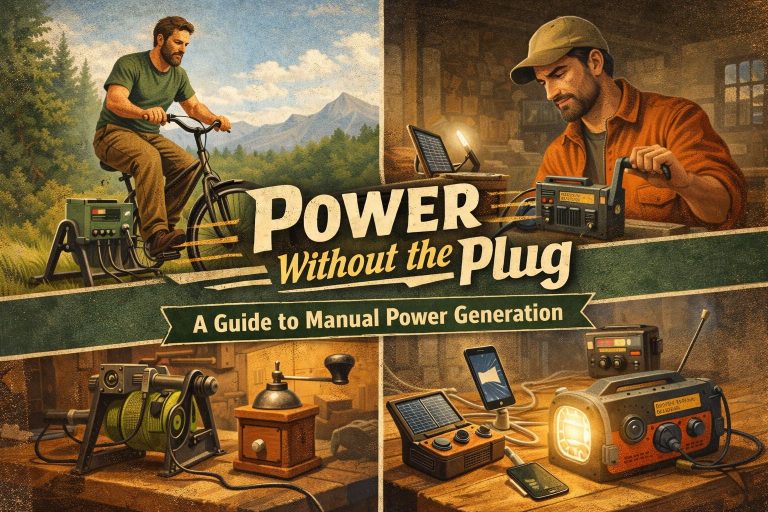
Every task moved away from electricity makes the entire power system stronger. A hand pump reduces demand on electric pumps. Gravity-fed water reduces dependence on motors. A brace and bit replaces a drill for many jobs. Hand saws, axes, drawknives, scythes, manual grain mills, clotheslines, block and tackle systems, foot-powered tools, and bicycle-powered devices all reduce the need to generate, store, and manage electricity.
This is not nostalgia. It is energy discipline.
A retreat that depends on electricity for every basic task is fragile. A retreat that uses electricity only where it matters most can survive on a much smaller system.
Heating is another major example. Trying to heat with electricity in a long Canadian grid-down scenario is usually a losing game unless the system is enormous. Wood heat, thermal mass, passive solar design, proper insulation, smaller heated spaces, layered clothing, and good building habits matter far more. Electricity should not be wasted trying to do what wood, design, and discipline can do better.
The same applies to cooking, drying, water movement, and food processing. Solar dehydrators, wood cookstoves, rocket stoves, manual grinders, hand pumps, and root cellars may not sound exciting, but they reduce electrical demand where it counts.
The best energy system is not always the one that produces more power. Sometimes it is the one that needs less.
Related CPN Hub:
Canadian Preppers Network Shelter & Heat Hub
The 12-Volt Retreat Mindset
Most homes are built around grid abundance. Lights everywhere. Plug-in devices in every room. Large appliances. Electric convenience. Phantom loads. Waste hidden behind a monthly bill.
A retreat cannot think that way.
The 12-volt mindset is different. It starts with small, essential loads and builds around them. LED lighting. Radio charging. Battery charging. Low-draw fans. Small pumps where necessary. Security sensors. Tool batteries. Communications equipment. Simple fused circuits. Short wiring runs where possible. DC power used directly instead of constantly converting through inverters.
This matters because every conversion wastes energy and adds another failure point. Inverters are useful, but they should not become the centre of the system unless there is a clear reason. A low-voltage DC setup can keep critical systems alive with less demand, less complexity, and less waste.
This is especially important for communications. A charged radio may matter more than a lit living room. A working battery charger may matter more than a microwave. A small light in a work area may matter more than lighting the whole house.
Survival power is not about comfort. It is about function.
Related CPN Hub:
Canadian Preppers Network Communications Hub
Energy Priority After Collapse
When power becomes scarce, the question is not “what can we run?”
The question is “what deserves power?”
Water comes first. If electricity is needed to move, purify, or pressurize water, that system outranks almost everything else. Without water, nothing else matters for long.
Communications come next. Radios, battery chargers, and information systems can keep a retreat connected to weather, local conditions, other group members, and emergency developments. Isolation is dangerous.
Medical needs come after that. Some households may have devices, refrigeration requirements, lighting needs, or charging needs tied to health and safety. Those loads must be identified before the crisis, not discovered during one.
Food preservation follows. Freezers, dehydrators, refrigeration, and processing tools can save food, but only if they fit the size of the system. In many long-term scenarios, it may be smarter to shift from freezing to canning, drying, fermenting, smoking, and root cellaring rather than trying to keep modern appliances alive forever.
Security and work lighting matter, but they should be controlled. The goal is not to light up the property like a gas station. The goal is safe movement, controlled work areas, and minimal visibility from outside.
Comfort comes last.
That sounds harsh because modern people are trained to see electricity as normal. But after collapse, entertainment, large appliances, electric heat, decorative lighting, and convenience loads become luxuries. If the system is strong enough to support them, fine. If not, they get cut.
A household that cannot make hard energy decisions will waste power on comfort while critical systems suffer.
The Real Answer Is Layering
No single energy system wins everywhere.
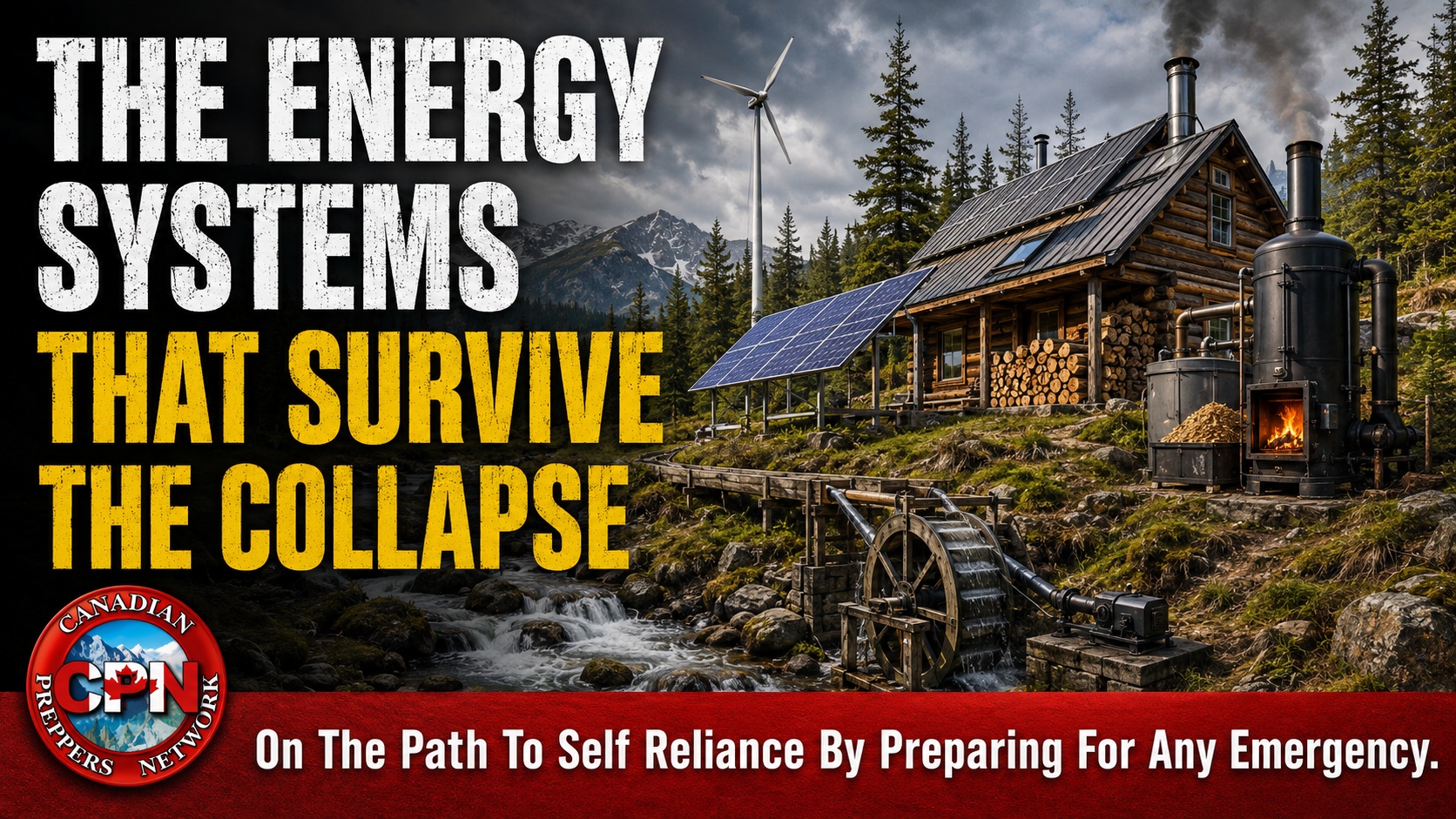
A strong Canadian retreat may use wood heat for warmth, solar for battery charging, micro-hydro if the land allows it, wind if the site actually supports it, a generator for controlled backup use, manual tools for routine work, and perhaps wood gasification for advanced mechanical users.
The battery bank should be sized around essential loads, not fantasy loads. The wiring should be understandable. The system should be repairable with tools and parts on hand. The household should know what gets powered, what gets shut down, and what gets replaced with manual labour.
This is where many preppers get the order wrong. They buy equipment first and think about demand later. The better approach is to reduce demand first, then build power systems around what remains.
If you can move water without electricity, do it. If you can heat without electricity, do it. If you can cook without electricity, do it. If you can preserve food without a freezer, learn how. If you can replace a power tool with a hand tool, own the hand tool and know how to use it.
Electricity should be reserved for what electricity does best: communications, battery charging, essential lighting, medical needs, selected tools, and small systems that multiply human effort.
Everything else should be questioned.
CPN Preparedness Buying Box
The serious systems discussed here — micro-hydro, wind siting, and wood gasification — require site-specific planning and proper technical knowledge. Random parts are not a substitute for a real design. But the support gear below fits the practical side of low-voltage preparedness and energy discipline.
12V LED lighting
https://www.amazon.ca/s?k=12v+led+lighting&tag=canadianprep-20
12V fuse block
https://www.amazon.ca/s?k=12v+fuse+block&tag=canadianprep-20
Battery monitor
https://www.amazon.ca/s?k=12v+battery+monitor&tag=canadianprep-20
Digital multimeter
https://www.amazon.ca/s?k=digital+multimeter&tag=canadianprep-20
MC4 solar connector tools
https://www.amazon.ca/s?k=mc4+solar+connector+tool&tag=canadianprep-20
12V water transfer pump
https://www.amazon.ca/s?k=12v+water+transfer+pump&tag=canadianprep-20
Rechargeable AA and AAA batteries
https://www.amazon.ca/s?k=eneloop+aa+aaa+rechargeable+batteries&tag=canadianprep-20
AA/AAA battery charger
https://www.amazon.ca/s?k=aa+aaa+battery+charger&tag=canadianprep-20
Manual hand pump
https://www.amazon.ca/s?k=manual+hand+pump+water&tag=canadianprep-20
LiFePO4 battery
https://www.amazon.ca/s?k=lifepo4+12v+battery&tag=canadianprep-20
Final Thought
Collapse energy is not about owning the biggest generator or the flashiest solar array. It is about knowing what your land can provide when supply chains disappear.
A property with water, wood, tools, discipline, and layered systems may outlast a house full of batteries and fuel cans. The person who can reduce demand, repair equipment, manage stored power, and draw energy from local resources has a far better chance than the person waiting for normal life to return.
The best power system is not the one that looks impressive during a weekend outage.
It is the one still working when there is no store left to visit.