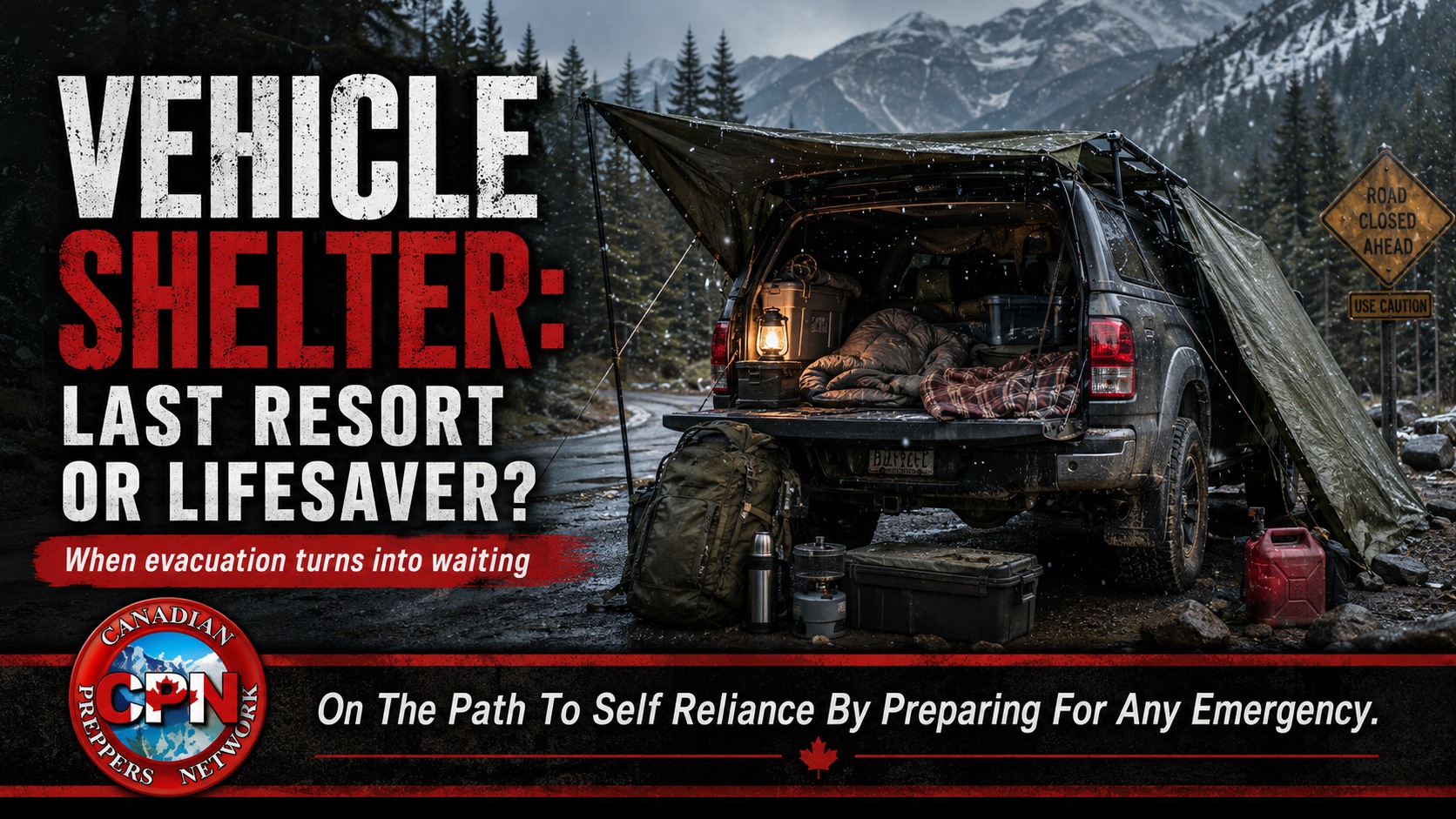
How to think about cars, trucks, vans, and trailers when evacuation turns into waiting
Most people think of shelter as a house, cabin, tent, or retreat building. That makes sense during normal times. But in a fast-moving emergency, the shelter you actually have may be the vehicle you are sitting in.
A vehicle is not ideal shelter. It is cramped. It loses heat quickly. It depends on fuel. It has glass, electronics, rubber, upholstery, and mechanical systems that can all become weak points. But when the road closes, the weather turns, the evacuation route stalls, or the destination is not reachable, that vehicle may be the only barrier between your family and exposure.
That makes vehicle shelter planning worth taking seriously.
Not because you should plan to live in your car, but because there are realistic Canadian emergencies where you may have to survive in or around one for several hours, overnight, or longer than expected.
Wildfire evacuations. Winter highway closures. Flooded roads. Multi-vehicle pileups. Power outages away from home. Sudden medical delays. Police roadblocks. Fuel shortages. Mechanical breakdowns in rural areas. A bugout route that looked good on paper but turns into a parking lot in real life.
In those moments, the question is simple: is your vehicle just transportation, or is it part of your shelter plan?
The Vehicle Is a Heat Trap, Not a Cabin
The first mistake is thinking a vehicle is automatically warm because it has a heater.
That heater only matters while the engine can run. Once the engine is off, a vehicle cools down quickly. Glass bleeds heat. Metal conducts cold. Seats and flooring hold dampness. Wind can pull heat from the body of the vehicle faster than people expect.
In winter, the problem is obvious. But cold weather is not the only risk. A wet, windy spring night can become dangerous if people are exhausted, poorly dressed, and trapped without dry layers. In much of Canada, exposure does not need deep winter temperatures to become serious.
Your vehicle shelter plan should assume that the engine may not be available all night. Fuel may need to be conserved. Snow or debris may block the exhaust. Mechanical trouble may make running the engine unsafe. You may be forced to stay put without heat.
That means warmth has to come from insulation, clothing, bedding, and preparation — not just the dashboard controls.
The Minimum Vehicle Shelter Kit
Every Canadian vehicle used for commuting, road trips, rural travel, hunting, fishing, camping, or evacuation should carry more than a jumper cable and a windshield scraper.
At minimum, you want enough gear to keep the occupants dry, insulated, visible, and supplied until the situation changes.
That means wool blankets or compact emergency blankets, spare socks and gloves, rain protection, a toque, a flashlight or headlamp, water, food that can tolerate temperature swings, a basic first aid kit, a USB power bank, a paper map, a lighter, a whistle, a small shovel in winter, and some way to improve visibility if stopped on the shoulder.
For families, add extra children’s clothing, simple snacks, medication, wipes, and a way to manage bathroom needs if everyone is stuck in place for hours.
This is not about loading the vehicle like a full retreat. It is about building a practical survival buffer between “minor delay” and “real emergency.”
Sleeping in a Vehicle Is Not as Simple as Reclining the Seat
If you have to sleep in a vehicle, your goal is not comfort. It is heat retention, safety, and fatigue management.
The best approach is to reduce the amount of interior space you are trying to keep warm. People may be better off clustered together in one section of the vehicle rather than spread out. Use blankets, sleeping bags, coats, and spare clothing to create insulation around bodies, not around empty air.
The floor is often colder than people expect. Feet get cold quickly. Dry socks matter. So does keeping damp boots away from sleeping layers.
Cracking a window slightly may be necessary for ventilation if several people are inside for a long time, but it also costs heat. The balance depends on weather, number of people, and whether any fuel-burning device is being used nearby. As a rule, never use camp stoves, charcoal, propane heaters not rated for indoor use, or open flames inside a vehicle. Carbon monoxide is invisible, odourless, and unforgiving.
Running the engine for heat should be done cautiously. The exhaust must be clear, especially in snow or deep mud, and someone should stay alert enough to monitor conditions. A battery-powered carbon monoxide alarm in the vehicle kit is cheap insurance.
Your Vehicle Can Support a Shelter Outside the Vehicle
Sometimes the vehicle itself is not the best place to stay. It may be too hot, too cramped, damaged, or unsafe on the shoulder of a road. In that case, the vehicle becomes an anchor point for temporary shelter.
A tarp, paracord, bungee cords, and a few stakes can turn the side or rear of a vehicle into a windbreak, shade shelter, rain cover, or cooking area. A hatchback, truck cap, van, or SUV gives more options than a small sedan, but even a compact car can help block wind if you know how to use it.
This matters during roadside breakdowns, wilderness approaches, hunting trips, off-road travel, long evacuations, and grid-down movement toward a bugout location.
The vehicle gives you structure. The kit gives you shelter options.
Without the kit, you are just sitting in a metal box hoping conditions improve.
Trailers, Campers, and Vans Are Useful — But Not Magic
A camper, cargo trailer, van build, or small travel trailer can dramatically improve your emergency shelter options. But it also creates a new set of problems.
Can you heat it safely? Can you ventilate it? Can you tow it through bad roads? Can you turn around if the route is blocked? Can you protect the contents from theft? Can you sleep in it without drawing attention? Can you keep water from freezing? Can you maintain it when parts are unavailable?
For many prepper families, a modest cargo trailer may be more useful than a large RV. It can hold shelter supplies, tools, food totes, water containers, sleeping gear, and repair equipment without becoming a full-time maintenance burden. But it has to be packed intelligently. If every box is buried, the trailer becomes a mobile junk drawer.
A vehicle-based shelter system should be organized around access. The first things you need in bad weather should not be under six totes of “maybe someday” gear.
Fuel Is Shelter
In a vehicle emergency, fuel is not just transportation. Fuel is heat, battery charging, communication, lighting, and decision-making time.
Running low on fuel turns every choice into a gamble. Do you keep the engine running for warmth? Do you save fuel for movement? Do you risk driving to the next town? Do you wait for road conditions to improve?
A serious vehicle preparedness plan should include a personal rule: never let the tank sit near empty. In rural Canada, half a tank should be treated as the new empty during bad weather, wildfire season, long-distance travel, or unstable conditions.
For lawful and safe storage, some people also keep an approved fuel container at home as part of their evacuation plan. That does not mean driving around casually with fuel inside the passenger area. It means understanding safe storage, transport limits, ventilation, and fire risk before an emergency forces bad decisions.
Vehicle Shelter and the Bugout Reality
A lot of bugout planning assumes movement. Pack the bags, start the truck, take the route, arrive at the retreat.
Reality may not cooperate.
Roads can close. Bridges can wash out. Police may redirect traffic. Fuel may run short. A vehicle may break down. A child may get sick. A storm may make driving more dangerous than staying put. A secondary route may be blocked by everyone else who had the same idea.
That is why your vehicle plan should include three layers.
First, the ability to stay in the vehicle for several hours without panic.
Second, the ability to sleep in or around the vehicle overnight if movement stops.
Third, the ability to abandon the vehicle safely if it becomes a liability.
That last point matters. The vehicle is useful until it traps you. If fire, flood, violence, mechanical failure, or road conditions make staying with it dangerous, your supplies need to be portable enough to leave with the essentials.
A bugout bag, vehicle kit, and retreat plan should work together. They should not be three separate ideas.
What Should Stay in the Vehicle
The exact kit depends on season, region, passengers, and distance from home, but the core categories stay the same.
You want warmth, water, food, light, communication, visibility, medical basics, repair tools, traction support, navigation, sanitation, and a way to create basic shelter.
For cold-weather or rural travel, add wool blankets, sleeping bags, traction boards or sand, a shovel, winter gloves, spare hats, a candle lantern or safe light source, and high-calorie food.
For summer evacuations, add shade, extra water, electrolyte packets, sun protection, insect protection, and a way to keep children or pets from overheating.
For all seasons, keep paper maps. Phones are excellent until towers fail, batteries die, data disappears, or the route you need is not the one the app wants you to take.
Related CPN Reading
Bugout planning works better when the route, vehicle, and destination are all considered together.
- Bug Out Bag Essentials For Canadians
- Bugging Out: Preparing To Leave Home In An Emergency
- Emergency Car Kits
- Winter Survival Kit For Your Vehicle
Vehicle Shelter Gear Box
Disclosure: The following Amazon.ca links use the Canadian Preppers Network affiliate tag. Purchases may support the site at no extra cost to you.
A vehicle shelter kit does not need to be fancy. It needs to be useful, compact, and ready before the road closes.
Warmth and insulation
Shelter extension
Light, power, and safety
Roadside survival and recovery
Bottom line: start with warmth, light, water, visibility, and a way to make shelter outside the vehicle. Then build from there.
Final Thought
A vehicle shelter plan is not glamorous. It does not look like the survival fantasy version of preparedness. It looks like a family stuck on a closed highway, a truck waiting out a storm, a parent trying to keep children calm during evacuation, or a driver sleeping beside a road because pushing farther would be worse.
That is real preparedness.
Your vehicle may never become your shelter. But if it does, you will find out very quickly whether you packed a survival buffer or just a glovebox full of receipts.
The road is not the plan. The vehicle is not the destination. But in the wrong emergency, it may be the only shelter you have left.