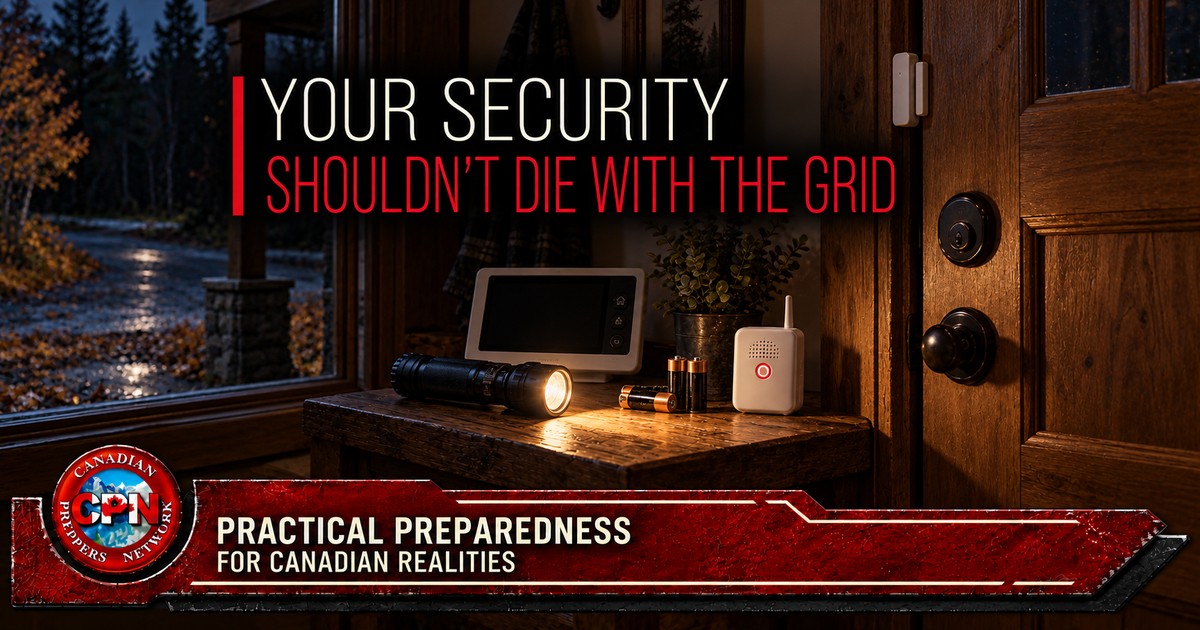
Keeping your home protected when power, internet and outside help become unreliable
Grid-down home security faces its first test when the power goes out. Your porch light disappears, the router shuts down, and the camera app on your phone stops updating.
You still have food, water, heat and a way to cook. But the security equipment you depended on has just become a collection of dark plastic boxes.
During a short outage, that might be an inconvenience. During prolonged disruption, when fuel becomes scarce and replacement equipment is unavailable, it becomes a serious weakness. The system that worked beautifully while electricity, broadband, subscriptions and technical support were available may offer very little after those services disappear.
Grid-down home security starts with knowing exactly what survives when you pull the plug. Your household needs barriers, warning systems and routines that keep working as conditions deteriorate.
Table of Contents
Find the Dependencies Before They Fail
“Wireless” does not necessarily mean battery powered. “Battery powered” does not necessarily mean independent of the internet. And a camera that continues recording may no longer deliver an alert you can hear.
Treat these as separate functions:
- Detection: Does the device still recognise movement or an opened door?
- Recording: Where does it save the event?
- Notification: How does someone inside the house learn about it?
- Viewing: Can you see what happened without an internet connection?
- Power: What keeps every required component operating?
Some cameras can record to a memory card during an internet outage. Other systems depend on cloud storage. Reolink’s outage guidance illustrates how supported functions vary by equipment and power availability. Check the instructions for your exact model rather than assuming that one product’s capabilities apply to an entire brand.
A recording you discover tomorrow morning is useful evidence. It provides little warning while someone is opening your shed tonight.
Write down the equipment involved in each security function. Include the camera, router, network switch, recorder, display, alarm receiver and any phone required to receive notifications. That list reveals how much equipment you actually need to support.
Start With Barriers That Require No Electricity
Start your grid-down home security improvements by inspecting the things that physically secure your home.
Does the exterior door close properly? Does the deadbolt fully engage? Is the frame solid? Can a basement window be secured? Does the shed containing your tools have a substantial lock attached to sound timber?
A strong lock cannot compensate for a rotten frame or poorly attached hardware.
Look at the complete assembly: door, frame, hinges, strike, fasteners and surrounding structure. Choose reinforcement suited to the actual door and construction. The Prepared’s review of door reinforcement and barriers provides a useful starting point for comparing different approaches.
Extend the inspection beyond the front entrance. During long-term scarcity, a missing fuel can, stolen bicycle or emptied tool shed can damage your ability to function even if nobody enters the house.
Secure valuable equipment before the disruption. Keep emergency exits usable from inside, and make sure everyone knows how to leave in darkness. A security measure that prevents your household escaping a fire creates another emergency.
Keep a Warning System Separate From the Cameras
For grid-down home security, cameras help you assess a situation. A simple alarm can tell you that something needs assessing.
Battery-operated door contacts, standalone motion alarms and driveway sensors can provide an additional warning layer without depending on a cloud service. However, independence must be verified for the complete system.
A battery-powered outdoor sensor may communicate with a receiver that plugs into a wall socket. Once the receiver loses power, the sensor can keep detecting movement while nobody inside hears a thing.
Sensor choice matters, too. A magnetic driveway sensor intended to detect vehicles will not provide warning of someone approaching on foot. Motion sensors cover a different need but may also react to wildlife. Modern Survival Blog’s firsthand driveway-alarm testing discusses these trade-offs and the effect of terrain on wireless range.
Place the receiver where it will actually wake someone. Test it with bedroom doors closed and the household’s normal overnight noise present.
Avoid creating so many nuisance alerts that everyone learns to ignore them. A warning system earns its place by delivering useful information consistently.
Give Grid-Down Home Security Its Own Power Allowance
Backup power disappears quickly when every appliance becomes a priority.
Refrigeration, communications, lighting, medical needs and charging already compete for limited energy. Grid-down home security equipment should have a deliberate allocation within that plan.
Identify the smallest useful combination. That might be an alarm receiver and a few battery contacts. Another household may need a recorder, selected cameras and a local display.
Measure actual consumption where possible. A continuous 10-watt load uses 240 watt-hours over 24 hours, before accounting for power-conversion losses. Add several devices and an apparently modest system becomes a meaningful daily demand.
Use a UPS to bridge short interruptions where appropriate. For longer outages, establish how the equipment will be recharged and how often. Verify voltage, polarity, connectors and manufacturer compatibility before using a DC backup supply.
Keep suitable spare batteries organised by device. Record installation dates and replacement requirements. For outdoor equipment, check the specified operating and charging temperatures, particularly before relying on solar charging through a Canadian winter.
A system that survives the first evening still needs a plan for the fifth night.
Use Light Where It Helps You
Lighting for grid-down home security should support movement, observation and identification.
Keep a dependable flashlight beside the bed and another at the entrance normally used after dark. A headlamp is useful when securing a door, changing batteries or helping another household member.
Test exterior lighting from inside the house. Can you see the approach clearly, or does the light create glare and reflections? Are nearby branches repeatedly triggering the sensor?
Indoor light deserves attention as well. Curtains and blinds can reduce how much household activity and stored equipment are visible from outside. Check this after dark; gaps that seem insignificant during daylight can become obvious when the room is illuminated.
Keep lights accessible so nobody has to search for them during an alarm. Use battery lighting around curtains and other combustible materials.
Secure the Equipment Keeping You Alive
During prolonged disruption, preparedness equipment becomes part of your security problem.
A generator produces sound. Fuel deliveries attract attention. Open garage doors can expose batteries, tools, food and other supplies to anyone passing.
Use equipment discreetly where practical, and put it away when finished. Secure portable assets without compromising their safe operation.
A generator must remain outdoors, well away from openings, with its exhaust directed away from occupied buildings. Theft concerns never justify operating it in a garage or enclosed hiding place.
Think beyond the generator. Secure charging equipment, extension leads, fuel, hand tools and replacement parts. Losing a modest battery charger can undermine an otherwise capable system if you have no replacement.
Avoid displaying the full extent of your preparations during ordinary conversations or public posts. People do not need an inventory of what is stored behind your shed door.
Establish an Overnight Routine People Can Sustain
Grid-down home security equipment needs a household routine behind it.
Before bed, check entrances, outbuildings, alarm settings, flashlights and the remaining power supply. Make sure everyone knows which door to use and how returning household members will announce themselves.
Agree on what happens when an alarm sounds. Wake the other adults, bring household members together, assess from a protected position and contact emergency services when available. Avoid turning an unexplained noise into an unnecessary trip outside.
During severe, prolonged deterioration, a household may decide that someone needs to remain awake. Be realistic about staffing and fatigue. Two adults cannot maintain demanding daytime work and continuous overnight observation indefinitely.
Use any watch arrangement according to actual conditions, with clear handovers and protected sleep. Exhausted people make poor decisions and eventually stop noticing things.
Run the Failure Test Now
Choose a convenient evening and test your grid-down home security setup in stages.
- Disconnect the internet while leaving the local network powered. Check recording, viewing and alerts.
- Switch off the normal supplies to the security equipment using its ordinary switches or plugs. Confirm which batteries and backup supplies take over.
- Test the household response. Can you hear an alert, locate lighting, account for everyone and secure an entrance?
- Record the gaps. Note the missing function, required equipment and practical correction.
- Repeat after making improvements. Confirm the correction works under the same conditions.
Do this without interrupting essential medical equipment, disabling smoke or carbon monoxide alarms, or creating an electrical hazard.
“Camera still records, but no audible warning reaches the bedroom” is a useful finding. “I think it should work” leaves the weakness unresolved.
Buy for the Failure You Actually Found
The most valuable purchase may be a reinforced strike, an independent alarm or replacement batteries rather than another camera.
Build your grid-down home security buying list around the test results. Prioritise sound entrances, useful warning, reliable lighting and enough power to maintain the essential functions. Each purchase should close a specific gap.
When the grid fails, your household still needs to sleep, work and protect the supplies carrying it through the disruption. Strong entrances, dependable warning, maintained equipment and a practised routine remain useful after the screen goes dark.
Test one part of your security system this week with its normal services disconnected. Find the failure while you can still correct it.
If your electricity and internet disappeared tonight, which security function would your household lose first?
Related Reading
- Security & Defence in Canada — connect physical security, access control, privacy and household routines.
- Running a Generator in Shifts — coordinate essential loads and battery charging to make each generator run count.