Evacuations, Outages and Infrastructure Strain
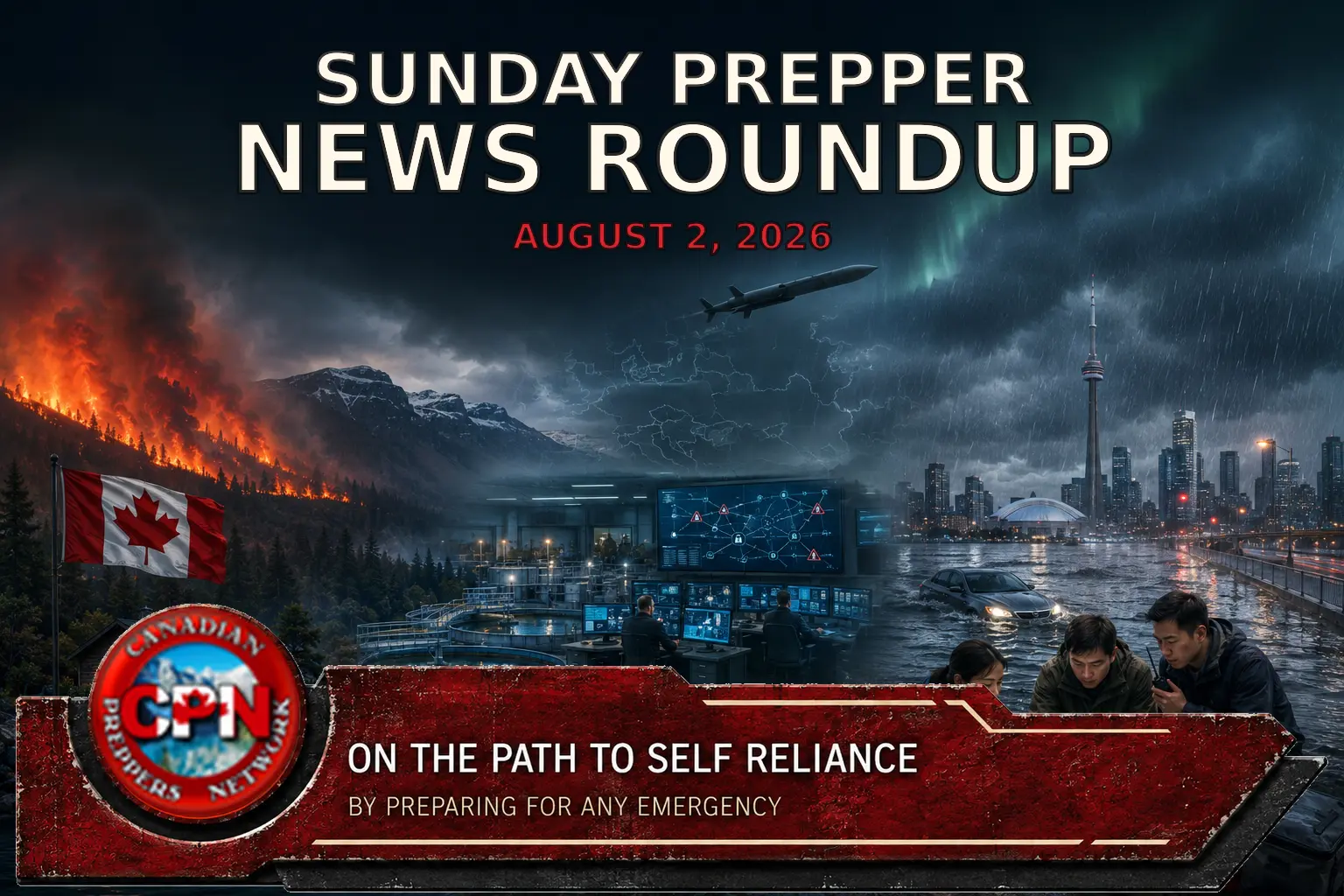
Wildfires continued to displace Canadian communities this week while record rainfall created a very different emergency in eastern Ontario and Quebec. Internationally, earthquakes, fast-moving fires, cyberattacks and escalating military tensions demonstrated how quickly transportation, utilities and public services can be disrupted.
Here are the preparedness stories worth watching from the past week.
Thousands Remain Evacuated by Canadian Wildfires
Wildfires continue to affect First Nations across four provinces. As of July 31, 24 First Nations were dealing with wildfire impacts, while 13 remained under evacuation.
Those evacuations involved 2,287 people from communities in British Columbia, Saskatchewan, Manitoba and Ontario.
The cumulative numbers are considerably larger. Since April 1, wildfires have affected 72 First Nations and forced 7,419 residents to evacuate at some point during the season.
Extended evacuations create problems that a simple 72-hour kit cannot fully address. Medication replacement, animal care, transportation, communications and access to banking or identification documents become increasingly important when residents remain away from home for days or weeks.
The continuing situation is another reminder that evacuation preparations should include both a grab-and-go kit and a longer-term plan for remaining functional away from home.
Source: Government of Canada evacuation information
British Columbia Faces 129 Active Wildfires
British Columbia reported 129 active wildfires on July 30, with 50 classified as out of control. Evacuation alerts and orders continued to change across several regions as the province entered the B.C. Day long weekend.
The provincial government warned travellers to check both wildfire and road conditions before departing. Fire restrictions remained in effect across much of the province, while prolonged dry conditions were also increasing concerns about local water supplies.
The combination of fires, road closures and heavy holiday traffic could make an evacuation considerably slower than expected. Anyone living in an exposed area should know more than one route out and keep enough fuel in the vehicle to reach a safe destination without relying on a nearby filling station.
Residents were also advised to prepare grab-and-go bags containing medication, important documents, chargers, food, water and clothing.
Source: Government of British Columbia
Record Rainfall Raises Flooding Concerns in Ontario and Quebec
While western Canada struggled with fire and drought, parts of eastern Ontario and Quebec dealt with repeated heavy rainfall.
Ottawa International Airport recorded 255.5 millimetres of rain by July 27, making July 2026 the wettest month at the airport since record-keeping began there in 1938. The previous monthly record was 249.8 millimetres, set in July 2017.
Additional storms threatened sections of the Ottawa Valley, eastern Ontario and the Laurentians, with some areas potentially receiving another 50 to 80 millimetres or more. Repeated storms crossing the same locations increased the possibility of localized flooding, poor visibility and dangerous road conditions.
Urban flooding can develop far from a river or lake when storm drains and sewer systems are overwhelmed. Basement storage should therefore be raised above floor level, particularly electrical equipment, food, documents and irreplaceable supplies.
A sump pump is useful only while it has power. Homes with a history of water intrusion should have a backup power plan, a high-water alarm and a safe method of moving water if the primary pump stops.
Source: The Weather Network
Russian Cruise Missile Lands Inside Poland
A Russian Kh-101 cruise missile entered Polish airspace and crashed in eastern Poland on July 30. Polish and allied aircraft were scrambled during the incident, and Warsaw formally protested to Moscow.
Because Poland is a NATO member, the incident represents more than an isolated navigation failure. It demonstrates how quickly the war in Ukraine could spill across an international border, trigger military alerts and place nearby civilian communities at risk.
For households living near military installations, transportation corridors or international borders, civil preparedness should include monitoring official alerts, keeping identification and essential supplies ready, and knowing where to obtain reliable shelter or evacuation information.
Source: Reuters
Taiwan Prepares Civilians and Industry for a Possible Attack
Taiwan announced that its August defence exercises will test more than conventional military operations. The drills will include relocating weapons production, converting civilian factories, protecting critical supply routes and continuing operations while mobile internet service is deliberately degraded.
The exercises reflect a broader civil-resilience approach in which government, industry and civilians prepare to function through communications failures, disrupted transportation and pressure on essential supplies.
The preparedness lesson applies well beyond Taiwan. Modern conflict can affect civilian communications, manufacturing, fuel distribution and access to basic services long before fighting reaches a community. Households should therefore maintain offline contact information, alternative ways to receive news and enough essential supplies to function through an extended disruption.
Source: Reuters
Major Earthquake Strikes Southern Japan
A powerful earthquake struck Japan’s southern island of Kyushu on July 28. Japan’s meteorological agency measured the earthquake at magnitude 7.1, while the United States Geological Survey recorded it at magnitude 6.8.
The earthquake damaged homes, businesses, roads, bridges and industrial facilities. Rail service was suspended, factories stopped production and a temporary tsunami advisory was issued before being lifted.
By August 2, the reported death toll had reached 36. More than 9,000 people were staying in evacuation centres or vehicles, while almost 47,000 homes remained without fresh water. Extreme heat complicated the response and increased the danger for people sheltering without adequate cooling.
The disaster illustrates how the emergency following an earthquake can become more dangerous than the initial event. Water shortages, crowded shelters, damaged roads and seasonal temperatures all place additional pressure on survivors.
Preparedness plans should account for the weather expected after a disaster. A winter evacuation kit is not suitable for extreme summer heat, just as a warm-weather kit will not provide adequate protection during a Canadian winter.
Source: Associated Press
European Wildfires Force Mass Evacuations
Wildfires across France and Spain forced approximately 330,000 people from homes and vacation areas at the height of the emergency. Although many residents were later permitted to return, major fires continued to threaten communities, while additional fires and evacuations developed in Greece.
France mobilized more than 2,200 firefighters and over 20 aircraft. In Spain, progress around Madrid and Ávila allowed some evacuation orders to be lifted, but thousands remained displaced in other regions.
The scale of the evacuation is especially significant. Moving hundreds of thousands of residents places enormous pressure on roads, fuel supplies, accommodations and emergency shelters.
Tourists and seasonal visitors can be particularly vulnerable because they may not know the local evacuation routes or warning systems. Before travelling into an area facing high fire danger, download offline maps, identify alternate routes and keep essential supplies in the vehicle rather than leaving everything at a hotel or campsite.
Source: Associated Press
Cyberattacks Target Municipal Water Systems
More than 30 municipal water systems in Minnesota and nine in Michigan reported malicious cyber activity this week. Authorities said the affected Michigan systems continued operating safely, while the FBI and other agencies investigated the attacks.
In Minnesota, attackers interfered with remote monitoring and control equipment. At least one community temporarily relied on stored water after automated treatment controls were shut down. Other utilities experienced communications or monitoring interruptions.
The incidents show that municipal water can be disrupted without a broken pipe, drought or natural disaster. Increasingly automated treatment and distribution systems introduce another possible point of failure.
Households should maintain a practical reserve of potable water and have a method of treating additional water if officials issue a boil-water advisory or temporarily suspend service. Stored water also needs to be rotated and protected from contamination; owning a filter does not replace having water immediately available.
Source: Associated Press
Fast-Moving Washington Wildfire Reaches Spokane
The Old Trails Fire erupted near Spokane, Washington, on August 1 and spread rapidly through dry grass and brush under strong winds. The fire crossed the Spokane River and forced thousands of people to evacuate.
By Saturday evening, it had burned roughly ten square kilometres, destroyed structures and remained uncontained. Utilities conducted precautionary power shutoffs while Washington’s governor declared a state of emergency.
This was the kind of incident where the available evacuation window could be measured in minutes rather than hours. Waiting to see flames before leaving can mean entering traffic at the same time as everyone else.
Wildfire evacuation plans should establish clear departure triggers. An official evacuation order is one trigger, but visible smoke, falling ash, worsening wind or the closure of a primary route may justify leaving earlier when it remains safe to do so.
Source: Associated Press
Earthquake and Seismic Swarm Hit the Naples Region
A magnitude-4.7 earthquake struck the Campi Flegrei area near Naples, Italy, on July 31. The shallow earthquake caused power outages, transportation disruptions, landslides and building damage.
At least 26 people were injured and approximately 300 residents were evacuated from Pozzuoli. Around 60 additional tremors were recorded after the initial earthquake, while inspections identified buildings that were no longer safe to occupy.
Campi Flegrei is a densely populated volcanic caldera that has experienced increasing seismic activity. Authorities continue to monitor the area, but the immediate problems faced by residents were familiar ones: damaged buildings, interrupted electricity, blocked transportation and the need for temporary shelter.
Source: Reuters
Geomagnetic Storm Watch
No G3 or higher geomagnetic storm was recorded during the July 27 to August 2 reporting period.
A widely circulated result referring to a G3 watch for July 29–31 was issued in 2024 and does not apply to this week. Natural Resources Canada described recent Canadian magnetic activity as quiet, with only some active intervals in the polar zone.
G3 storms remain worth monitoring because they can produce intermittent HF radio, satellite-navigation and electrical-system effects. Only current, dated notices from recognized space-weather agencies should be used when evaluating a possible event.
NOAA Space Weather Prediction Center | Canadian Space Weather Forecast Centre
The Preparedness Lesson This Week
This week’s stories involved different hazards, but the resulting problems were remarkably similar: evacuation, water interruption, power loss, transportation delays, communications failures and overloaded public services.
Preparedness is strongest when it is built around those consequences rather than a single predicted disaster. A household that can leave quickly, communicate without the internet, operate through a power outage and maintain safe water has useful resilience against wildfires, floods, earthquakes, cyberattacks, armed conflict and many other emergencies.