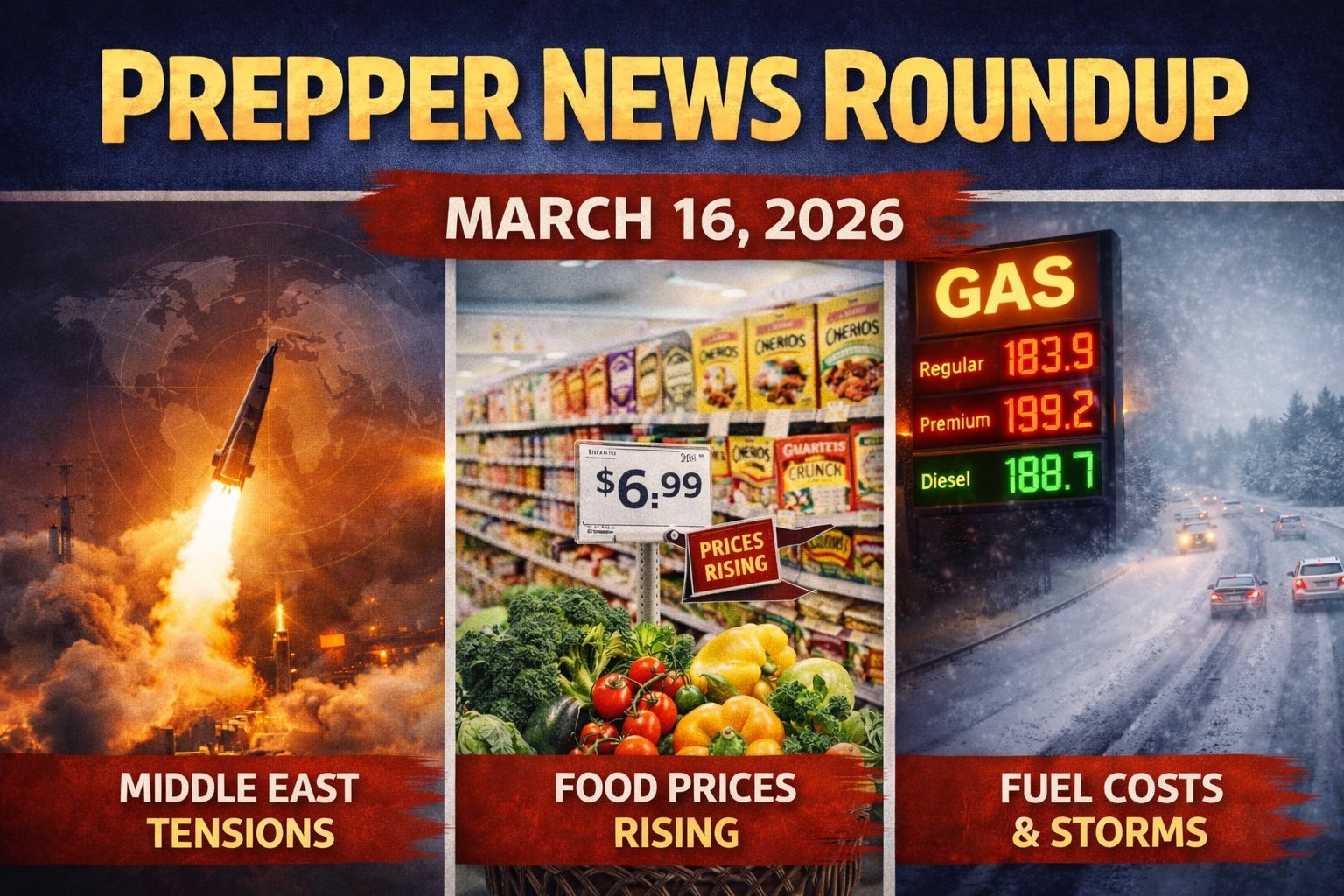
Preparedness begins with awareness. This week’s headlines point to a world that is becoming less predictable: rising food costs, increasing fuel prices, war in the Middle East, and extreme weather reminding Canadians how fragile modern infrastructure can be.
For those paying attention, several developments this week deserve a closer look.
MISSILE STRIKE HITS BASE HOSTING CANADIAN TROOPS
One of the most serious developments this week was confirmation that an Iranian missile strike hit Ali Al-Salem Air Base in Kuwait, where Canadian Armed Forces personnel are stationed.
Reports indicate the section of the base known as “Camp Canada” was struck during the attack. Canadian troops reportedly sheltered in bunkers and no casualties were reported, though infrastructure damage occurred in the area where Canadian personnel operate.
Original story:
https://globalnews.ca/news/11728266/iran-kuwait-military-base-canada-attack/
The story quickly became controversial in Canada after reports surfaced that the government did not initially disclose that the Canadian section of the base had been struck.
While Canada is not formally a combatant in the current conflict between Iran and the United States–Israel coalition, Canadian personnel stationed in the region are clearly operating within the potential strike zone.
From a preparedness perspective, this matters because wars have a tendency to widen. Nations that begin on the sidelines can gradually become more involved through alliance obligations, logistics support, or protection of deployed personnel.
For Canadians watching the situation unfold, the key question is not whether Canada intends to enter the conflict — but whether events might eventually make that unavoidable.
FUEL PRICES RISING AS GLOBAL TENSIONS AFFECT ENERGY MARKETS
Fuel prices across Canada are beginning to rise again as instability in the Middle East pushes global oil markets higher.
Energy analysts say geopolitical tensions involving Iran have already placed upward pressure on crude oil prices, and further escalation could disrupt shipping routes through the Strait of Hormuz, one of the world’s most critical oil transit corridors.
Original story:
https://globalnews.ca/news/11724084/gas-prices-canada-middle-east-conflict/
Even small disruptions in global oil supply can ripple quickly through the Canadian economy. Transportation costs increase, heating fuel becomes more expensive, and food prices often rise as trucking and agricultural costs climb.
For preparedness-minded households, rising fuel prices are not just about the cost of filling the tank. Fuel sits at the center of almost every supply chain.
Higher energy costs affect everything from grocery prices to building materials and fertilizer.
This is why many preparedness planners emphasize reducing dependence on external energy systems where possible — through fuel storage, improved home efficiency, and alternative heating options.
FOOD PRICES CONTINUE TO CLIMB
Food affordability remains one of the most immediate preparedness issues facing Canadian households.
According to the Canada Food Price Report 2026, grocery prices are expected to increase between 4 % and 6 % this year, pushing the average food cost for a Canadian family of four to approximately $17,571 annually.
Original story:
https://globalnews.ca/news/11558888/2026-canadian-food-report-cost-prediction/
The longer-term trend is even more significant. Canadian food prices have increased roughly 27 percent over the past five years, steadily eroding household purchasing power.
For preparedness-minded households, inflation is not just an economic issue. It affects the ability to build long-term food reserves and increases the financial pressure on families already struggling with housing and energy costs.
Food storage, gardening, and local food production are no longer fringe preparedness ideas. Increasingly, they are practical strategies for managing long-term cost pressures.
MAJOR BLIZZARD DISRUPTS MILLIONS ACROSS NORTH AMERICA
A powerful winter storm swept across parts of the northeastern United States and Atlantic Canada earlier this month, bringing heavy snowfall, high winds, and widespread power outages.
The storm — now referred to by meteorologists as the February 2026 North American Blizzard — forced thousands of flight cancellations, closed highways, and left hundreds of thousands of homes without electricity at the peak of the event.
Original story:
https://www.accuweather.com/en/winter-weather/northeast-blizzard-february-2026-travel-disruptions/
Meteorologists reported snowfall totals exceeding 60 centimetres in some regions, with strong winds creating dangerous whiteout conditions.
While the worst impacts occurred in the northeastern United States, parts of Atlantic Canada experienced heavy snowfall and strong winds as the system tracked northward.
For preppers, storms like this represent one of the most realistic emergency scenarios Canadians actually face. Severe winter weather regularly disrupts transportation networks, electrical infrastructure, and supply chains.
A household that can comfortably handle 72 hours without grid power — heat, light, water, and food — is far better positioned to ride out the kinds of emergencies Canadians encounter most often.
THE BIGGER SIGNAL
Taken together, this week’s headlines highlight several trends that preparedness-minded Canadians should be watching closely.
Global conflict continues to expand in the Middle East.
Canadian troops are already operating inside the potential strike zone.
Energy prices are beginning to rise again.
Food inflation continues to erode purchasing power.
And extreme weather continues to test infrastructure across North America.
None of these stories alone represents a crisis. But together they point toward a world where volatility is becoming more common.
Preparedness is not about panic. It is about recognizing these signals early and quietly strengthening household resilience before disruptions occur.
The families who prepare during calm periods rarely regret it later.
Stay aware.
Stay prepared.