In November 2025 a lawsuit and a secretly recorded conversation shook public trust in Campbell’s. A former employee of Campbell’s, now suing for wrongful termination, released a recording of a high-level executive allegedly disparaging the company’s own soups — calling them “highly processed” and saying the chicken was “bioengineered meat” or “from a 3-D printer.” ABC News+2Yahoo News+2
In the recording, the executive reportedly criticized Campbell’s products as “food for poor people” and admitted he personally avoided them. WDIV+2Yahoo News+2 In response, Campbell’s fired the executive and issued a statement insisting that their soups use “100% real chicken” from USDA-approved suppliers — and deny using lab-grown, 3-D-printed, or bioengineered meat. Florida Phoenix+2The Wall Street Journal+2
The controversy shines a spotlight on consumer concerns about processed foods, transparency, and bioengineered ingredients — an issue that resonates strongly with preppers who prioritize food sovereignty, shelf-stability, and control over their food supply.
What Preppers Should Know About ‘Bioengineered’ and GMO Ingredients
- The term “bioengineered foods” (or GMOs) refers to foods whose genetic material has been altered in a lab — traits not achievable via traditional breeding. Merck Manuals+2Food Revolution Network+2
- Regulatory agencies in countries like Canada (where you are located) carry out safety assessments before approving GM foods for sale. Canada
- Despite official safety assessments, many preppers and natural-food advocates prefer to avoid GMOs — citing concerns over pesticide/herbicide use, long-term environmental impact, and a desire for food grown with traditional methods. Consumer Reports+2Chiro.org+2
- GM ingredients are especially common in processed foods containing crops like corn, soy, canola, cottonseed, and sugar beets — or derivatives thereof (oils, starches, sweeteners, lecithin, etc.). Center for Food Safety+2Chiro.org+2
For someone building a prepping pantry, that means many “convenience” items (canned soups, processed meals, snacks, frying oils, etc.) could include bioengineered ingredients — even if the meat or visible components seem “normal.”
What Preppers Can Do to Avoid Bioengineered Food in Their Storage
If you want to build a food store that minimizes GM/bioengineered ingredients — and maximizes long-term control and survivability — here are practical strategies:
✅ Prioritize Organic and “Non-GMO” Verified Products
- Look for labels like “100% organic” or certified “Non-GMO Project Verified” — these are the most reliable indicators that ingredients were not bioengineered. Down to Earth+2Center for Food Safety+2
- Prefer whole, unprocessed foods (grains, legumes, root vegetables, etc.) over heavily processed, ingredient-dense meals.
🌾 Build Relationships with Local Farms & Grow Your Own
- Whenever possible, source food from small, local farms where you can directly ask how crops were grown. Small-scale growers are more likely to use traditional, non-GMO seeds. Down to Earth+1
- For long-term prepper storage, consider growing your own heirloom vegetables and grains — this gives you control over the genetics and growth methods from seed to harvest.
🏡 Embrace Home Preservation: Canning, Dehydrating, Fermenting & Smoking
Rather than relying on commercially processed canned goods (which may contain GMO ingredients), use home preservation methods:
- Canning — Pressure canning low-acid foods (beans, meats if you raise them, stews made with non-GMO ingredients) gives you shelf-stable, long-term storage.
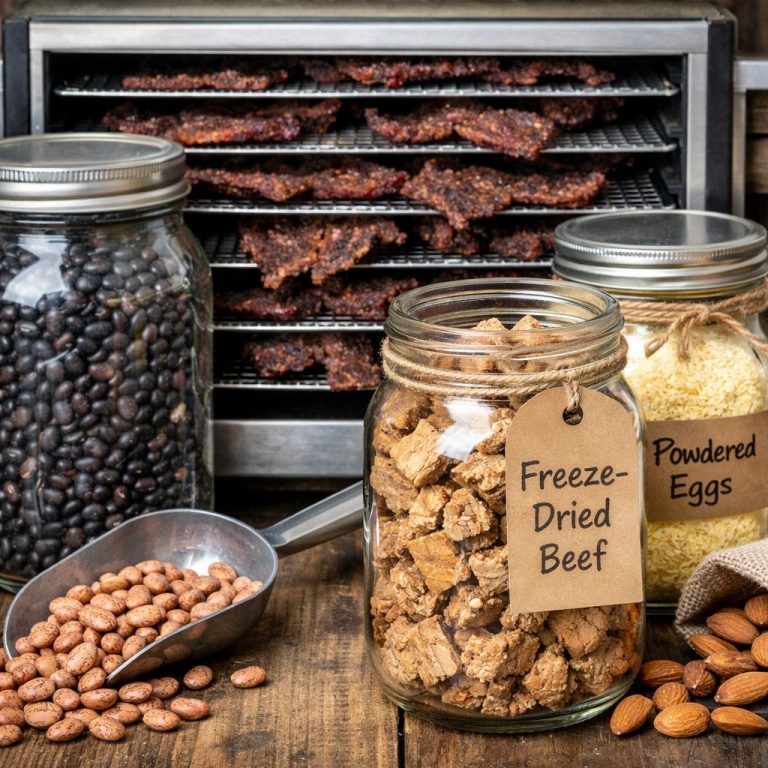
- Dehydrating / Freeze-drying — Fruits, vegetables, herbs, even meats (if you raise/hunt them) can be dried for long shelf life and minimal packaging.
- Fermenting — Sauerkraut, kimchi, fermented vegetables, root ferments — good nutrition, long shelf life, and entirely home-controlled.
- Smoking / Dry Curing — If you raise livestock or hunt, you can smoke or cure meats, creating a non-perishable, long-lasting protein source without relying on processed foods.
These methods also reduce dependence on store-bought processed food — giving you more control, transparency, and resilience, especially in a long-term or collapse scenario.
📦 Rotate & Maintain Your Stock — Know What’s Inside
- Keep an inventory of what you store: mark which items are home-preserved vs store-bought, and note their contents (especially if store-bought).
- Regularly rotate your supplies: use older preserved food sooner, replace with fresh harvests or home-preserved batches.
- When purchasing store items, practice label reading — avoid foods with obvious “at-risk” ingredients (corn oil, soy derivatives, canola oil, sugar from beets, soy lecithin, etc.). Center for Food Safety+2Chiro.org+2
Why This Matters — From a Prepper’s Viewpoint
- Autonomy: Relying on home-grown and home-preserved food means you’re not at the mercy of large food corporations, supply-chain disruptions, or changing ingredient formulations.
- Transparency & Control: You know exactly what went into your food — no hidden soy lecithin, GMO corn starch, or “bioengineered” additives.
- Resilience: In a societal disruption or emergency, access to seeds, preservation skills, and stored food gives you independence, long shelf life, and food security.
- Health & Simplicity: Simple foods, with minimal processing and additives, tend to store well and avoid many of the modern controversies (GMO, excessive preservatives, etc.) — aligning with a self-sufficient, prepper ethic.
Final Thoughts + What Preppers Should Do Right Now
The recent uproar around Campbell’s — an executive disparaging his own company’s products and publicly admitting suspicion over “bioengineered meat” — acts as a trigger for many in the prepping community: a reminder of the fragility of processed food supply, the opacity of corporate food systems, and the importance of preparing our own food sovereignty.
If you haven’t already, treat it as a wake-up call: start auditing what’s in your pantry; begin identifying which items are store-bought vs home-preserved; begin sourcing non-GMO seeds; and dust off your canning jars, dehydrator, or smoker.