
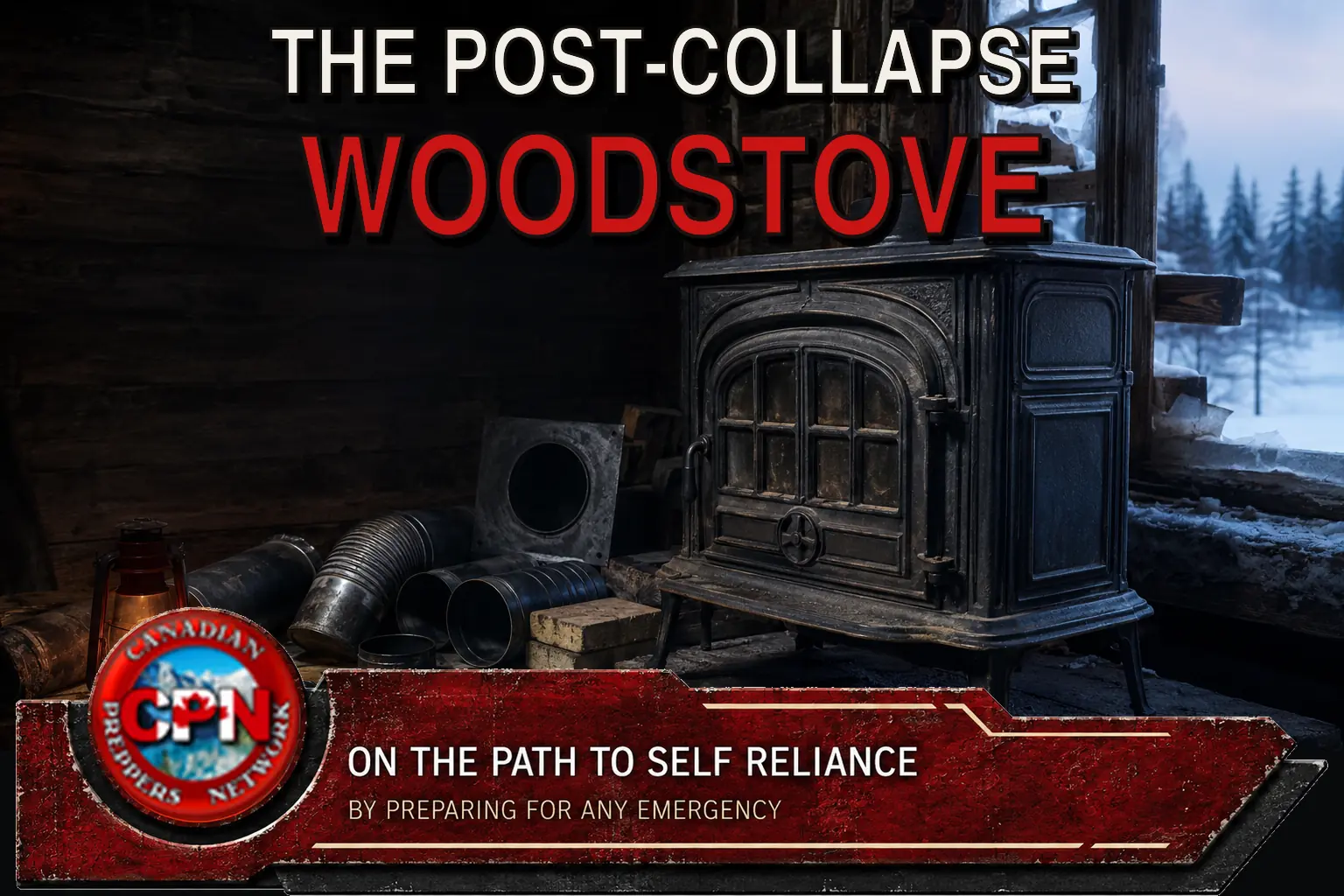
What survives inspection—and what belongs in the scrap pile.
When conventional heating disappears, an old woodstove can look like salvation.
One may be sitting in an abandoned workshop. Another might be pulled from a damaged hunting camp. A neighbour may have an unused stove in a barn, while sections of chimney pipe can be found scattered among several properties.
The temptation is obvious: gather the parts, cut a hole and make heat.
That is also how a cold-weather emergency becomes a structure fire or carbon-monoxide incident.
A woodstove is not a freestanding metal box that can simply be placed in a room. The stove, connector pipe, chimney, floor protection, clearances and building all function as one system. If one part is wrong, the entire system may be unsafe.
The post-collapse question is therefore not simply, “Can this stove burn wood?”
It is, “Can this complete system contain fire, control combustion and carry exhaust safely out of the building?”
Free Canadian Grid-Down Starter Kit
Wood heat is only one part of surviving a prolonged winter outage. Use this printable first-72-hours checklist to assess heat, lighting, fuel, water, communications and household routines before the grid fails.
The Stove Is Only the Beginning
The stove itself is usually the most visible—and frequently the least complicated—part of a wood-heating system.
The chimney is where much of the real risk lies.
A serviceable stove connected to damaged, incompatible or incorrectly routed chimney components is not a safe heating system. Neither is a quality chimney attached to a warped stove with a damaged flue collar or uncontrolled airflow.
Before relying on any recovered equipment, separate the system into five parts:
- The stove body and internal components.
- The door, glass, gasket and controls.
- The connector pipe between the stove and chimney.
- The insulated chimney system passing through the building.
- The hearth, wall protection and surrounding structure.
Each part must be identifiable, complete and compatible with the others.
A pile containing three different brands of chimney pipe is not three-quarters of a heating system. It is a pile of questionable parts.
Start With Identity and History
A stove with a readable model plate, known manufacturer and available manual is considerably more useful than an anonymous iron box.
The manual identifies the chimney requirements, approved configurations, replacement parts and minimum clearances for that particular model. Those measurements must never be guessed from the stove’s appearance or copied from another installation.
Try to establish where the stove came from and why it was removed.
A stove replaced during a renovation may still be serviceable. A stove abandoned after a chimney fire, building fire or severe overfiring deserves immediate suspicion. Missing history does not automatically condemn it, but it removes one more layer of confidence.
Photograph the model plate, serial number and every side of the stove while reliable information and professional assistance remain available. Download and print the manual. Keep the documents with the household’s heating plan.
After communications and supply chains disappear, a printed manual may be more valuable than another random section of stovepipe.
What Should Put a Stove in the Scrap Pile
Surface rust and faded paint do not necessarily mean a stove is finished. Structural damage does.
Reject any recovered stove showing serious defects such as:
- Cracked castings or broken welds.
- A warped firebox or top plate.
- A loose, cracked or distorted flue collar.
- Holes caused by corrosion.
- A door that will not close and latch correctly.
- Missing baffles, firebrick retainers or other essential internal parts.
- Unexplained welded patches or homemade alterations.
- Controls that are seized, broken or incomplete.
- Evidence that the stove has been severely overheated.
Firebrick, door glass and gaskets may be replaceable when the correct model-specific components remain available. They should not be improvised from unidentified materials.
The stove must be judged as a pressure-and-temperature system, not as furniture. Fresh paint cannot restore warped steel, damaged cast iron or compromised welds.
If the stove body cannot be confidently identified and assessed, keep it for metal stock—not household heat.
Treat Unknown Chimney Parts as Contaminated Evidence
Used chimney sections often look acceptable from the outside while concealing damage inside.
Components may have been overheated, crushed during removal, filled with corrosive deposits or exposed to years of moisture. Locking bands and support pieces may be missing. Sections from different manufacturers may appear to fit while not being designed to function together.
Reject chimney components showing:
- Holes, deep corrosion or separated seams.
- Crushing, distortion or out-of-round ends.
- Heat discolouration or evidence of a previous chimney fire.
- Damaged locking connections.
- Wet, loose or exposed insulation.
- Missing identification markings.
- Homemade repairs, screws or brackets that were not part of the system.
- An uncertain history that cannot be resolved.
Ordinary stovepipe, heating duct, vehicle exhaust pipe and other thin metal tubing are not substitutes for an insulated chimney system.
Connector pipe and chimney pipe serve different purposes. Finding a length of pipe that physically fits does not make it suitable for passing through a wall, ceiling or roof.
Do not mix chimney brands or product lines unless the manufacturer specifically identifies them as compatible.
The Building Must Survive the Stove
A woodstove can overheat nearby walls, framing, flooring, stored supplies and furniture long before those materials visibly ignite.
That is why clearances cannot be estimated by holding a hand near the stove or deciding that a wall “doesn’t feel too hot.” Heat exposure accumulates, and combustible materials can become increasingly vulnerable over time.
The correct distances and protection requirements come from the manual for the exact stove and chimney system.
Floor protection must also match the appliance. A decorative sheet of metal laid over a wood floor is not automatically a proper hearth. Some appliances require only ember protection, while others require protection against sustained heat transfer.
The proposed chimney route must be assessed as carefully as the stove location. Hidden framing, wiring, insulation and previous renovations can all complicate what appears to be a direct path through the building.
This is work to complete and have inspected while qualified assistance, replacement parts and building access remain available. A post-collapse winter is not the time to discover that a roof support, wall pass-through or chimney component is missing.
Build the System Before You Need It
The strongest preparedness move is not storing an unidentified stove for some future emergency. It is establishing a complete, documented and regularly used wood-heating system now.
That means:
- Selecting a stove appropriate for the building.
- Retaining its manual and installation records.
- Using one complete, compatible chimney system.
- Having the installation evaluated by a WETT-certified professional.
- Learning the stove’s normal operating behaviour.
- Maintaining the stove and chimney on a regular schedule.
- Storing the correct replacement parts.
- Building a dependable supply of properly seasoned firewood.
- Keeping smoke and carbon-monoxide alarms operational.
- Ensuring fire extinguishers remain accessible.
A stove used occasionally during normal winters provides valuable information. The household learns how quickly the room warms, how the chimney drafts, how much wood is consumed and which areas of the house remain cold.
That knowledge cannot be scavenged after the grid goes down.
Store Parts for Your Stove—not “A Stove”
Generic spare parts are less useful than components selected for the appliance already installed.
A proper wood-heat repair box might contain the correct door gasket, approved adhesive where applicable, spare firebrick sized for the stove, a replacement glass panel obtained from the manufacturer, stove tools, maintenance brushes and printed part numbers.
The point is not to rebuild the stove while it is burning. It is to prevent a minor, predictable failure from disabling the household’s primary heat source when replacements are no longer available.
Never continue operating equipment with a damaged door, broken glass, failed control or compromised chimney simply because the house is cold. Move people into a smaller insulated living zone and use safer backup arrangements until the system can be properly evaluated.
Cold creates urgency. Urgency does not make damaged equipment trustworthy.
Fuel Quality Becomes System Maintenance
Wet wood produces less useful heat and contributes to dirtier operation. Painted, treated, glued or chemically contaminated material should not be burned in a household stove.
A collapsed building may contain an enormous quantity of lumber, but that does not make every board firewood.
Maintain separate piles for:
- Clean, seasoned firewood.
- Newly cut wood requiring further drying.
- Construction material of uncertain origin.
- Painted, treated or manufactured wood that must not enter the stove.
A moisture meter helps remove guesswork. Firewood should be split, checked and organised before deep winter—not discovered under a snowbank when the household is already cold.
Good fuel reduces waste, improves predictable operation and stretches a limited woodpile farther.
Know When the Answer Is No
Preparedness culture values improvisation, but fire does not reward optimism.
If the stove is cracked, the chimney is unidentifiable, the route passes too close to combustible material or essential components are missing, the correct decision is not to “try a small fire.”
It is to reject the system.
The household should then fall back on its cold-house plan: consolidate into a smaller living area, block drafts, protect plumbing, layer clothing and bedding, and relocate if the building can no longer remain safely habitable.
An unusable stove is disappointing. An unsafe stove can destroy the shelter the household was trying to heat.
Amazon Buying Box: Wood-Heat Support Equipment
These products support an existing, properly installed wood-heating system. They are not substitutes for professional assessment or model-specific components.
- Firewood moisture meter
- Magnetic woodstove thermometer
- Heat-resistant fireplace gloves
- Metal ash bucket with lid
- Woodstove tools
- Smoke and carbon-monoxide alarms
- Home fire extinguishers
- Indoor thermometers and hygrometers
As an Amazon Associate, Canadian Preppers Network may earn from qualifying purchases. This does not change the price paid.
Related CPN Reading
- Shelter & Heat in Canada
- Shelter and Emergency Heat Buying Guide
- Dealing With Extreme Cold During a Grid-Down Emergency
- Shelter and Heat Under Winter Stress
Final Thought
The post-collapse woodstove is not the first rusty heater that can be dragged through the door.
It is a complete system prepared before the collapse: known stove, compatible chimney, documented installation, stored parts, dry fuel and household members who understand its normal operation.
Salvaged equipment may provide replacement parts or eventually be restored by someone with the necessary expertise. Until then, the ability to make fire does not prove that a stove is safe enough to heat an occupied building.
When the household’s shelter depends on wood heat, “probably good enough” is not a standard. It is a warning.

2 Comments