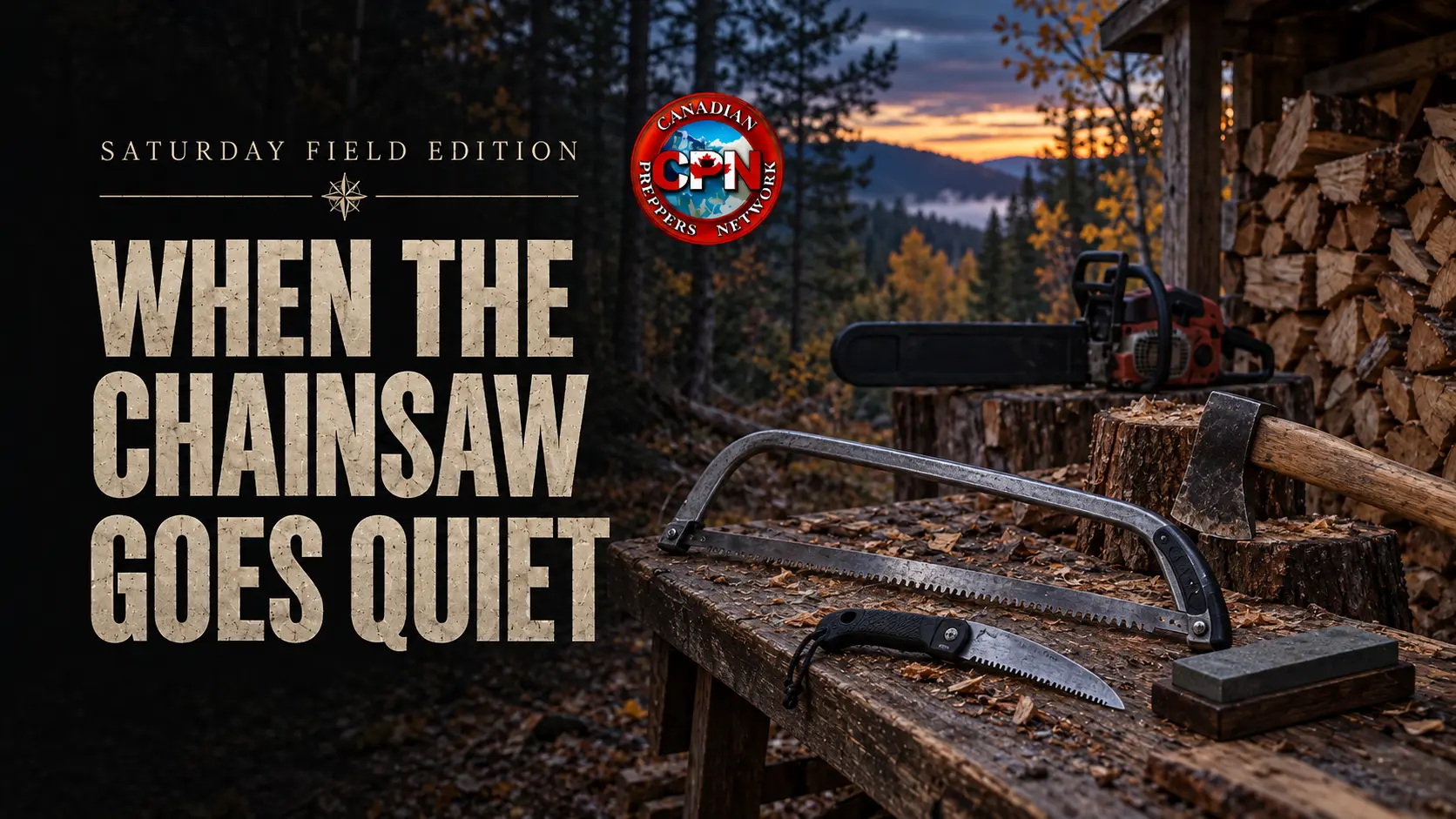
A field guide to cutting tools that keep working after fuel and spare parts run short
The chainsaw quits halfway through the woodpile. Perhaps you still have petrol, but the chain is damaged, the bar is worn or a small part has failed. The dealer is closed. Deliveries have stopped. Cold weather is coming whether you finish the job or not.
An axe hanging in the shed looks reassuring until you calculate what you are asking it to replace.
Cutting a few branches for a cooking fire and preparing a household’s winter fuel are very different workloads. Your backup must match the work, your physical capacity and the tools you can maintain when shopping is no longer an option.
The useful question is not simply which survival axe to buy. It is which combination lets you cut, split and maintain a supply of usable wood without exhausting the people who need that heat.
Separate the jobs before buying the tools
Crosscutting means cutting across the grain to shorten a branch or log. Splitting means opening a piece along the grain. Limbing, carving and making kindling add other demands.
One tool can sometimes do several jobs, but that does not make it equally suitable for all of them.
| Tool | Main role | Limitation to plan around |
|---|---|---|
| Folding pruning saw | Portable branch cutting and modest camp fuel | Limited working length; blade damage can end its usefulness |
| Bow saw | Repeated crosscutting of manageable logs | Frame clearance, blade fit and tension matter |
| General-purpose axe | Chopping, limbing and some splitting | A compromise when bulk firewood is the main task |
| Splitting axe | Splitting stove-length rounds | Not a replacement for a crosscut saw |
| Splitting maul | Heavier splitting work | More weight and fatigue; unsuitable for every user or round |
For a fixed retreat, a saw and a dedicated splitting tool are a sensible foundation. A compact folding saw serves a different purpose: keeping useful cutting capacity with you away from that tool rack.
The folding saw: useful enough to carry
A folding saw earns its place when weight and packed size matter. It can shorten manageable deadwood, trim material for camp repairs and prepare fuel for a small fire without carrying a full workshop.
Choose it around the wood you expect to cut. A pocket-sized blade that handles small branches comfortably can become frustrating when almost every piece approaches its practical limit. Buying the shortest saw merely because it fits a pouch can leave you spending more time and effort on each cut.
Look for a secure blade lock, a grip you can use with gloves and a replacement blade you can actually obtain. Check how much of the blade remains available for a useful stroke around the material you normally cut.
As a size reference, Silky lists its BIGBOY 2000 with a 360 mm blade and a weight of 450 g. That illustrates the difference between a substantial folding saw and a tiny pocket tool; it is not a claim that everyone needs that model. Manufacturer specifications.
The main restraint is workload. A folding saw can be a good companion for a day in the bush without being your preferred tool for weeks of household firewood production.
The bow saw: give the woodpile its own tool
At a retreat or vehicle-accessible camp, a bow saw deserves serious consideration. Weight matters less there than it does on your back, and a longer working blade gives you room for a useful stroke on appropriately sized wood.
A conventional frame can be a practical purchase for a woodshed. A folding frame makes more sense when the saw must travel in a vehicle, canoe or pack. Pay for compactness when you need it.
AGAWA’s BOREAL21 provides a Canadian example: the company lists a 53 cm blade length, 530 g weight and tool-free blade replacement. Its folding bow saws are designed and assembled in Canada using some global components. Product details and manufacturer FAQ.
Do not assume every blade marked with the same nominal length will fit equally well. AGAWA specifically notes that hole-to-hole dimensions affect tension and that other blades may vary in performance.
Buy a spare, install it and make several cuts before treating it as a dependable replacement. A blade still in its wrapper is an untested assumption.
Also check frame clearance. The distance between the blade and frame can limit a cut even when the blade itself seems long enough.
Choose the axe for the work you actually do
The small axe that looks ideal strapped to a rucksack may disappoint beside a pile of stove-length rounds. A heavy maul can be equally disappointing if its user tires quickly or cannot control it comfortably.
Start with your normal work. Are you making kindling, splitting straight-grained rounds or repeatedly tackling difficult wood? Match the tool to that task and to the person swinging it.
If you already have an axe that works well, keep it in the system. Spend the next money on a suitable saw, maintenance equipment or proven spares before buying a second axe for its appearance.
Avoid treating every axe poll as a hammer. Gränsfors Bruk states that, within its range, only the splitting maul’s poll is designed for hammering a wedge; its other axes should not be used as sledgehammers or wedges. Follow the instructions for your particular tool and use striking equipment intended for the job. Axe-care guidance.
The goal is a manageable workload. It is not a contest to swing the heaviest tool or force every knotty round into submission.
The blade that cannot be sharpened
This is an important buying distinction for long-term preparedness.
Some modern saw teeth are hardened for wear resistance and are intended to be replaced when worn. Silky explicitly states that its induction-hardened teeth cannot be sharpened, while blades without that treatment can be filed. Check the exact model rather than making assumptions about an entire brand. Silky’s technical guidance.
A replaceable blade is not a bad choice. It simply needs a different support plan from a blade designed for resharpening.
Before buying, establish whether the saw needs spare blades, sharpening tools or both. If it is resharpenable, identify the correct files and learn the tooth geometry. A traditional saw does not remain effective indefinitely merely because somebody could theoretically sharpen it.
For a retreat, one practical approach is a modern saw with tested replacement blades, supported by a maintainable alternative whose servicing you have already learned. That costs more than a single purchase, so build it in stages around the work you genuinely expect.
Reduce the job before increasing the effort
When motor power disappears, your choice of material becomes more important.
For short-term camp use, select manageable wood that needs fewer cuts. For household heating, protect the stock already cut and seasoned. Do not leave your whole winter plan dependent on harvesting and processing fresh wood after the disruption begins.
Consider an illustrative workload: twenty pieces needing two crosscuts each create forty cuts. That is before moving and splitting anything. A tool that seems perfectly adequate for three demonstration cuts may feel very different partway through that pile.
Run your own trial on safely supported material. Record the wood species, approximate diameter, condition, number of cuts and time taken. Include carrying, splitting and stacking when judging the day’s workload. Leave the stopwatch out of any operation where it encourages rushing.
Do not turn a successful trial into a universal production rate. Dry hardwood, knots, awkward pieces, cold hands and tired users change the result.
Storm-damaged trees, suspended limbs and timber under tension require different skills and carry serious hazards. A backup hand tool does not make those jobs suitable for an inexperienced operator.
Build three kits around three locations
For the pack: choose a folding saw matched to expected material, with its teeth securely enclosed. Add a small axe only when the planned work justifies its weight. A walking kit should help you complete realistic tasks without compromising the rest of what you need to carry.
For the vehicle: consider a larger folding or conventional bow saw, a suitable axe, protected spare blades and the fittings needed to keep the saw working. Secure cutting tools during travel. This kit can support camp chores and manageable cutting tasks; it does not guarantee that you can clear a blocked road.
For the retreat: keep a dedicated crosscutting tool, a splitting tool matched to your users, compatible spares and maintenance equipment. Provide a stable work area and dry storage. If there are multiple capable users, consider whether one missing blade or broken handle would halt everyone’s work.
These kits can share tools while you build them. The important distinction is between what must travel and what can stay where the heavy work happens.
Buy the maintenance kit with the tool
A sensible purchase list extends beyond the blade and handle:
- Correct replacement saw blades, fitted and tested.
- Any model-specific pins, clips, bolts or tensioning parts likely to stop work if lost.
- A suitable axe file and sharpening stone, with protective storage.
- A compatible spare wooden handle and wedges where the axe is designed to be rehandled.
- Blade guards, cleaning supplies and appropriate corrosion protection.
- Printed instructions for adjustment, blade changes and maintenance.
A replacement wooden handle still needs correct fitting. Store-bought compatibility does not remove that skill requirement. Likewise, a composite-handled tool may be durable in use but have different replacement options; check before choosing it as your only long-term tool.
Gränsfors recommends dry storage without excessive heat that could shrink a wooden handle, drying the head and sheath before storage, oiling the head for longer storage and checking regularly that the handle remains secure. Those small routines protect the equipment you already paid for. Manufacturer guidance.
Make the backup earn your confidence
This autumn, complete a realistic wood-processing session with the chainsaw left in the shed. Choose work within your existing skills and use safely supported wood.
Find out which saw fits your workload, which splitting tool your household can control and which spare parts are missing. Change a blade. Inspect a handle. Service an edge. Count the usable fuel produced without pretending the exercise represents a whole winter.
A dependable cutting system is built from suitable tools, maintainable parts, practised skills and wood prepared ahead of need.
If the chainsaw stopped today, how much usable firewood could your household prepare with the tools it already owns?
Turn the lesson into a household check: use the free Canadian Grid-Down Starter Kit to identify the other equipment and supplies your plan depends on.
Related Reading
- Shelter and Heat in Canada — build the wider heating and shelter plan around your fuel supply.
- The Post-Collapse Woodstove — connect wood preparation to the stove that will use it.
- Fire After Three Days of Rain — prepare for the wet conditions that complicate outdoor fire-making.