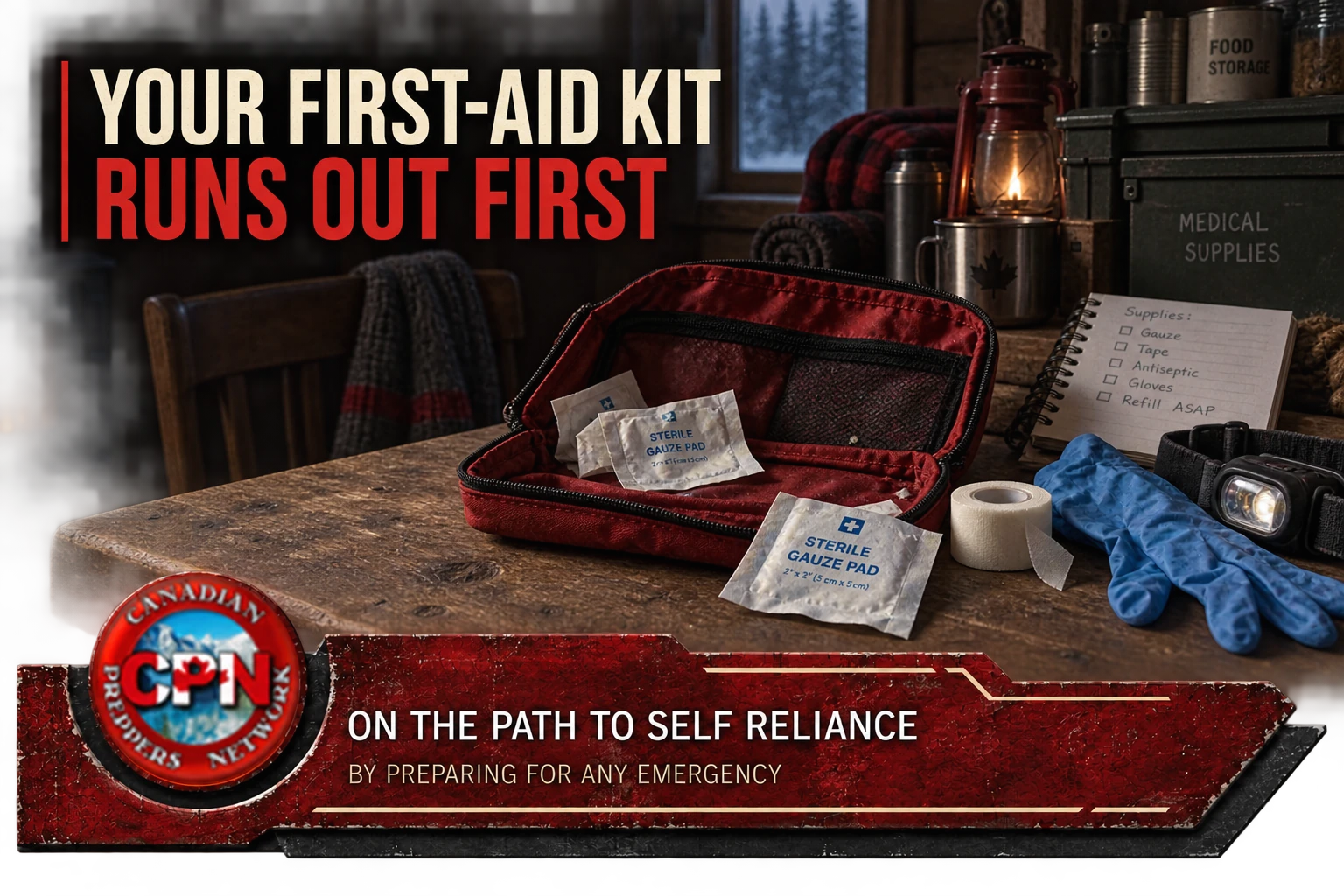
The emergency ends. The need for care does not.
On the fourth day without power, someone slices their forearm while repairing a damaged shed. The bleeding is controlled. The wound is covered. Your first-aid kit has done its job.
By the following week, you are counting the dressings that remain.
Free Canadian Grid-Down Starter Kit
Stress-test your first 72 hours and find the weak points in your household plan before a prolonged outage exposes them. Sign up for CPN preparedness emails and receive the free printable PDF.
That is the medical supply problem many preparedness plans overlook. We buy equipment for the moment someone gets hurt, then give much less thought to the days that follow. During a prolonged collapse, the pharmacy may be empty, roads impassable and professional care difficult to reach.
Your medical stockpile must support repeated care while leaving enough supplies for the next person who gets injured.
Stop counting pieces. Count useful care.
A “300-piece” first-aid kit sounds substantial until you spread its contents across a table. A large share of that number might consist of small adhesive bandages, individual wipes and cotton-tipped applicators. Useful items, certainly, but the number on the label tells you little about how long the kit can support your household.
Ask a different question: What would run out if one person needed care every day for a week?
You might discover that your impressive-looking bag contains only a handful of suitably sized dressings, two pairs of gloves and one narrow roll of tape. There may be plenty left in the bag after those are gone, but very little that solves the problem in front of you.
Separate your inventory into three practical groups:
- Immediate response: supplies for the first minutes of an injury, selected to match your training.
- Continuing care: dressings, gloves, tape and other consumables needed repeatedly.
- Supporting equipment: lighting, washing facilities, bedding, monitoring tools and written records.
A strong first-response kit can still have a very weak reserve.
What one week can consume
Consider a planning exercise involving a minor wound that needs a protective dressing for seven days.
For illustration, assume each dressing change uses one non-adherent pad, two gauze pads, one pair of examination gloves and half a metre of tape. Those quantities are assumptions for stocktaking, not a treatment prescription. Actual needs depend on the wound, dressing product and clinical advice.
| Supply | One change daily for seven days | With three additional changes |
|---|---|---|
| Non-adherent pads | 7 | 10 |
| Gauze pads | 14 | 20 |
| Examination gloves | 7 pairs | 10 pairs |
| Medical tape | 3.5 metres | 5 metres |
Those additional changes could result from a dressing becoming wet, dirty or displaced. For ordinary minor cuts and scrapes, Mayo Clinic advises changing the covering at least daily or whenever it becomes wet or dirty; specialised dressings may have different instructions.
The table does not include the original response, handwashing, wound cleaning, waste bags or anything used by a second caregiver. It also assumes only one injured person.
Seven pairs of gloves means fourteen individual gloves. That distinction matters when checking box quantities.
This exercise exposes the weakness of planning solely around household size. Four people do not necessarily need four identical little kits. They need accessible response equipment and enough reserve supplies to support plausible injuries over time.
Count how many complete care sessions your limiting supply allows. Twenty dressings offer little reassurance if you have enough suitable tape to secure only five.
Build a reserve behind the grab bag
Keep your portable first-aid bag ready to move. Build the continuing-care reserve separately, in clearly labelled containers.
For a household starting with reasonable first-response equipment, the next useful purchases may be thoroughly ordinary:
- Sterile non-adherent dressings in useful sizes.
- Individually packaged gauze pads and appropriate absorbent dressings.
- Roller bandages and medical tape.
- Nitrile examination gloves in sizes household caregivers can wear.
- Soap, hand-drying supplies and a dependable source of clean water.
- Bags for containing used dressings and contaminated waste.
Choose supplies around likely tasks and existing health needs. A household processing firewood, repairing fencing and working a garden should think through those activities rather than copying a military packing list.
Buy depth in the items you understand and can use. A drawer of unfamiliar instruments does not compensate for running out of basic dressings.
Keep a separate training supply. Practise opening packages, securing dressings and locating equipment with those materials so your emergency reserve remains ready.
Support CPN with Gold Membership
Help support independent Canadian preparedness publishing and access Gold member resources, including the monthly intelligence briefing. Put practical preparedness information behind your household planning.
Your water plan is also a medical plan
A medical bag can look complete while depending on a working kitchen tap.
Cleaning hands, rinsing a minor wound, washing around an injury and cleaning the work area all require resources. In an off-grid household, water must be collected, treated where necessary, carried and allocated.
Reserve clean water for care rather than assuming the drinking-water allowance will stretch indefinitely. Keep it in a container that allows controlled pouring without dipping dirty hands or utensils inside.
For minor cuts, established guidance supports rinsing with clean water. Pouring hydrogen peroxide or iodine into the wound is not a substitute for proper cleaning; both can irritate wound tissue. See Mayo Clinic’s guidance on cuts and scrapes.
Set up a modest care station before you need it: a washable surface, good lighting, accessible supplies and a waste container. Keep unused materials away from dirty tools, outdoor clothing and used dressings.
During a Canadian winter outage, choose that location with your heating plan in mind. A beautifully organised medical cupboard in an unheated outbuilding is less useful than supplies accessible from the room where people can actually receive care.
Protect the supplies you already own
Medical reserves need inspection, just like stored food.
Check package seals, expiry dates and manufacturer storage instructions. Look for water damage, crushed packaging, deteriorating gloves and tape that no longer performs properly. A damaged sterile barrier means you cannot assume the contents remain sterile.
Keep the main reserve somewhere dry and within the products’ specified storage conditions. Vehicle kits need particular attention because temperatures vary widely through Canadian summers and winters.
Arrange supplies so older usable stock gets used first. Record quantities by size and type rather than writing “dressings: plenty.”
Use a simple inventory with four columns: item, usable quantity, storage location and replacement point. Whenever something is removed, record it immediately. The half-empty box that everyone assumes is full is a preparedness failure you can prevent today.
Split some reserve supplies between two protected locations. A plumbing leak, fire or hurried evacuation should not automatically take the entire medical stockpile with it.
Build Your Off-Grid Communications Skills
Medical planning also needs a way to request help and exchange information when ordinary communications fail. Prepper Radio Canada offers a self-paced Canadian Basic Amateur Radio Course for Preppers.
The injured person still has a job
The supply bill is only part of the loss.
Someone with a painful hand injury may struggle to carry water, prepare food, operate tools or keep clothing clean. A second person may need to help with those tasks as well as care.
That changes your household’s working capacity.
Build redundancy into essential jobs. More than one adult should understand the water system, heating routine, communications equipment and food-storage arrangements. Make frequently needed items accessible without heavy lifting.
Place a chair at the care station. Keep a headlamp there. Maintain a notebook recording the injury, changes observed, supplies used and any medicines taken. Clear records help caregivers hand over responsibility and provide useful information if professional help becomes available.
Your reserve should buy the injured person a chance to recover. A plan that depends on everyone immediately returning to full manual labour is fragile.
More dressings cannot solve every injury
Preparedness also means recognising when the problem exceeds what you can manage.
Uncontrolled bleeding, a deep or very large wound, an embedded object, loss of feeling or difficulty moving the injured area require urgent professional assessment. Increasing redness, swelling, pain, pus or fever can signal infection. Seek care through whatever functioning services and transport remain available. See NHS guidance on cuts and grazes.
Scarcity does not make those warning signs less serious. Nor does owning closure strips, sutures or antibiotics make every wound suitable for home treatment.
Before disruption occurs, keep first-aid training current, review tetanus protection with a healthcare professional and discuss particular household medical needs. HealthLink BC’s guidance on cuts also distinguishes minor cuts from injuries involving deeper structures that need assessment.
Run the seven-day test
Tonight, choose one plausible minor injury and walk through a week of care on paper.
Identify the supplies used initially, what might be needed repeatedly, where clean water would come from and who would take over the injured person’s work. Do not open sterile packages for the exercise.
Then introduce a complication: three extra dressing changes, a second person needing supplies, or the loss of running water.
Buy to close the first meaningful gap your exercise reveals. Repeat until the plan is workable.
A first-aid kit deserves credit for what it lets you do when someone gets hurt. A medical reserve must also answer the question waiting behind that first response:
What will you use tomorrow—and what will still be left next week?
Extend the exercise to the rest of your household with the free Canadian Grid-Down Starter Kit. Sign up to receive the printable checklist and CPN preparedness emails.
Related Reading
- Medical & First Aid in Canada: build a complete household preparedness plan
- Grid-Down Heating Options Compared: keep your living and care space habitable
Build the Reserve Behind Your First-Aid Kit
Use your seven-day audit to identify the supplies you actually need. These links open Amazon.ca searches so you can compare package quantities, sizes and specifications.
As an Amazon Associate, Canadian Preppers Network earns from qualifying purchases.
- Sterile non-adherent dressings — compare pad dimensions and individually sealed quantities.
- Sterile gauze pads — build reserve depth in useful sizes.
- Nitrile examination gloves — select suitable sizes and distinguish individual gloves from pairs.
- Medical tape and roller bandages — compare widths and total roll lengths.
- Non-digital clinical thermometers — look for a mercury-free model intended for human body temperature and follow its instructions.
- Headlamps for hands-free lighting — match the power source to your household battery plan.
- Water containers with dispensing spigots — select food-safe containers suitable for controlled pouring at a care station.
- Folding cots for a temporary rest space — check weight capacity, stability and room dimensions.
Buy for the gap your audit reveals. Check seller information, product labelling, package integrity and applicable expiry dates. More pieces in a bag do not automatically mean more days of useful care.