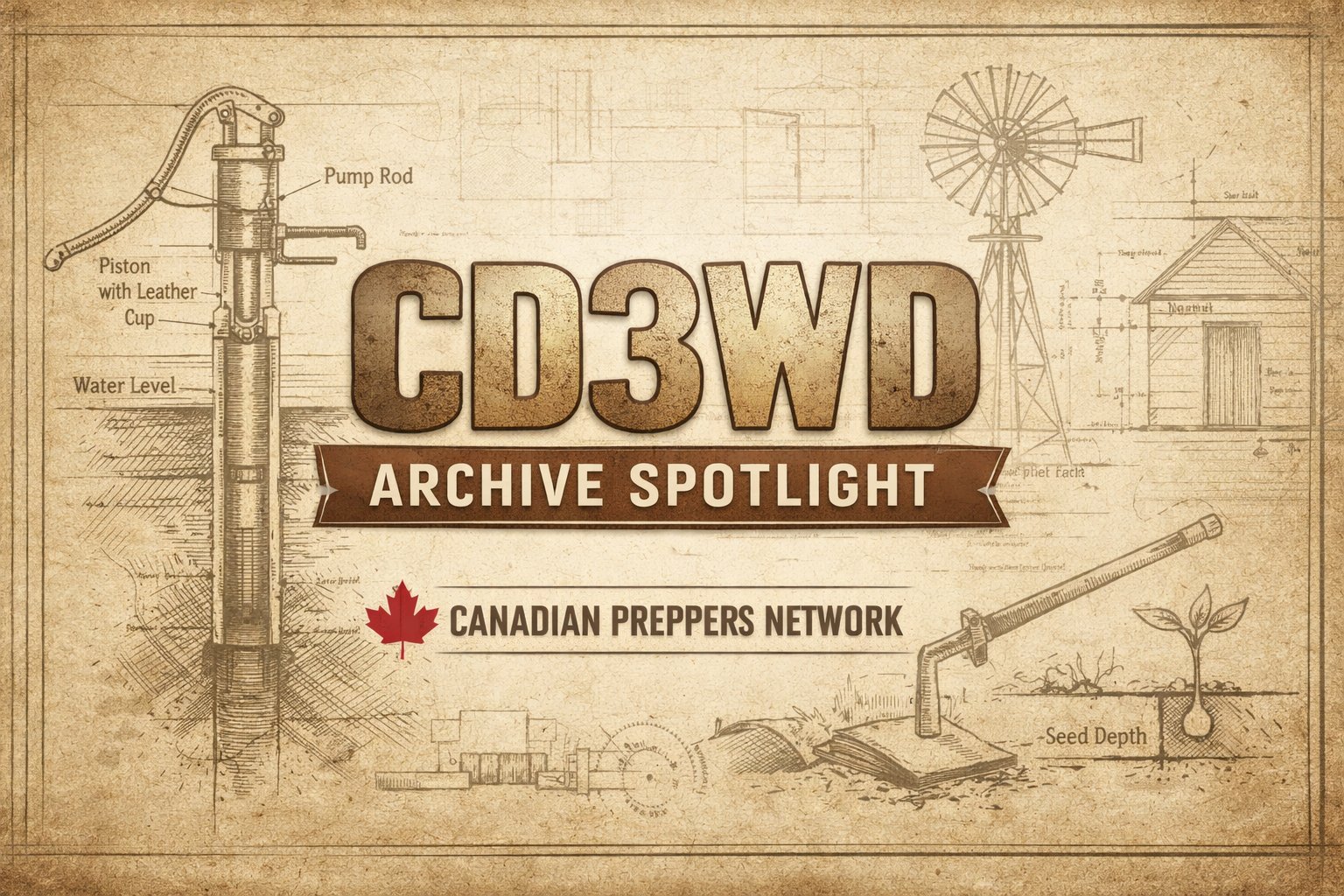
Modern preparedness discussions around water almost always start with purification. Filters, chemicals, boiling methods, snow melt. What gets far less attention is the more basic question of access. Once municipal pressure drops or an electric well pump stops, clean water may still exist underground, but it becomes unreachable.
This is where a specific subset of the CD3WD archive becomes quietly valuable. Buried within the collection are detailed manuals on hand-operated wells and manual water-lifting systems—material originally assembled to preserve practical knowledge in places where electricity, replacement parts, and supply chains were never guaranteed in the first place.
The strength of these documents lies in what they assume. They do not expect power, branded components, or precision-machined parts. Instead, they describe how water has been lifted for generations using simple mechanical principles: pistons, leathers, ropes, pulleys, treadles, and gravity. The emphasis is not on speed or convenience, but on reliability and repairability.
For Canadian preppers, this perspective matters more than many realize. In rural and semi-rural areas, power loss often means more than darkness and cold. It means pressure tanks that will not recharge, pump controls that will not reset, and water systems that fail even though the well itself remains intact. Stored water bridges the gap for a time, but without a way to continue extracting water, storage is a countdown rather than a solution.
The CD3WD manuals approach this problem at its root. They explain how shallow and intermediate-depth wells can be accessed manually, how rope and piston pumps function, and how these systems can be maintained with locally available materials. The designs are intentionally simple, because simplicity is what survives when logistics collapse.
What makes this material especially relevant today is not that most readers will immediately hand-drill a well. It is that understanding how water lifting works at a mechanical level changes how people plan. It informs smarter choices about backup hand pumps, gravity-fed storage, and system redundancy. It also reframes water planning as an ongoing process rather than a one-time stockpile.
Many Gold members treat this section of the archive as reference material rather than a step-by-step project guide. Diagrams are printed and stored. Key pages are annotated. The knowledge becomes something that can be revisited years later, when circumstances, land access, or group size changes. In that sense, the value is cumulative.
This is also why CD3WD fits naturally into long-term preparedness thinking rather than short-term emergency response. It is not about reacting to the next outage or storm. It is about understanding how essential systems function when modern assumptions are stripped away.
Manual water access is not glamorous, and it will never trend on social media. But it solves a problem that remains once filters clog, batteries die, and replacement parts run out. That is why this material continues to earn its place in the Canadian Preppers Network Gold library, and why it belongs in a Saturday spotlight rather than a weekday how-to.