

A core CPN reference guide.
Which backup heat source will actually keep a Canadian home habitable during a prolonged winter outage?
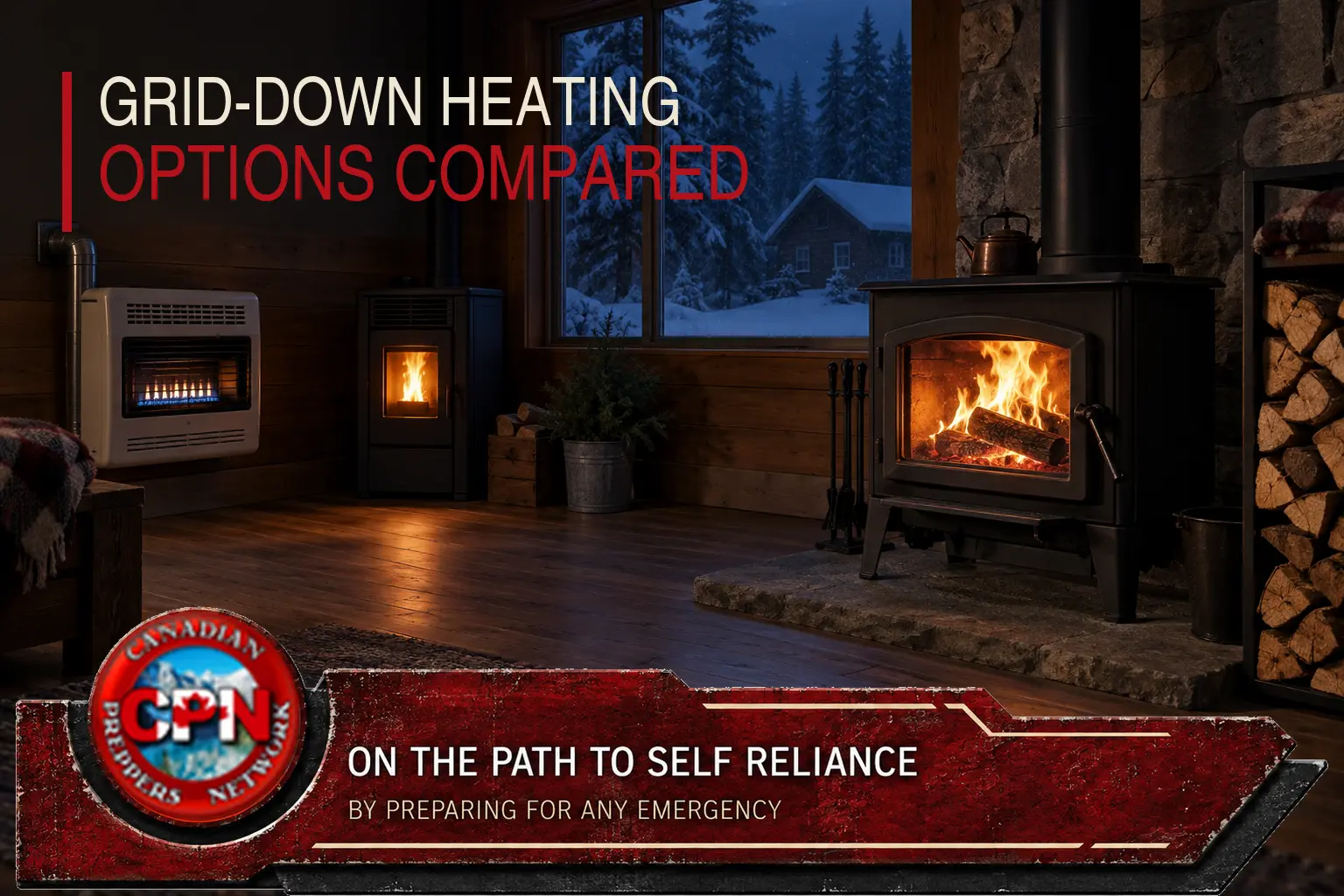
When the electrical grid fails in January, having “backup heat” can mean several very different things. A wood stove can continue producing heat for months if fuel and labour are available. A pellet stove may stop as soon as its electrical supply disappears. A propane heater might work immediately but become useless once its stored fuel is exhausted.
The right system must do more than produce heat during a short outage. It must remain safe, fuelled and repairable after deliveries, utility services and replacement parts become unreliable.
There is no perfect answer for every Canadian home. Rural properties, suburban houses, apartments and remote retreats face different limitations. The most resilient plan is usually a layered one: a dependable primary heat source, a secondary option using a different fuel and a designated warm room that reduces the amount of space that must be heated.
FREE CANADIAN GRID-DOWN STARTER KIT
A heating system is only one part of staying operational when the grid fails. Download the free Canadian Grid-Down Starter Kit and assess your household’s food, water, lighting, communications, sanitation and backup-power plans.
Grid-Down Heating Comparison
| Heating option | Grid independence | Fuel storage | Heat output | Long-term value |
|---|---|---|---|---|
| Wood stove | Excellent | Excellent | High | Excellent |
| Pellet stove | Limited | Good | High | Moderate |
| Vented propane heater | Very good | Very good | Medium–high | Very good |
| Portable propane heater | Good | Very good | Low–medium | Limited |
| Kerosene heater | Good | Good | Medium | Moderate |
| Natural-gas fireplace | Varies | None onsite | Medium | Limited |
| Generator with furnace | Limited | Poor–moderate | High | Short-term |
| Electric space heater | None | Not applicable | Low | Poor |
Wood Stove: The Strongest Long-Term Option
For a detached home or rural retreat, a properly installed wood stove remains one of the strongest grid-down heating options. It requires no electricity, produces substantial heat and uses a fuel that can be acquired locally with basic tools.
Firewood stores well when it is split, seasoned and protected from rain while remaining exposed to airflow. Unlike gasoline or propane, it does not depend entirely on refineries, filling stations or pressurized containers.
Its disadvantages are significant. A safe installation requires a suitable chimney, proper clearances and floor protection. Cutting, splitting, moving and stacking wood demand time and physical labour. A household that has only a decorative pile of firewood may discover that it represents days—not months—of winter heat.
A wood stove also concentrates heat near the appliance. Without powered fans, distant rooms may become cold enough to threaten plumbing. Doorways, gravity-fed air movement and small heat-powered fans can help distribute warmth, but the household may still need to retreat into a smaller occupied area.
Best suited for: Rural homes, retreats and detached houses with adequate wood storage.
Primary weakness: Installation requirements and the enormous volume of fuel needed for an entire winter.
Pellet Stove: Efficient but Electrically Dependent
Pellet stoves offer controlled combustion, consistent heat and convenient fuel handling. Bagged pellets are compact, relatively clean and easier to move than split firewood.
Their central weakness is electrical dependency. Most pellet stoves require power for an auger, combustion fan, exhaust fan and electronic controller. When electricity disappears, the stove normally stops even if the hopper is full.
This does not make a pellet stove useless for preparedness, but it changes its classification. It is a fuel-burning heater with a modest electrical support requirement—not a completely grid-independent appliance.
A battery power station can keep these relatively small electrical loads working for a limited period. Runtime depends on the stove’s measured wattage, startup surge, battery capacity and inverter losses. Solar panels or a generator may extend that runtime. The battery is supporting the stove; it is not producing the heat.
Pellets also depend on manufacturing and distribution. Once the stored supply is consumed, most owners cannot produce replacements at home.
Best suited for: Homes wanting efficient heat with stored fuel and a dedicated backup electrical plan.
Primary weakness: Electrical and mechanical complexity.
Vented Propane Heater: Reliable Stored-Fuel Heat
A permanently installed direct-vent propane heater can provide dependable backup heat without requiring a traditional chimney. Some models operate without household electricity, while others need power for controls, ignition systems or blowers. This must be confirmed for the specific appliance rather than assumed.
Propane stores for long periods without degrading like gasoline. Larger exterior tanks can hold a meaningful heat reserve, and the fuel requires little physical labour compared with firewood.
The limitation is resupply. In a widespread or prolonged collapse, propane deliveries may stop. Once the tank is empty, the system becomes dead equipment. Owners should measure their consumption before the emergency and treat every stored litre as a finite resource.
Best suited for: Homes needing low-maintenance backup heat with substantial onsite fuel storage.
Primary weakness: Complete dependence on a finite, commercially supplied fuel.
CPN GOLD MEMBERSHIP
Move beyond general preparedness advice with exclusive reports, supporting resources and deeper analysis for serious Canadian preppers.
Portable Propane Heater: Useful but Limited
Portable propane heaters are attractive because they are inexpensive, compact and quick to deploy. They can be valuable for heating a designated room during an outage, but they should not be confused with a whole-house heating system.
Only an appliance specifically approved for the intended indoor setting should ever be used indoors. Every manufacturer requirement concerning ventilation, clearances, connections and cylinder placement must be followed. A heater consuming oxygen inside an occupied space introduces risks that a permanently vented appliance avoids.
Small cylinders disappear quickly under sustained use. Larger cylinders improve runtime but create additional storage, connection and placement considerations. Battery-backed carbon-monoxide alarms are essential around any combustion appliance.
Best suited for: Short outages and emergency warm-room use with an appropriate indoor-rated appliance.
Primary weakness: Limited output, fuel consumption and indoor-combustion concerns.
Kerosene Heater: Substantial Portable Heat
A proper kerosene heater can produce more useful room heat than many small propane units while operating without electricity. Fuel can be stored onsite, and the heater can be moved to the occupied portion of the house.
Kerosene requires disciplined fuel handling. Only the fuel specified by the manufacturer should be used, and the heater must be allowed to cool before refuelling. Ventilation and maintenance are critical. Odour, soot or poor combustion can indicate a problem with the fuel, wick, adjustment or airflow.
Fuel availability varies considerably across Canada. A system is not resilient if its fuel cannot be obtained locally. Before selecting kerosene, determine where it can be purchased, how much can be stored safely and how quickly the heater consumes it.
Best suited for: Households with reliable kerosene supplies and safe fuel storage.
Primary weakness: Regional fuel availability and the demands of operating a portable liquid-fuel appliance indoors.
WEAR THE NETWORK
Support independent Canadian preparedness content while representing the Canadian Preppers Network. Visit the CPN merchandise shop for branded clothing and gear created for Canadian preppers.
Natural-Gas Fireplace: Better Than Nothing, but Not Independent
Some natural-gas fireplaces can operate during a power failure, particularly systems with a standing pilot, millivolt controls or battery-backed ignition. The circulating blower may not operate, reducing how effectively heat spreads. Other fireplaces will not function without electricity.
Even when it operates perfectly, a natural-gas fireplace still depends on the gas network. That network may continue working through an ordinary outage, but it cannot be treated as an independent fuel supply during a prolonged infrastructure failure.
It is a useful first layer when already installed. It is not the same as storing fuel under your own control.
Best suited for: Short and moderate electrical outages while gas service remains available.
Primary weakness: Dependence on an external utility network.
Generator-Powered Central Heating
Running electric resistance heaters from a generator is generally a poor use of stored fuel. A typical portable space heater consumes approximately 1,500 watts while producing heat for only one room.
Using a generator to operate the electrical components of an existing gas, propane or oil furnace can make much more sense. The generator powers the controls, igniter, blower or circulation pump while the furnace’s fuel produces the heat.
The home must have a safe, properly arranged method of connecting the required circuits. A generator must never be operated inside a house, basement, attached garage or other enclosed area. Improvised backfeeding can injure occupants, damage equipment and endanger anyone working on the electrical system.
This solution remains limited by generator fuel, oil changes, noise, maintenance and mechanical wear. It is excellent for bridging a short disruption but difficult to sustain through an entire winter without a substantial fuel reserve.
Best suited for: Maintaining an existing fuel-burning furnace during temporary power failures.
Primary weakness: Fuel consumption, noise and long-term maintenance.
Electric Space Heaters: A Heavy Load, Not a Grid-Down Plan
An electric heater is simple and effective while electricity remains available. During an outage, however, it becomes a very demanding appliance.
A standard 1,500-watt heater running for eight hours consumes 12 kilowatt-hours. That is beyond the practical daily capacity of many portable battery systems, especially after inverter losses and reduced cold-weather performance are considered.
Stored electricity is far more valuable when reserved for communications, lighting, medical equipment, pellet-stove components and furnace controls. Converting scarce battery capacity directly into resistance heat should normally be a last resort.
Best suited for: Normal grid operation or very short generator-supported use.
Primary weakness: Extremely high electricity consumption.
The Warm Room: The Option Every Household Needs
The easiest space to heat is the space you stop trying to heat.
During a prolonged outage, close unused rooms and concentrate the household in one carefully selected area. Choose a room that is small, centrally located and separated from large windows and exterior doors where possible.
Add temporary window coverings, door sweeps, rugs and insulated curtains. Hang heavy blankets across open doorways, but keep every combustible material well away from heaters, stovepipes and fireplaces. Move essential supplies into the room before conditions deteriorate.
The objective is not summer comfort. It is to maintain a safe occupied area while conserving fuel. Bedrooms and unused rooms can be allowed to cool, but plumbing in exterior walls, basements and other vulnerable areas must be monitored.
Passive measures cannot create heat, but they can dramatically reduce how much heat must be produced. More planning information is available through the CPN Shelter & Heat Hub.
Estimate the Heat Required
A professional heat-loss calculation accounts for insulation, air leakage, windows, ceiling height and local winter temperatures. For preliminary preparedness planning, use this rough estimate:
Room area × estimated heating factor = required BTU per hour
- Well insulated: 30 BTU per square foot
- Average insulation: 45 BTU per square foot
- Poor insulation or severe exposure: 60 BTU per square foot
For a 250-square-foot room with average insulation:
250 × 45 = 11,250 BTU per hour
Add a 20 per cent planning margin:
11,250 × 1.20 = 13,500 BTU per hour
This rough calculation does not replace proper appliance sizing. It provides a useful starting point when comparing heater output and deciding whether a proposed warm room is realistic.
Build a Layered Heating Plan
A resilient household should avoid depending on one appliance, one fuel or one delivery system. A strong arrangement could include:
- A wood stove or permanently vented propane heater as the principal grid-down system.
- A portable propane or kerosene heater as a secondary option where appropriate.
- A generator or battery system reserved for furnace controls, pumps, fans or pellet-stove operation.
- A prepared warm room that reduces fuel consumption.
- Battery-backed smoke and carbon-monoxide alarms.
- Enough stored fuel to cover a defined period based on measured consumption.
The correct question is not simply, “Which heater produces the most heat?” It is, “Which system can we fuel, operate, maintain and use safely after outside support disappears?”
For many rural Canadian homes, wood offers the greatest long-term independence. For suburban properties, a vented propane appliance with substantial stored fuel may be more practical. Pellet stoves offer efficient heat when paired with dependable backup electricity, while generators are best used to support an existing fuel-burning furnace rather than resistance heaters.
Whatever system is selected, test it before winter. Measure its actual consumption, confirm which components require electricity and practise converting the home to warm-room operation. Discovering those limitations during a January blackout is far too late.
GRID-DOWN HEATING ESSENTIALS
These supporting items help households monitor conditions, detect combustion hazards and operate backup-heating equipment more safely.
- Battery-powered carbon-monoxide detectors
- Indoor/outdoor thermometers
- Firewood moisture meters
- Heat-powered wood-stove fans
- Fire-resistant hearth rugs
- Propane tank gauges
Compare additional equipment in the CPN Shelter and Emergency Heat Buying Guide.
As an Amazon Associate, Canadian Preppers Network earns from qualifying purchases.
Related CPN Reading
- Shelter and Emergency Heat Buying Guide
- Shelter and Heat Fail Faster Than Anything Else
- Fall Maintenance Audit for Canadian Homes
- Manual Energy When the Grid Is Gone
JOIN THE DISCUSSION
What is your primary grid-down heating system, and how long could you operate it using only the fuel currently stored on your property?


6 Comments