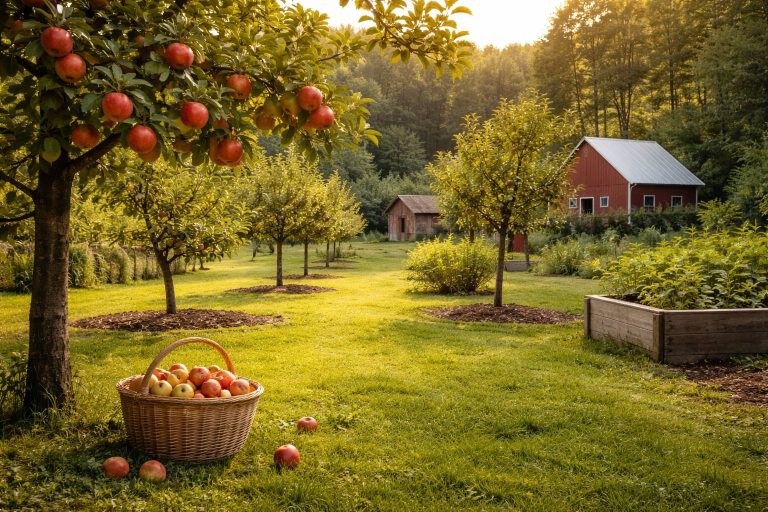
Turn this year’s harvest into an honest food-security audit before planning next season.
A garden can look enormously successful in August. Baskets of tomatoes cover the counter, zucchini appear faster than anyone can eat them, and photographs of the harvest make the season feel productive.
Then comes the uncomfortable question:
How long would that garden have actually fed your household if the grocery stores had remained empty?
That cannot be answered by counting jars, seed packets, raised beds or wheelbarrows of produce. It requires measuring edible weight, useful calories, storage losses, saved seed, outside inputs and labour.
Most gardeners never perform that calculation. They judge success by appearance, taste or how much produce they gave away. Those are perfectly reasonable measures for a recreational garden, but they do not tell you whether the garden is becoming dependable food infrastructure.
Before ordering next year’s seeds, conduct an honest harvest audit.
Harvest Photographs Hide the Real Numbers
A table covered in lettuce, tomatoes, herbs and summer squash looks impressive. It may provide excellent nutrition and improve household meals, but its calorie contribution can be surprisingly small.
A less photogenic harvest of potatoes, dry beans or storage squash may provide considerably more usable energy. It can also remain edible long after frost has destroyed the garden.
This does not make tomatoes, greens or herbs worthless. Fresh vegetables provide nutrients, flavour and variety that stored staples often lack. The mistake is treating every kilogram of produce as though it contributes equally to long-term food security.
A preparedness garden must be judged in several ways:
- How much edible food did it produce?
- How many usable calories did it provide?
- How much remained after spoilage and processing?
- How long could the harvest be stored without electricity?
- Could the crop be planted again from saved seed?
- How dependent was production on purchased fertilizer, fuel, plastic or replacement parts?
- How many hours of labour were required?
- What failed when conditions became difficult?
Published yield estimates can provide rough planning targets, but even agricultural specialists caution that variety, spacing, irrigation, pest pressure, weather and production methods can change results dramatically. Your own records are the figures that matter most on your property. Penn State’s crop-yield research explains why results from one production system cannot simply be assumed for another, while the University of Minnesota recommends using a farm or garden’s own historical yield data for future planning.
Step One: Measure Food, Not Garden Activity
Hours spent weeding are not a harvest. Neither are the number of plants set out in May or the number of seed packets opened.
Begin with the food that actually reached the kitchen, pantry, freezer, root cellar or drying rack.
- Record the area planted.
- Record the number of plants or length of row.
- Weigh the total harvest.
- Weigh the edible portion after trimming and cleaning.
- Separate what was eaten fresh from what was preserved or stored.
- Record losses to pests, disease, overripening and spoilage.
- Record seed retained for next season.
- Estimate the labour hours invested.
- List the purchased inputs required.
Do not count stems, spoiled produce or vegetables left in the garden as food. If ten kilograms of damaged potatoes produce only seven kilograms suitable for eating or planting, seven kilograms is the number that belongs in the audit.
A basic kitchen scale handles small harvests. A hanging or platform scale is more practical for crates, sacks and larger quantities.
Step Two: Convert the Harvest Into Calories
Weight alone can be misleading. Ten kilograms of tomatoes and ten kilograms of dry beans are not remotely equivalent as survival food.
Use a reliable nutrition database such as USDA FoodData Central to find the approximate calories per 100 grams for each crop in the condition in which it will be stored or eaten. Raw potatoes, cooked potatoes and dehydrated potato flakes have very different weights because their water content differs. Dry beans must be recorded as dry beans—not as their heavier cooked weight.
Harvest-calorie calculation
Edible kilograms × calories per kilogram = total harvest calories
Here is an illustrative harvest using rounded food-energy values:
| Crop | Edible Harvest | Approx. Calories/kg | Harvest Calories |
|---|---|---|---|
| Potatoes | 25 kg | 770 | 19,250 |
| Winter squash | 12 kg | 450 | 5,400 |
| Carrots | 10 kg | 410 | 4,100 |
| Tomatoes | 15 kg | 180 | 2,700 |
| Dry beans | 2 kg | 3,330 | 6,660 |
| Total | 64 kg | — | 38,110 |
The precise values will vary by crop, variety and edible portion. The example is a planning demonstration, not a dietary recommendation or universal food table. It shows why a large harvest by weight may still represent a relatively small energy reserve.
At an illustrative planning figure of 2,200 calories per adult per day, 38,110 calories represents roughly seventeen adult food-days before losses. For a household of four using the same planning figure, it represents slightly more than four household-days.
That is the reality the harvest photograph does not show.
Step Three: Calculate What Survives Storage
Food is not secure merely because it crossed the kitchen threshold.
Some is eaten immediately. Some spoils before processing. Some jars fail to seal. Potatoes sprout or rot. Squash develops soft spots. Rodents find poorly protected stores. Freezer contents become vulnerable when electricity fails.
Storage requirements also differ sharply between crops. Properly handled winter squash may remain useful for months, while ripe tomatoes have a much shorter untreated storage life. Temperature, humidity, bruising and variety all affect the outcome. The University of Minnesota’s vegetable harvesting and storage guide illustrates how widely those storage conditions and expected lifetimes vary.
Your audit therefore needs two calorie totals:
- Gross harvest calories: everything edible when harvested.
- Retained calories: what remains usable after processing, storage and spoilage.
If you did not track losses this season, enter an estimate but label it honestly. Do not quietly treat an assumption as measured performance.
Using a provisional 15 per cent loss against the example harvest would leave approximately 32,400 calories. That reduces the four-person household reserve to less than four days.
Next season, inventory stored produce monthly. The difference between October’s count and February’s count will provide a much more useful storage-loss figure.
Step Four: Do Not Count Next Year’s Seed as Food
A crop that can reproduce is more valuable than a crop that must be repurchased every spring—but only if seed is actually collected, dried, labelled and stored correctly.
Seed retained for planting should be removed from the edible-calorie calculation. This may feel unnecessarily strict when the quantity is small, but it establishes an important principle:
The portion required to restart production is not part of the current food surplus.
Record the variety, whether it is open-pollinated or hybrid, the amount saved, the harvest year, storage conditions, expected planting quantity, a reserve for germination failure and any isolation or selection problems that could affect seed quality.
Stored seed is not automatically viable seed. A small germination test during winter can reveal whether the reserve is dependable before planting time.
Step Five: Expose Purchased-Input Dependence
A garden can produce food and still fail as a preparedness system.
Imagine an excellent potato harvest that depended on purchased seed potatoes, commercial fertilizer, pumped municipal water, replacement drip fittings, gasoline-powered tilling and a fungicide obtained at the last minute.
The potatoes are real. The ability to repeat the harvest after supply chains fail is less certain.
Give every crop an input-dependence score:
- 0 — Locally repeatable: saved seed or propagated stock, on-site fertility, manual tools and dependable local water.
- 1 — Minor dependence: one purchased input that could realistically be replaced.
- 2 — Significant dependence: several outside inputs or powered systems are required.
- 3 — Fragile: production is unlikely to continue without normal retail and utility services.
This score should not be used to pretend that complete independence is easy. It is meant to identify the first broken link.
If irrigation requires an electric well pump, determine how water would be lifted and distributed during an extended outage. If fertility depends on bagged products, begin building compost, manure-handling or other appropriate soil-management capacity. If a favourite variety cannot be reproduced reliably, maintain an open-pollinated alternative.
The objective is not purity. It is reducing single points of failure.
Step Six: Measure Labour Before Expanding
Garden plans often assume that more space automatically produces more security.
More space also requires more planting, watering, weeding, harvesting, processing and soil improvement. During a prolonged emergency, those jobs compete with hauling water, cutting fuel, cooking, repairs, security, communications and caring for other people.
Labour-efficiency calculation
Retained calories ÷ labour hours = useful calories per labour hour
The figure will be imperfect, especially in the first year, but it exposes crops or methods consuming excessive effort for little return.
Include the hours spent on bed preparation, seed starting, planting, watering, weeding, pest control, harvesting, trimming, preservation, storage inspection and seed saving.
Do not automatically remove every labour-intensive crop. Some provide vitamins, medicinal value, flavour, animal feed or valuable seed. The point is to recognize the workload rather than assuming it will somehow be absorbed during a crisis.
Step Seven: Measure the Ground
Once retained calories are known, calculate what each growing area produced.
Retained calories ÷ square metres planted = retained calories per square metre
This allows a fair comparison between beds.
A sprawling crop that looks productive may be using ground that could produce more dependable food. Conversely, a crop with moderate calories might deserve its space because it stores well, tolerates poor weather, supplies livestock feed or fills a seasonal gap.
| Crop | Calories/m² | Storage | Labour | Input Dependence | Seed Repeatability | Decision |
|---|---|---|---|---|---|---|
| Crop A | High | Long | Moderate | Low | Good | Expand |
| Crop B | Low | Short | High | High | Poor | Reduce |
| Crop C | Moderate | Long | Low | Low | Good | Retain |
| Crop D | Low | Short | Low | Low | Good | Keep for nutrition |
This prevents calories from becoming the only measure while still refusing to ignore them.
The Seven-Day Paper Test
Before planning next year’s garden, perform one final exercise.
On paper, create seven days of realistic meals using only what the garden produced and what remains in storage. Do not actually restrict your diet. This is a planning test, not a stunt.
Write down every outside ingredient required:
- Cooking oil or animal fat
- Flour or grain
- Salt
- Sugar
- Protein
- Herbs and spices
- Fuel for cooking
- Clean water
- Canning and preservation supplies
- Animal feed used to produce eggs, milk or meat
The missing ingredients reveal what the garden cannot presently provide.
For many households, fat will be one of the largest gaps. Others will discover that they grew plenty of sauce ingredients but little starch or protein. Some will have substantial frozen food but no credible way to protect it through a long outage.
That missing-food list may be more useful than next year’s seed catalogue.
Decide What Earns Space Next Year
Expand
Increase crops that produced useful calories, stored reliably, performed under local conditions and can be reproduced with manageable inputs.
Repair
Keep crops that have strong potential but suffered from a correctable problem such as poor soil, inadequate spacing, late planting, weak storage or unreliable irrigation.
Reduce
Cut back crops that consumed excessive space or labour without providing enough food, nutrition or another clearly defined benefit.
Retain for Quality
Keep a deliberate amount of lower-calorie produce for nutrition, flavour, morale and meal variety. A calorie-first garden does not need to become a field of nothing but potatoes. It needs to know why each crop is present.
The result should be a balanced system: calorie crops, protein sources where feasible, nutrient-dense vegetables, storage crops, seed-producing varieties and some foods people genuinely enjoy eating.
One Good Season Proves Almost Nothing
A single harvest is evidence, but it is not a guarantee.
Weather changes. Pests arrive. Illness interrupts work. Stored seed performs poorly. A crop that thrived one year may fail the next.
Keep the audit for several seasons. Your records will eventually reveal which crops are dependable, which storage methods work in your building, how much labour your household can sustain and where outside inputs remain unavoidable.
That knowledge cannot be purchased during an emergency.
A survival garden is not measured by how impressive it looks in August. It is measured by how many meals remain in February—and whether you possess the seed, soil, water, tools and experience to produce them again.
Before ordering anything for spring, weigh what you grew, calculate what survived and decide which crops truly earned another season.
Which crop looked productive this year but failed to earn its space once you considered calories, losses and labour?
Related Reading
- Homestead Skills in Canada: build practical production, preservation and repair capability
- Garden Planning for Food Security: design around calories, storage and reliability
- The Last Seed Packet: keep a crop alive when replacement seed is gone
Make the Audit a Yearly Rule
Store the finished audit with the seed inventory and next year’s garden map. When winter planning begins, expand crops because the numbers support them—not because the catalogue photograph is attractive.
Repeat the same measurements every year. Three seasons of honest records will teach more about the property’s real food-production capacity than any generic yield chart.