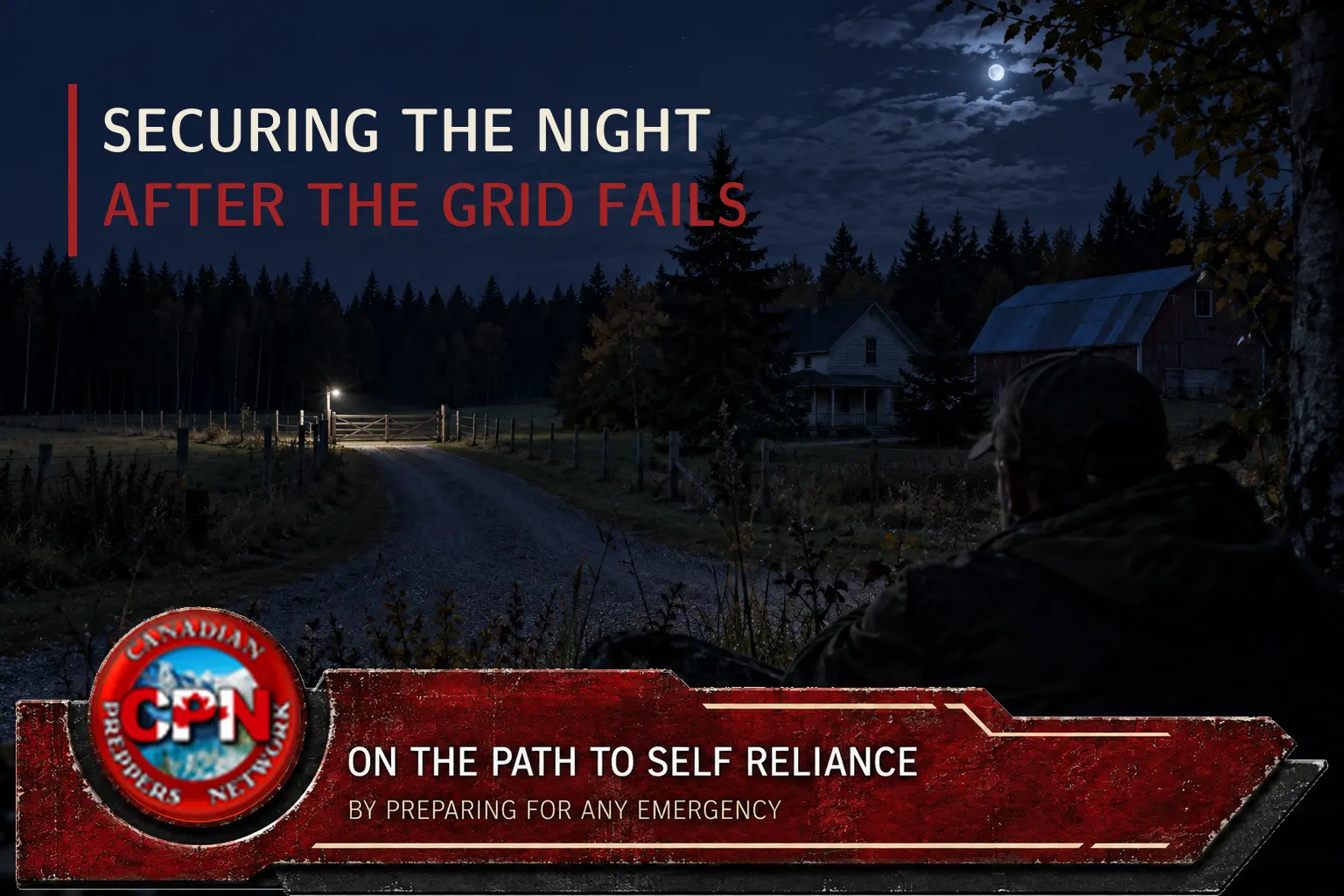
Darkness becomes an advantage only when you have prepared to use it
When the electrical grid fails, night changes almost immediately.
Streetlights disappear. Houses go dark. Security cameras stop transmitting once their batteries and internet connections fail. Familiar roads become difficult to navigate, and ordinary sounds carry farther through quiet neighbourhoods. Anyone using a flashlight, lantern or illuminated window can be seen from a surprising distance.
FREE CANADIAN GRID-DOWN STARTER KIT
Find the weak points in your first 72 hours before a real emergency exposes them. Download the free Canadian Grid-Down Starter Kit from Canadian Preppers Network.
During the first evening, most people will treat the blackout as an inconvenience. They will search for candles, check their phones and wait for the power to return. If the outage continues, however, darkness begins to affect how people behave.
Unprepared households become increasingly visible as they run generators, move between buildings with bright flashlights and advertise their remaining supplies. Prepared households face a different challenge: maintaining security without revealing everything they have worked to protect.
Night security after a prolonged grid failure is not about turning your home into a fortress. It is about detecting trouble early, controlling your own light and noise, and ensuring everyone in the household knows what to do before someone appears at the door.
Darkness Works Both Ways
A dark property is more difficult for an outsider to evaluate. From the road, they may not know whether the house is occupied, how many people are present or whether anyone is watching. That uncertainty can be valuable.
The advantage disappears when someone opens a brightly lit door, walks across the yard carrying a powerful flashlight or starts a generator beside the house. A single uncovered window can reveal the location of people, supplies and interior rooms.
Light discipline does not require sitting silently in complete darkness. It means controlling where light goes and when it is used.
Blackout curtains should prevent indoor lighting from being visible outside. Pay particular attention to basement windows, bathroom windows, glass doors and rooms on upper floors. Light escaping through a small gap can be visible from farther away than expected.
Inside the home, use the lowest practical level of illumination. Red or dimmable lights can help preserve night vision, although even a red light remains visible outside. Headlamps should have a low-output setting so they do not flood an entire room every time someone turns their head.
Before darkness falls, complete as many outdoor tasks as possible. Bring in firewood, refuel equipment, secure livestock, check gates and move vehicles while there is still daylight. Every unnecessary trip outside after dark creates noise, movement and exposure.
Build Warning Time Into the Property
The worst time to discover someone is approaching is when they are already standing beside the house.
A useful security plan creates distance between the first warning and the occupied building. That warning does not need to rely entirely on electronic equipment.
Locked gates, gravel approaches, dogs, manually positioned bells and battery-powered driveway alarms can all provide notice that something is moving through the property. Solar motion lights may remain useful after the grid fails, but they must be positioned carefully. A light that illuminates the intruder while leaving the observer in darkness is useful. A light mounted above your own doorway may expose you instead.
Avoid improvised traps or anything that could injure a neighbour, family member, emergency worker or returning member of your group. Warning devices should alert you, not indiscriminately harm whoever activates them.
Walk the property during daylight and identify the most likely approaches. These may include the driveway, a trail from an adjacent property, a tree line, a drainage ditch or the path between the house and an outbuilding.
Then inspect those same approaches at night. You will often discover blind areas that were not obvious during daylight. A shed may hide movement from the house. A woodpile may provide concealment. Vegetation may prevent anyone inside from seeing the gate. Correcting these problems before a crisis is usually easier than trying to compensate with more equipment.
PREPPER RADIO CANADA
When ordinary communications fail, radio skills become part of your security system. Learn amateur radio through a Canadian course built specifically for preppers.
Establish a Night Watch
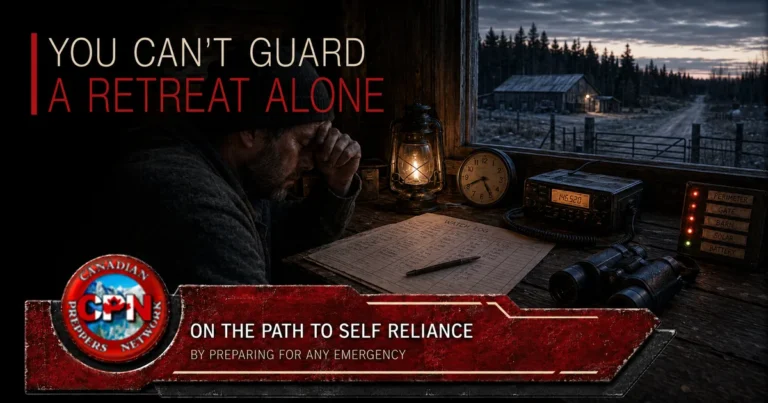
One exhausted person staring out a window for six hours is not an effective security system.
If conditions justify maintaining a watch, divide the night into manageable shifts. The length will depend on the number of capable adults available, the weather and the seriousness of the threat. Two-hour shifts are often more realistic than expecting someone to remain alert for half the night.
The person on watch should have a clearly defined job:
- Monitor the most likely approaches.
- Listen for vehicles, footsteps, voices, dogs or unusual animal behaviour.
- Check warning devices at planned intervals.
- Record anything unusual.
- Wake the designated decision-maker when necessary.
- Avoid confronting anyone alone unless immediate action is required to protect life.
Observation positions should be dark, protected from the weather and located away from illuminated rooms. Avoid standing directly in front of a window. Reflections from interior lights can make it almost impossible to see outside while leaving the observer visible to anyone looking in.
Binoculars can be useful even at night when there is moonlight, snow cover or distant ambient light. A handheld thermal viewer or night-vision device provides a greater advantage, but it should be treated as one layer of security rather than a replacement for disciplined observation.
Cold is another concern. A person who is uncomfortable, shivering or repeatedly leaving a position to warm up will not remain attentive. Keep appropriate clothing, a chair, water, a quiet snack and communications equipment at the watch position.
Use Challenge Words and Duress Codes
In darkness, silhouettes are difficult to identify. People returning from a neighbouring property, an observation point or a supply run should not have to approach the house and announce their names loudly.
Establish a simple challenge-and-response system. The person guarding the entrance gives a predetermined challenge word. The approaching person provides the correct response. Both words should be unrelated and changed regularly.
Challenge: Cedar
Response: Lantern
The system should be simple enough to remember under stress but not so obvious that an outsider could guess it. Avoid using family names, street names or words connected directly to your location.
A separate duress code can warn that a returning person is being watched, coerced or accompanied by someone they do not trust. The code must sound natural enough that it can be used without alerting the other person.
The household must decide in advance what receiving the duress code means. Locking the entrance, moving vulnerable people to a protected room and observing before responding may be appropriate. The code is useless if everyone recognizes it but nobody knows what action follows.
Control Doors and Visitors
A knock at the door during a prolonged emergency creates both a moral and security decision. The person outside may genuinely need help. They may also be gathering information, testing whether the home is occupied or trying to force an entry once the door opens.
Do not make the decision while standing with your hand on the doorknob.
Create a way to speak with visitors without opening the primary barrier. This may involve a locked gate, an intercom, a camera operating on local power or a protected speaking position away from the main entrance.
Never illuminate yourself while questioning someone who remains hidden in darkness. If lighting is used, it should illuminate the approach and the visitor, not the people inside.
One person should communicate while another observes. Keep the conversation calm and direct:
- Who are you?
- Where have you come from?
- What do you need?
- Is anyone else with you?
- Why did you approach this property?
Offering limited assistance does not require allowing someone inside. Water, basic first-aid supplies or information can be passed across a controlled boundary when circumstances allow. During a widespread crisis, generosity must be balanced against the safety of everyone already depending on the household’s resources.
CPN GOLD MEMBERSHIP
Move beyond general preparedness advice with exclusive reports, member resources and deeper monthly analysis for serious Canadian preppers.
Keep Communications Quiet
Shouting between the house, barn and observation point reveals positions and tells outsiders how many people are present.
Small handheld radios can keep members connected, but radio discipline matters. Use earpieces where practical, keep volume low and avoid unnecessary conversation. Assume anyone with compatible equipment may be able to hear an unencrypted transmission.
Use simple location names and status words that make sense to your group without broadcasting a detailed description of the property.
A check-in schedule prevents constant radio traffic. If the watch reports at the top and bottom of each hour, everyone knows when to expect contact. A missed check-in should trigger a predetermined response rather than a series of increasingly loud radio calls.
Keep at least one non-electronic backup. A whistle, bell, coloured card or agreed series of knocks can communicate basic warnings if radios fail.
Protect Your Night Vision
Human eyes require time to adapt to darkness. A sudden burst of white light can destroy that adaptation in seconds.
Assign specific lights for specific purposes:
- A low-output headlamp for indoor movement.
- A covered lantern for a work area.
- A focused flashlight for identifying something outside.
- A brighter light reserved for emergencies.
- Spare batteries stored where they can be found in darkness.
Do not allow everyone to use high-output flashlights indiscriminately. Light sweeping across windows, walls and neighbouring properties reveals activity and makes it harder for your own people to see.
If someone must investigate a sound, they should pause and listen before using a light. Moving immediately toward every noise with a flashlight announces exactly where the observer is located.
Canadian winters add another complication. Snow reflects moonlight and artificial light, making movement easier to see but also making the household more visible. Fresh tracks can reveal patrol routes, storage locations and the number of people moving between buildings. Vary routes when practical and inspect the property from outside its boundary to understand what those tracks disclose.
Decide What Triggers a Response
Not every noise requires waking the entire household. At the same time, hesitation can waste the warning time your security system was designed to create.
Routine: Normal watch conditions. Gates are secured, lights are controlled and scheduled checks continue.
Caution: An unexplained noise, distant light, activated sensor or unfamiliar vehicle. A second person is awakened, exterior movement stops and the property is observed.
Alert: Confirmed people approaching, repeated testing of the perimeter or an attempted entry. Everyone moves to assigned positions, vulnerable household members go to the protected area and communications are maintained.
Immediate danger: Forced entry, fire or a direct threat to life. The household follows its emergency response and evacuation plans.
The purpose of these levels is to replace confusion with predictable action. Every member of the household should understand where to go, who makes decisions and which exit to use if remaining in the building becomes unsafe.
Any defensive response must remain lawful and focused on protecting life. Avoid chasing unknown people into darkness or leaving a defensible position to investigate something that can be observed safely from a distance.
Night-Security Buying Box
BUILD A PRACTICAL NIGHT-SECURITY KIT
Buy equipment that improves detection, controlled movement and quiet communication. Test every item under realistic blackout conditions before depending on it.
- Blackout curtains and window coverings
- Battery-powered driveway alarms
- Low-output headlamps with red-light mode
- Handheld two-way radios and earpieces
- Solar motion-sensor lights
- Low-light binoculars
- Rechargeable batteries and chargers
As an Amazon Associate, Canadian Preppers Network may earn from qualifying purchases. This does not change the price you pay.
Practise Before You Need It
A plan that has never been tested is mostly a collection of assumptions.
Choose an evening and shut off the household’s main lights. Cover the windows, issue the equipment and operate for several hours as if the grid had failed.
Can you move around without exposing light outside? Can the person on watch hear someone approaching? Do the radios reach the outbuildings? Can everyone remember the challenge word? Can a household member find the protected room without turning on a hallway light?
The exercise will expose missing batteries, noisy doors, poor sightlines and instructions that sounded clear during daylight but become confusing in darkness.
Correct one problem at a time. Night security is built through familiarity and discipline, not by purchasing one expensive device.
Related Reading
Build the System Around People
Cameras, alarms, radios and night-vision equipment can extend what people are capable of doing. None of them will decide whether a noise matters, calm a frightened household or recognize that a familiar voice is using the duress code.
The foundation of night security is a group that understands the plan.
When the grid fails, darkness will conceal both danger and opportunity. A prepared household uses that darkness to reduce its visibility, increase its warning time and avoid being surprised.
The objective is not to dominate the night. It is to remain quiet, observant and difficult to approach without detection until daylight returns.