
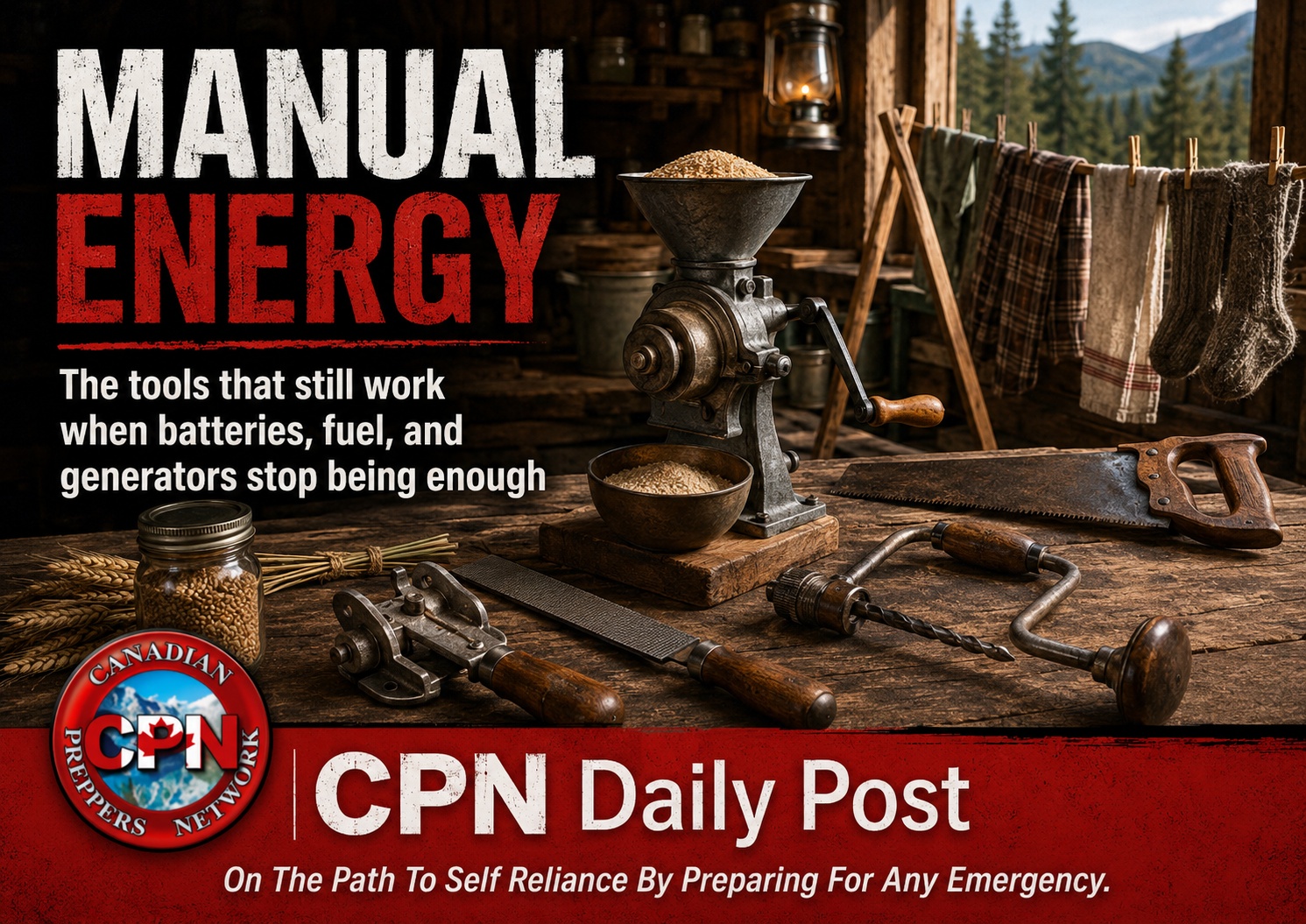
The tools that still work when batteries, fuel, and generators stop being enough
Most people think of energy preparedness in terms of adding more power.
More solar panels. Bigger batteries. Larger generators. Extra fuel cans. Portable power stations. Inverters. Extension cords. Charge controllers. Backup chargers.
There is nothing wrong with any of that. A good electrical backup system can keep radios running, lights on, batteries charged, tools working, medical devices supported, and refrigeration alive during the early stages of a grid failure. But there is a trap hidden in that thinking. If every useful job around the home depends on electricity, then every outage becomes a race against stored power.
The smarter question is not always, “How do I generate more electricity?”
Sometimes the better question is, “Why does this job need electricity at all?”
That is where manual energy comes in.
Manual energy is not a gimmick. It is not nostalgia. It is not about pretending life was easier in the old days. It is the deliberate use of human-powered, mechanical, non-electric tools to remove pressure from your electrical system. Every task you can do by hand is one less task draining your battery bank, one less load on the generator, one less reason to burn fuel, and one less failure point in a long emergency.
That matters in a Canadian preparedness plan. Winter storms, ice damage, wildfire evacuations, fuel shortages, rural outages, supply-chain failures, and prolonged grid instability all punish households that depend on powered convenience for every basic function. The home that can only cook, pump, grind, cut, charge, open, repair, and preserve food with electricity is not off-grid ready. It is grid-dependent with a few backup batteries.
Preparedness begins with load reduction. The Canadian Preppers Network Energy Production hub makes that point clearly: the first layer of energy preparedness is not production, but reducing what must be powered in the first place.
Manual tools are part of that reduction.
The Forgotten Side Of Energy Planning
A generator can run a freezer. A solar setup can charge batteries. A power station can keep lights and radios working. But all of those systems have limits.
Fuel runs out. Batteries age. Solar output drops under cloud, snow, shade, smoke, and short winter days. Inverters waste power. Cords break. Electronics fail. Charge ports loosen. Proprietary cables disappear exactly when you need them. Even good equipment becomes fragile when every household task is stacked on top of it.
Manual systems change the equation because they do not compete for the same limited power.
A hand-crank grain mill does not care whether the battery bank is full. A manual can opener does not care whether the inverter is running. A brace and bit does not care whether the cordless drill packs are charged. A hand pump does not care whether the pressure system is down. A paper notebook does not care whether the tablet battery is dead. A clothesline does not care whether the dryer works. A broom does not care whether the shop vac is available.
That sounds simple because it is simple. But simple is not the same as unimportant.
In a short outage, manual backups are convenient. In a long outage, they become energy infrastructure.
Electricity Should Be Reserved For What Only Electricity Can Do
The most disciplined off-grid households do not waste electricity on jobs that can be done another way. They protect electrical power for high-value uses.
Communications. Lighting. Battery charging. Essential medical equipment. Security sensors where appropriate. Water movement when no manual option exists. Refrigeration while the food plan is being adjusted. Critical tools. Information storage. Small electronics that support coordination and decision-making.
That kind of prioritization is hard if the household is full of powered convenience devices and no manual alternatives.
A battery bank that is used to charge radios and LED lights can last a long time. A battery bank that is used to run blenders, mixers, grinders, coffee makers, fans, entertainment devices, power tools, kitchen gadgets, and convenience appliances will not last nearly as long.
This is why manual energy should be planned before the outage, not improvised during it.
Look around the house and ask a brutal question: what routine tasks currently require electricity only because convenience made them that way?
Opening cans. Grinding grain. Making coffee. Mixing dough. Sharpening tools. Drilling holes. Cutting material. Pumping small amounts of water. Drying clothes. Preserving food. Cleaning floors. Recording inventory. Reading instructions. Lighting a room. Cooking a meal.
Many of those jobs have non-electric options. Some are cheap. Some are not. Some require skill. Some require practice. All of them reduce demand on the power systems that matter most.
The Manual Kitchen Is A Power-Saving System
The kitchen is one of the first places electrical dependency shows up.
Modern kitchens are packed with small appliances that make normal life easier but grid-down life more fragile. Coffee grinders, electric can openers, mixers, blenders, food processors, dehydrators, bread machines, induction burners, microwave ovens, electric kettles, vacuum sealers, and powered dishwashing systems all assume stable electricity.
A prepper kitchen does not have to reject those tools. It does need alternatives.
A manual can opener should be considered mandatory. Not one buried in a drawer and forgotten, but a sturdy one that is tested and kept where people can find it. A household with shelves of canned food and no reliable manual opener has made a ridiculous mistake.
A hand grinder can keep coffee, grains, spices, and small dry goods usable when powered grinders are unavailable. A manual grain mill becomes more important if the household stores wheat berries, corn, oats, or other whole grains. Whole grains often store better than flour, but they only help if you can process them.
Manual mixing tools, dough whisks, hand beaters, heavy spoons, kneading boards, and proper bowls are not glamorous, but they keep basic food preparation moving. In a long emergency, the ability to turn stored staples into actual meals matters more than having a perfect solar array on paper.
This also connects directly to grid-down cooking. If the plan is to cook without grid power, the prep work should not depend on grid power either. The article Cooking When the Grid Is Gone covers that side of the problem.
The manual kitchen is not just about food. It is about preserving the battery bank for things the kitchen cannot do by hand.
Food Preservation Without Plugging Everything In
Food preservation is another area where powered systems create hidden vulnerability.
Freezers are excellent until they are not. Electric dehydrators are useful until the power is limited. Vacuum sealers are handy until the bags, heating strip, or power supply become the weak point. Freeze dryers are powerful tools, but they are not field equipment and they are not low-energy devices.
A resilient household uses layers.
Canning still requires proper equipment, heat, jars, lids, and tested methods, but it does not require an electric appliance if the heat source is appropriate and safe. Drying can be done with sun, airflow, screens, racks, and patience when conditions allow. Root-cellaring, sand storage, fermentation, salting, smoking, and cool storage all have their place depending on the food, climate, and household skill level.
Solar drying is a perfect example of manual energy thinking. It uses sunlight, airflow, and time instead of grid power. It is not always fast. It is not suitable for every food in every condition. But it reduces electrical demand and preserves food using a system that can keep working when the wall outlet is useless.
For a deeper look at that skill, see Solar Drying of Foods — A Forgotten Skill Worth Relearning.
That is the mindset worth building: not one perfect method, but overlapping methods that do not all fail at the same time.
The No-Power Workshop
The workshop is where many preparedness plans quietly collapse.
A property owner may have cordless drills, circular saws, grinders, battery chargers, air compressors, shop vacs, powered sharpeners, electric pumps, and every attachment imaginable. That is useful in normal times. It is also a major electrical dependency.
A no-power workshop does not mean abandoning power tools. It means having the ability to repair, modify, cut, fasten, drill, sharpen, measure, and maintain without them.
Hand saws matter. Files matter. Clamps matter. Brace-and-bit drills matter. Hand drills matter. Manual sharpeners matter. Wrenches, pliers, screwdrivers, hammers, chisels, planes, drawknives, rasps, squares, levels, measuring tapes, and vises matter. So do spare handles, fasteners, cordage, wire, adhesives, sandpaper, oil, and basic hardware.
The point is not speed. The point is continuity.
A cordless drill is faster than a brace and bit. A circular saw is faster than a hand saw. A bench grinder is faster than a file. But when batteries are dead, fuel is scarce, and the generator is being saved for higher-value work, slow tools beat dead tools.
This is especially important on rural properties, homesteads, retreats, and bug-out locations. Gates break. Handles loosen. Stove parts need adjustment. Hinges sag. Tarps need frames. Animal housing needs repair. Water systems need patching. Tools need handles. Shelves need reinforcement. A household that cannot repair without electricity becomes dependent on outside help at exactly the wrong time.
The Homestead Skills in Canada hub ties directly into this. No-power repair is not a hobby category. It is part of household resilience.
Manual Water Movement
Water is one of the hardest areas to generalize because every property is different.
Some households depend on municipal pressure. Some use wells. Some have shallow wells, drilled wells, cisterns, rain barrels, ponds, creeks, lake access, livestock waterers, pressure tanks, sump pumps, or gravity-fed systems. Some have no realistic manual option without major changes.
That is exactly why the question should be asked before the emergency.
How much water can you access if the power is out?
Not theoretically. Not with a generator. Not after you buy another part. Right now.
Can you dip from stored barrels? Can you draw from a cistern? Can you use a hand pump? Can you move water with buckets, carts, siphons, or gravity? Can you filter water without electricity? Can you carry enough for people, animals, cooking, sanitation, and cleaning? Can older family members do it? Can the system work in winter?
A powered pump is excellent until it is not powered. A manual pump, gravity system, stored water supply, and practical water-hauling setup can reduce the electrical demand dramatically.
The goal is not to make water effortless. The goal is to make it possible.
Human Power Has Limits
Manual energy is useful, but it is not magic.
People get tired. People get injured. Cold weather makes work harder. Heat makes work dangerous. Older adults may not be able to grind grain, haul water, split wood, or use heavy hand tools for long periods. Repetitive manual work can cause strain. A tool that works well for ten minutes may be miserable after an hour.
That means manual systems need to be realistic.
Choose tools that suit the people who will use them. Mount tools securely. Keep blades sharp. Use proper handles. Build work surfaces at useful heights. Store tools where they are accessible. Practise before the emergency. Do not assume that owning a manual grain mill is the same as knowing how to use it for a week of meals.
This is one of the biggest differences between preparedness and collecting.
A collection sits on a shelf. A system gets used, tested, adjusted, and maintained.
Manual Does Not Mean Primitive
There is a bad habit in modern preparedness circles of treating manual tools as primitive and electrical systems as advanced. That is not the right way to look at it.
A good manual tool is advanced in a different way. It is repairable. Understandable. Durable. Independent. Quiet. Often portable. Often immune to software, charging protocols, proprietary batteries, and electronic failure.
A manual grain mill with replaceable parts is not primitive when the electric grinder is dead. A hand saw is not primitive when the battery packs are frozen. A clothesline is not primitive when the dryer cannot be powered. A printed binder is not primitive when the tablet has no charge. A hand pump is not primitive when the pressure pump is offline.
Preparedness is not about having the most modern tool. It is about having the tool that still works under the conditions you are actually planning for.
That does not mean rejecting solar, batteries, generators, or efficient electronics. It means making them last longer by not wasting them on jobs that can be done mechanically.
Start With A Household Energy Audit
The best way to build manual energy into a preparedness plan is to walk through the house and list routine electrical tasks.
Do not start with gear. Start with jobs.
How do you open food? How do you make coffee? How do you grind grain? How do you mix dough? How do you dry clothes? How do you sharpen tools? How do you drill holes? How do you cut wood? How do you pump or move water? How do you preserve food? How do you clean floors? How do you cook? How do you light rooms? How do you track inventory? How do you communicate when devices are low?
Then sort those tasks into three categories.
First, tasks that truly need electricity. Those deserve protected power.
Second, tasks that can be done manually with the right tools and practice. Those should have manual backups.
Third, tasks that are mostly convenience and can be dropped during an emergency. Those should not be allowed to drain critical systems.
This audit often reveals something uncomfortable. Many households do not need a bigger power system as badly as they need fewer powered dependencies.
Buying Box: Manual Energy Tools
As an Amazon Associate, Canadian Preppers Network may earn from qualifying purchases.
A manual energy setup does not need to be bought all at once. Start with the jobs your household depends on most, then replace the weakest electrical assumptions first.
Manual grain mills
Useful for households storing wheat berries, corn, oats, or other whole grains.
Search manual grain mills on Amazon.ca
Heavy-duty manual can openers
A basic but essential backup for any household storing canned food.
Search heavy-duty manual can openers on Amazon.ca
Manual coffee grinders
A small comfort item, but also a good example of removing pointless electrical demand.
Search manual coffee grinders on Amazon.ca
Hand drills and brace-and-bit sets
Useful for no-power repair work when cordless tools are dead or being conserved.
Search hand drills and brace-and-bit sets on Amazon.ca
Hand saws and pull saws
Quiet, repairable cutting tools for basic workshop and property maintenance.
Search hand saws and pull saws on Amazon.ca
Manual sharpening files and tool sharpeners
Dull tools waste human energy. Sharpening gear belongs with the tools themselves.
Search manual sharpening files and tool sharpeners on Amazon.ca
Clotheslines and drying racks
Simple, low-cost ways to remove laundry drying from the power budget.
Search clotheslines and drying racks on Amazon.ca
Hand-crank emergency chargers
Limited output, but useful as a last-ditch supplement for small devices and radios.
The Final Takeaway
Manual energy is not about rejecting electricity. It is about respecting its limits.
In a real emergency, every watt has a job. Some watts keep radios alive. Some keep lights on. Some protect food. Some move water. Some support medical needs. Some keep tools, phones, and small devices operating long enough to make decisions.
Those watts should not be wasted on tasks that a simple manual tool could handle.
A strong energy plan includes generation, storage, wiring, safety, and fuel. But it also includes can openers, hand drills, grain mills, clotheslines, hand pumps, saws, files, printed records, and the skill to use them.
The household that can do more without electricity needs less electricity to survive.
That is manual energy.



One Comment