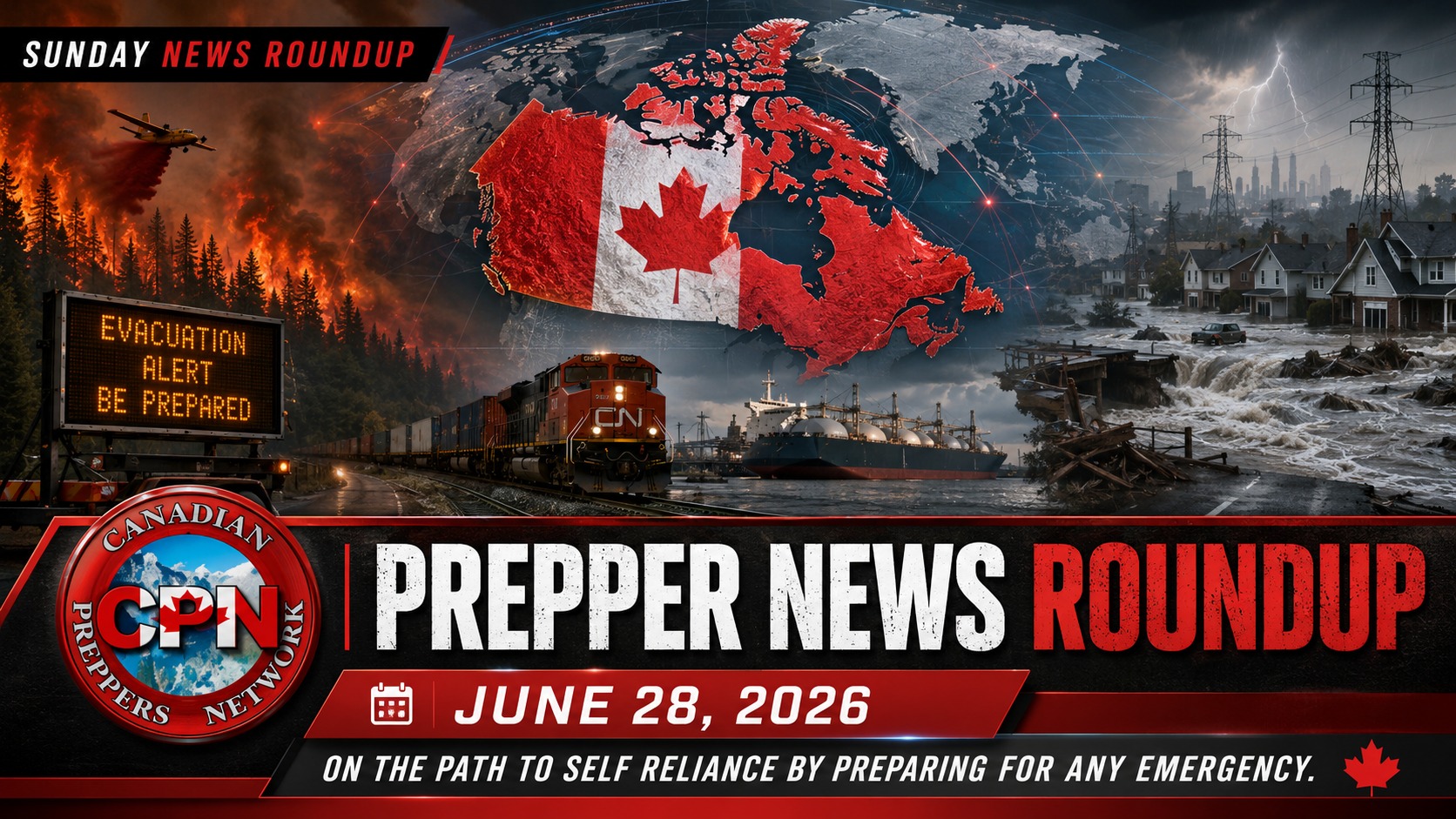
Evacuations, strained infrastructure, food recalls, and distant wars with local consequences
The point of a prepper news roundup is not to chase fear. It is to look at real events from the past week and ask a simple question: what would this mean if it happened closer to home?
This week’s stories are a good reminder that emergencies rarely arrive in neat categories. A flood risk in British Columbia, wildfire alerts in the Northwest Territories, food recall notices, rail disruptions in Europe, flash flooding in Kentucky, and renewed military action in the Middle East may look unrelated at first glance. From a preparedness perspective, they all point toward the same larger truth: systems are fragile, warning time is often short, and the people who are already organized have a much easier time responding.
B.C. Glacier Flood Risk Forces an Evacuation Order
One of the most preparedness-relevant Canadian stories this week came from the Squamish-Lillooet Regional District, where the evacuation alert for the Poole Creek and Gates Lake area was upgraded to an evacuation order on June 25 due to the risk of a Place Glacier outburst flood.
This is not the kind of flood many people imagine. It is not just heavy rain pooling in a low spot or a river slowly creeping over its banks. A glacial lake outburst can release water, sediment, and debris suddenly, creating dangerous flow conditions with very little practical time to react once the event begins.
That matters for preppers because evacuation orders are often misunderstood. Many people treat an evacuation alert as an early rumour and an evacuation order as the moment to start packing. That is backwards. The alert stage is when the vehicle should already be fuelled, documents should be gathered, pets and livestock should be planned for, medications should be packed, and the destination should be decided.
The actual order should be the moment you leave.
This story also highlights the importance of local geography. A household does not need to live beside an ocean or a major river to face flood risk. Mountain valleys, creeks, culverts, forest roads, landslide zones, and old drainage paths can all become part of the hazard. Preparedness begins by knowing the specific threats around your own property, not by relying on broad regional assumptions.
Fort Simpson Moves to Evacuation Alert as Wildfire Grows Nearby
In the Northwest Territories, Fort Simpson moved to evacuation alert on June 26 after a wildfire developed south of the community and west of the airport. Reports described air tanker work, structure-protection preparations, and continued concern even after early suppression efforts appeared to limit the fire’s growth.
There are two practical lessons here.
The first is that rain does not always remove fire risk. Residents had seen a storm move through the area, yet lightning from that same system helped trigger the fire. A soaking rain in one place can exist alongside dry fuels, lightning strikes, wind shifts, and rapid fire growth nearby. Weather can help, but it can also create the next problem.
The second lesson is that airports, roads, and staging areas matter. In northern and remote communities, an evacuation alert is not just about families getting ready to drive out. It is also about whether aircraft can operate, whether roads remain usable, whether fuel is available, and whether outside help can get in before conditions deteriorate.
For individual households, this means preparedness cannot stop at a plastic tote in the basement. A proper evacuation plan should include multiple routes, communications options, fuel discipline, cash, printed maps, and a realistic plan for what happens if the preferred route or destination is unavailable.
Lytton Recovery Shows That “All Clear” Does Not Mean “Back to Normal”
Lytton was also back in the news this week as evacuation orders and alerts connected to the Saw Creek wildfire were downgraded to all clear for the Thompson-Nicola Regional District and the Village of Lytton. The Village also reported that the boil-water notice affecting Lytton and parts of Lytton First Nation was rescinded as of June 24.
That is good news, but it should not be mistaken for a simple return to normal.
An all-clear notice means the immediate emergency condition has eased enough for people to return or stand down from evacuation status. It does not mean every road, utility, water line, communication system, or personal routine has fully recovered. After a fire, there can still be damaged infrastructure, unstable slopes, contaminated water concerns, smoke impacts, insurance complications, and weeks of practical cleanup.
The preparedness lesson is that evacuation planning needs two halves. Most people think about leaving. Fewer think about returning.
Before going home after an evacuation or fire-related water notice, households should be prepared to verify water safety, inspect food storage, check refrigerators and freezers, document damage, test communications, and restock the supplies that were burned through during the alert period. Recovery is part of preparedness, not a separate category.
B.C. Shows Overlapping Emergencies in the Same Province
British Columbia’s emergency dashboard this week showed the kind of overlap that makes emergency management difficult. Flood-related evacuation action was active in one area while wildfire-related orders and alerts remained part of the broader provincial picture.
That overlap matters. A province does not get to handle one disaster at a time. Fire crews, road crews, emergency managers, shelters, communications staff, and volunteers can be stretched by different emergencies happening at once. Even if your own community is not directly affected, support systems may already be busy elsewhere.
For preppers, the lesson is to stop thinking of preparedness as a single-event exercise. A household might face a power outage during a heatwave. A family might evacuate from wildfire smoke while another nearby road is closed by flooding. A rural property might lose water pressure while local stores are short of supplies because transport has been disrupted.
Real preparedness has layers: water, food, heat, power, sanitation, transportation, communications, medical needs, and community contacts. One layer buys time when another layer fails.
Food Recalls Remind Us That Pantry Depth Is Not Enough
Canada’s recall system listed several food-related warnings this week, including recalled spices and spice blends due to undeclared allergens and a pounded yam product recalled due to undeclared milk. The Canadian Food Inspection Agency also announced enforcement action connected to misrepresented food.
For most preppers, the obvious focus is quantity: how many pounds of rice, how many cans of meat, how many buckets of wheat, how much freeze-dried food, how many jars on the shelf. Quantity matters, but food safety and food trust matter too.
A deep pantry can still contain recalled products. A long-term food plan can still be undermined by poor labelling, undeclared allergens, damaged packaging, counterfeit goods, or products that were never what the seller claimed they were. This is especially important for households with allergies, celiac disease, special diets, children, elderly relatives, or anyone with medical dietary restrictions.
The practical habit is simple: rotate food, keep receipts when practical, record lot numbers for bulk purchases, inspect packaging, and do not assume that dry goods are automatically safe just because they store well. Preparedness is not hoarding random calories. It is building a reliable food system.
Middle East Escalation Keeps Pressure on Shipping and Fuel Risk
Overseas, the Middle East produced another reminder that faraway conflicts can affect local preparedness. Reuters reported renewed U.S. strikes connected to Iranian attacks and commercial shipping risks, while related reporting described tension around the Strait of Hormuz and attacks involving tankers and military targets.
For Canadians, the immediate risk is not usually direct involvement at the household level. The more realistic concern is second-order impact: fuel prices, shipping costs, insurance rates, military escalation, port delays, and pressure on global supply chains.
The Strait of Hormuz remains one of the most important energy chokepoints in the world. When conflict touches that region, it does not have to stop all shipping to matter. Even limited attacks can raise costs, slow movement, reroute ships, and make markets nervous. That can eventually show up in diesel, gasoline, heating fuel, fertilizer, plastics, transportation, and imported goods.
The prepper lesson is not to panic-buy every time there is a headline. It is to maintain enough fuel discipline and household supply depth that you are not forced to react at the worst possible moment. Keep vehicles from running near empty. Keep generator fuel rotated where lawful and safe. Keep essential consumables topped up gradually rather than trying to compete with everyone else after prices jump.
Lebanon-Israel Deal Shows How Fragile Ceasefires Can Be
Reuters also reported that Hezbollah rejected a U.S.-brokered Israel-Lebanon security agreement, while Israel carried out a drone strike in southern Lebanon shortly after the agreement was signed. The details are regional, but the larger lesson applies broadly: political agreements do not instantly restore stability on the ground.
For displaced civilians, border communities, aid groups, and local authorities, a ceasefire or framework agreement may reduce fighting in one area while leaving other risks unresolved. Roads may remain unsafe. Homes may be damaged. Utilities may be broken. Armed groups may reject the deal. Civilians may not be able to return home even when the diplomatic language sounds hopeful.
This is worth remembering because many people misunderstand what “the situation is improving” means. In any conflict, disaster, or civil emergency, official statements and real-world safety may not move at the same speed.
For preparedness, the lesson is to wait for conditions, not headlines. Whether the emergency is a fire, flood, civil unrest, or war zone, a family should make decisions based on verified local information, actual access, available services, and the ability to sustain themselves after return.
Europe’s Heatwave Strains Power, Transportation, Hospitals, and Daily Life
Europe’s heatwave this week created a wide range of infrastructure problems. Reporting described extreme temperatures, transport disruptions, pressure on hospitals, power concerns, and reduced nuclear output in France as high temperatures affected cooling water availability.
Heat is often treated as a comfort problem. It is not. Heat can become a systems problem very quickly.
When temperatures stay high, electricity demand rises as people try to cool homes, businesses, hospitals, and public buildings. Roads and rails can be affected. Elderly and medically vulnerable people become more dependent on reliable cooling and hydration. Workers slow down or stop. Schools, hospitals, and care facilities face operational stress. Power plants that rely on water for cooling can face output restrictions just when demand is climbing.
Canadian preppers should pay attention. Much of Canada is built for winter resilience, not extreme summer heat. Many homes have good heating systems but limited cooling options. Many backup plans focus on staying warm in January while ignoring how to keep people, pets, medications, and food safe during a multi-day heat event in July.
Preparedness for heat should include water storage, shade, ventilation, battery fans, cooling rooms, blackout curtains, neighbour checks, and a plan for medications or medical devices that are temperature sensitive. A heatwave combined with a power outage is not a minor inconvenience. It can become dangerous quickly.
Germany’s Rail Outage Shows the Risk of Centralized Communications Failure
Germany also saw a major rail disruption this week when a communications system failure forced trains to stop nationwide for several hours. Reports described a problem with the railway communications system and a gradual restart after service was halted.
The important point is not whether the failure was malicious. Authorities reported it as a technical issue. The preparedness point is that modern transportation systems depend on complex communications networks. When one critical layer fails, the visible result can be stranded passengers, halted freight, missed connections, and cascading delays.
That matters far beyond Germany.
Railways move people, fuel, food, industrial parts, chemicals, construction materials, and countless goods that eventually appear on store shelves. A communications failure, labour disruption, cyberattack, signal problem, bridge closure, or weather event can interrupt that flow.
The household-level lesson is to avoid running life on a just-in-time model. If a family has only a day or two of food, no backup transportation plan, no extra medication, and no cash, then a disruption does not need to be catastrophic to become personal. Small failures become big problems when there is no margin.
Kentucky Flash Flooding Kills Four and Triggers Emergency Declarations
In the United States, Kentucky saw deadly flooding after heavy rains, with four deaths reported and a state of emergency declared. Roads became impassable in some areas, water rescues were carried out, and residents in one area were told to evacuate as a precaution after a landslide affected a dam embankment.
Flash flooding remains one of the clearest examples of how quickly a normal day can turn into an emergency. It can happen at night, on familiar roads, in places that have flooded before and places that have not. Vehicles are especially dangerous in moving water, and rural roads can become traps when culverts wash out or low crossings disappear.
For preppers, flood planning should be practical rather than dramatic. Know which roads flood first. Keep paper maps. Do not depend entirely on GPS if roads are closed. Keep a go-bag accessible upstairs or near the exit, not buried in the basement. Store critical documents in a portable waterproof container. Make sure everyone in the household understands that driving through floodwater is not a shortcut.
The Common Thread: Warning Time Is Getting Shorter Than People Expect
This week’s stories cover different places and different hazards, but the pattern is familiar.
A glacier flood risk becomes an evacuation order. A lightning-triggered wildfire puts a northern community on alert. A wildfire recovery still includes water system concerns. Food recalls remind us that stored food still needs oversight. A distant war threatens shipping and fuel stability. Heat stresses power and transportation systems. A rail communications failure halts movement. Heavy rain turns roads and homes into flood zones.
None of these stories require panic. They require seriousness.
Preparedness is not about predicting the exact next disaster. It is about building enough margin that the specific disaster matters less. If you have water, food, communications, transportation plans, backup power, medical supplies, documents, cash, and trusted people around you, you are harder to knock off balance.
The lesson from this week is simple: do not wait for the order, the outage, the recall, the road closure, or the fuel spike before you start preparing.
Use the quiet days well.