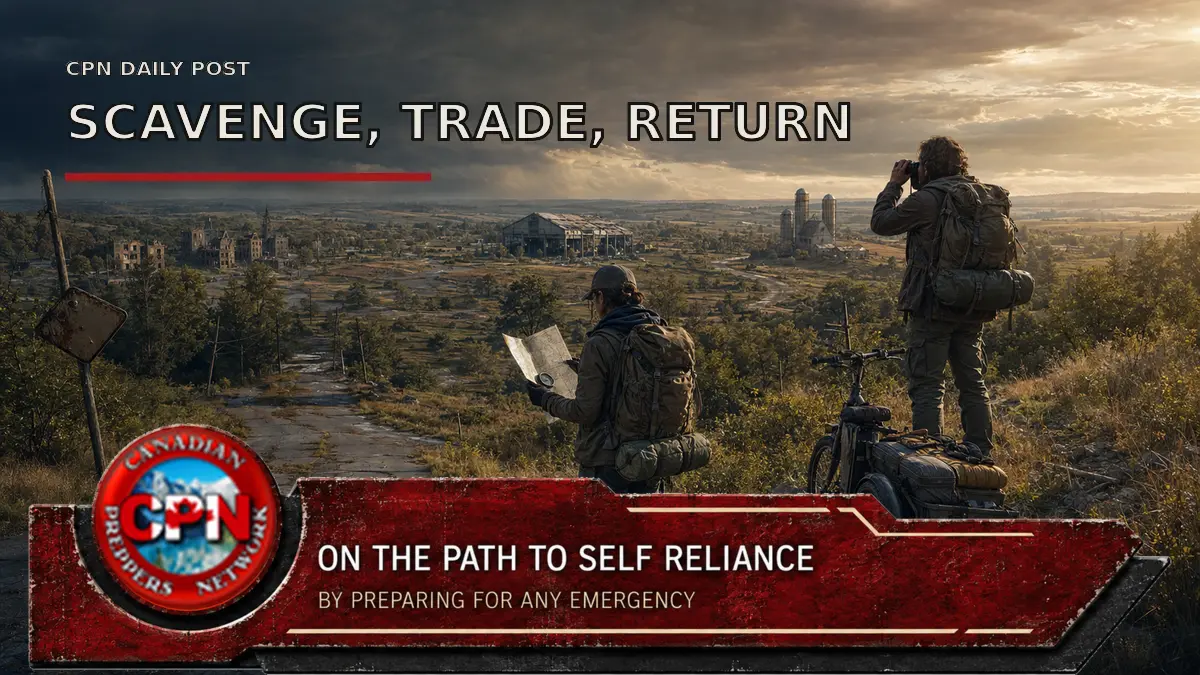
Every trip beyond the retreat must justify the risk.
When the retail supply system is gone, a trip into town is no longer a shopping run.
The shelves were emptied long ago. Fuel pumps are silent. Warehouses, pharmacies and hardware stores have been stripped, damaged or repurposed. Anything useful that remains is scattered through abandoned homes, ruined businesses, stalled vehicles, deserted workshops and the debris of a system that no longer functions.
At the same time, no household can store every tool, replacement part or raw material it will eventually need. Pumps fail. Clothing wears out. Fasteners disappear. Containers break. Stored food runs low, and local production creates new shortages.
Eventually, people must look beyond their own property.
Some trips will be made to recover useful materials from abandoned places. Others will carry surplus goods, labour or skills to trade with neighbouring families and functioning communities.
Neither should begin with, “Let’s go see what we can find.”
Every journey consumes time, calories, fuel and daylight. It exposes the travellers, the goods they carry and potentially the household waiting behind them. A successful run begins with a specific objective and ends with everyone safely home.
FREE DOWNLOAD: CANADIAN GRID-DOWN STARTER KIT
Identify the household systems and supplies most likely to fail first—before a shortage forces an unnecessary journey.
Scavenging Is Not Wandering
Post-collapse scavenging is the deliberate recovery of useful materials from the remains of the old system.
It is not aimless exploration. Wandering through buildings and opening every container consumes daylight while increasing exposure to unstable structures, contamination and other survivors.
A proper run begins with a known need and a likely source.
The objective might be:
- A compatible belt for a water pump
- Copper wire of a particular gauge
- Bicycle parts for local transportation
- Manual tools from an abandoned workshop
- Lumber or sheet metal from a ruined building
- Fasteners, hinges or plumbing fittings
- Containers for non-food storage
- Parts from an inoperative machine
- Fabric, cordage or repair materials
- Glass jars with undamaged rims
“Anything useful” is not a useful mission objective.
Specific targets help the group decide where to look, how much equipment to bring and when the run has accomplished enough.
Learn to Read What Has Been Left Behind
Collapse will leave property and resources in several very different conditions.
The distinction is no longer about finding someone behind a counter who can grant permission. It is about recognizing whether an item has truly been abandoned or remains part of another survivor’s life.
A practical assessment looks like this:
- Occupied, guarded or maintained: Someone is still using the location. Move on.
- Cultivated, repaired or regularly visited: The property remains active even if nobody is currently visible.
- Cached, marked or deliberately concealed: The supplies were stored for someone’s future use. Leave them.
- Clearly abandoned, ruined or discarded: The material may be recoverable if it can be reached safely.
- Uncertain: Observe, reassess and look elsewhere.
A working farm is not a salvage site. Neither is an occupied house, maintained camp, functioning well or vehicle that is obviously being kept operational.
Taking from active survivors does more than deprive them of supplies. It creates enemies, retaliation and instability throughout the surrounding area. A questionable load of materials is never worth starting a conflict that may follow the group home.
Set Priorities Before Leaving
A salvage list should separate genuine needs from attractive distractions.
Divide the objective into three levels:
- Critical: Needed to repair or restore an essential system.
- Useful: Worth recovering if it can be collected without delaying the mission.
- Optional: Taken only when time, safety and carrying capacity permit.
If a greenhouse ventilation system needs a specific motor, finding that motor matters more than filling the cart with assorted hardware. If a pump requires a particular fitting, unrelated tools should not consume the space needed to transport it.
The group should also establish a stop time before departure. When that time arrives, searching ends whether the critical item has been found or not.
A failed recovery attempt is disappointing. Missing the return deadline because the group kept searching is dangerous.
Observe Before Approaching
A familiar location may have changed since it was last visited.
Stop far enough away to assess it before committing the vehicle, cart or group. Look for smoke, fresh tracks, recently moved objects, maintained pathways, covered equipment, new barriers or other signs of activity.
The objective is not to spy on people. It is to avoid walking unexpectedly into an occupied site or trapping the group in a location that no longer matches the original report.
Binoculars can help examine a road, building exterior or access point without getting closer. If the situation appears uncertain, leave. There will always be pressure to continue because of the time already invested, but distance travelled does not make the site safer.
The Ruins Are Dangerous
Abandoned does not mean safe.
Fire, flooding, frost and neglect can weaken structures without producing obvious external damage. Floors may have rotted, stairs may no longer be anchored and shelving may collapse when disturbed.
Other hazards include:
- Broken glass and exposed nails
- Mould and animal waste
- Fuel, oil and chemical contamination
- Damaged wiring
- Floodwater and sewage
- Pressurized cylinders
- Unlabelled liquids or powders
- Unstable machinery
- Sharp or rusted metal
- Insects and rodents
Do not enter leaning, partially collapsed, burned or flooded structures. Do not crawl beneath unstable equipment or disturb unknown chemical containers. Materials that can be recovered from open ground, exterior storage or debris piles are generally safer than anything buried deep inside a damaged building.
The mission should be abandoned if the required material cannot be reached without accepting a serious structural or contamination risk.
A replacement part is not worth losing a member of the group.
Travel With a Recovery Limit
The carrying capacity of the vehicle, trailer, bicycle or cart should be decided before the search begins.
Overloading creates new problems. A heavily loaded vehicle uses more fuel and takes longer to stop. An overloaded handcart becomes difficult to control on slopes and damaged roads. Large loads also slow the return journey and make abandoning the cargo harder if conditions deteriorate.
Recover the smallest amount that solves the immediate problem.
Raw materials should be separated by type. Sharp metal must be secured. Chemicals and mechanical parts should not travel with food. Liquids should remain upright, and heavy items should be prevented from shifting.
If the group cannot transport something safely, leave it and record its location for a better-equipped trip.
Nothing Goes Directly Into Household Stores
Recovered goods should stop at an inspection area outside the main living and food-storage spaces.
Every item should be examined, cleaned and sorted before it enters household inventory. Watch for:
- Mould or moisture damage
- Fuel and chemical residue
- Insects, eggs or rodent contamination
- Cracked containers
- Frayed wiring
- Missing safety guards
- Structural weakness
- Sharp edges
- Unknown modifications
- Parts that no longer move freely
Unknown food, opened medicine, bulging cans and unlabelled chemicals should be rejected. Scarcity does not make an unidentified substance safer.
Usable materials should be labelled with the recovery date and location. Untested mechanical or electrical parts should also be marked so nobody later mistakes them for dependable spares.
Trade Runs Connect the Survivors
Scavenging recovers what the old system left behind. Trade creates a new system.
One household may produce eggs but lack soap. A farm may have grain but need equipment repaired. Another community may be able to charge batteries but require preserved food, sewing work or help processing firewood.
A trade run should begin with an arrangement, not a wagon full of goods and a hope that somebody wants them.
Before departure, establish:
- What each side is offering
- The requested quantity
- The expected condition
- The meeting location
- The arrival window
- Who is expected to attend
- What will postpone or cancel the exchange
Details can travel through radio, written messages, trusted travellers or scheduled contact times. Important terms should be repeated back to prevent misunderstandings.
“We need lamp oil” leaves too much uncertain.
“We will trade two sealed kilograms of salt for four litres of usable lamp oil tomorrow at the regular meeting place” gives both sides a clear agreement.
Value Will Be Local
There may be no universal post-collapse price list.
An item’s value will depend on local need, season, availability and the relationship between the people trading. Seeds may be especially valuable before planting. Dry firewood may matter more before winter. Repair work becomes valuable when replacement equipment is no longer manufactured.
Possible trades include:
- Preserved food and seed
- Soap and sanitation supplies
- Clothing and fabric repair
- Tool sharpening
- Mechanical work
- Battery charging
- Radio-message relay
- Milling, welding or sewing
- Veterinary or agricultural knowledge
- Firewood processing
- Transportation
- Replacement parts
- Labour for a defined project
Skills are particularly valuable because they can be exchanged without emptying the household’s storage shelves.
However, never promise work the group cannot complete. A reliable reputation will eventually be worth more than any advantage gained from one-sided bargaining.
Keep Early Trades Away From Main Stores
A first exchange should not expose either household’s primary food, fuel or equipment stores.
Use a familiar meeting place that both sides can approach and leave easily. It should provide enough visibility to recognize unexpected changes before goods are unloaded.
The travelling group needs instructions for situations such as:
- The expected contact is absent.
- Unknown people arrive with them.
- The meeting place has suddenly changed.
- The goods do not match the agreement.
- New terms are demanded.
- The meeting consumes too much daylight.
- Something simply feels inconsistent with previous dealings.
The answer is usually to pause or leave.
Nobody should feel forced to complete an exchange because of the distance travelled. A missed trade can be attempted again. A bad meeting can damage trust throughout the local network.
Carry Only the Agreed Goods
Do not take the household’s entire surplus on a single trade run.
Carry the agreed amount, plus a modest allowance for differences in measurement. If the other group wants a larger exchange, that can be arranged for another day.
Transport food separately from fuel, chemicals and dirty salvage. Keep goods packaged so they can be inspected without unpacking everything carried by the group.
The travellers should also know how much flexibility they have. Can they accept a slightly smaller quantity? Can one good be substituted for another? At what point must they decline?
These decisions are easier to make at home than under pressure at the meeting place.
Information Is Also Being Exchanged
Every conversation can reveal something about the household.
Questions about stored food, fuel, livestock, illness, population or equipment may appear casual. Travellers should know what information they can share and what should remain private.
There is no need to lie or exaggerate. Keep the discussion centred on the exchange:
- What can be offered now?
- What might be available later?
- What is currently needed?
- When should contact be made again?
- Which communication method will be used?
- What circumstances could interrupt the arrangement?
Trust should grow gradually through completed exchanges. One successful trade does not require either side to reveal everything it possesses.
The Destination Is Only Halfway
Every salvage or trade run needs a primary route, an alternate route and a firm return deadline.
The people remaining behind should know:
- Who left
- The mission objective
- The expected destination
- The planned routes
- The check-in times
- The return deadline
- What happens if the group becomes overdue
Turn back when the route changes unexpectedly, weather deteriorates, communication is lost beyond the agreed limit or the return reserve begins disappearing.
The cargo is never more important than the people carrying it.
Return With Information
A group coming home brings back two resources: materials and knowledge.
Before unloading, record:
- Road and trail conditions
- New barriers or damage
- Signs that previously abandoned areas are now occupied
- Locations that appear deserted
- Communication coverage
- Condition of the salvage site
- Goods neighbouring communities need
- Goods they may be able to provide
- Reliability of the trading contact
- Changes needed before the next trip
Date every observation and separate what the group personally saw from what it heard from someone else.
Over time, these reports create a practical picture of the surrounding area. That knowledge may eventually become more valuable than any single load of recovered materials.
Salvage and Trade-Run Gear
A useful kit supports navigation, observation, documentation, inspection and safe transport.
- Canada road atlases
- Baseplate compasses
- Waterproof map cases
- Compact binoculars
- Motorola Talkabout licence-free radios
- Waterproof notebooks
- Cut-resistant work gloves
- Protective safety glasses
- Heavy-duty storage totes
- Heavy-duty folding utility carts
- Vehicle first-aid kits
As an Amazon Associate, Canadian Preppers Network may earn from qualifying purchases.
Related CPN Reading
- Security & Defence in Canada
- Communications in Canada
- How Far Can Your Radio Really Reach?
- The Lost Art of Low-Tech Communication
- Wilderness Bugout Survival
Final Thought
In a post-collapse world, scavenging and trade are not side activities. They are how isolated households begin rebuilding a local supply system.
Scavenging recovers useful material from what the old world abandoned. Trade moves resources and skills between the people who remain. Both require discipline, reliable information and the willingness to walk away when conditions no longer justify the risk.
Do not wander blindly. Do not mistake another survivor’s lifeline for abandoned salvage. Do not expose the household’s entire inventory to complete one exchange.
Leave with a purpose.
Recover what matters.
Trade honestly.
Bring everyone home.