There’s a dangerous assumption built into most preparedness plans: that communication will always be available in some form.
Maybe not perfect. Maybe delayed. But available.
That assumption fails quietly—and then all at once.
In real Canadian emergencies—ice storms, wildfires, flooding—communication systems don’t disappear. They degrade. Networks become congested. Messages arrive late or not at all. What should take seconds stretches into hours.
And in that delay, people make bad decisions.
They leave when they should stay. Stay when they should move. Miss each other entirely.
Preparedness isn’t just about radios or charged phones. It’s about ensuring information moves when those systems can’t be trusted.
Long before digital networks, people solved this problem with something far more reliable: low-tech communication systems built on planning, discipline, and physical message transfer.
Most of those methods still work today. And in many cases, they work better.
Dead Drops: Communication That Doesn’t Require Timing
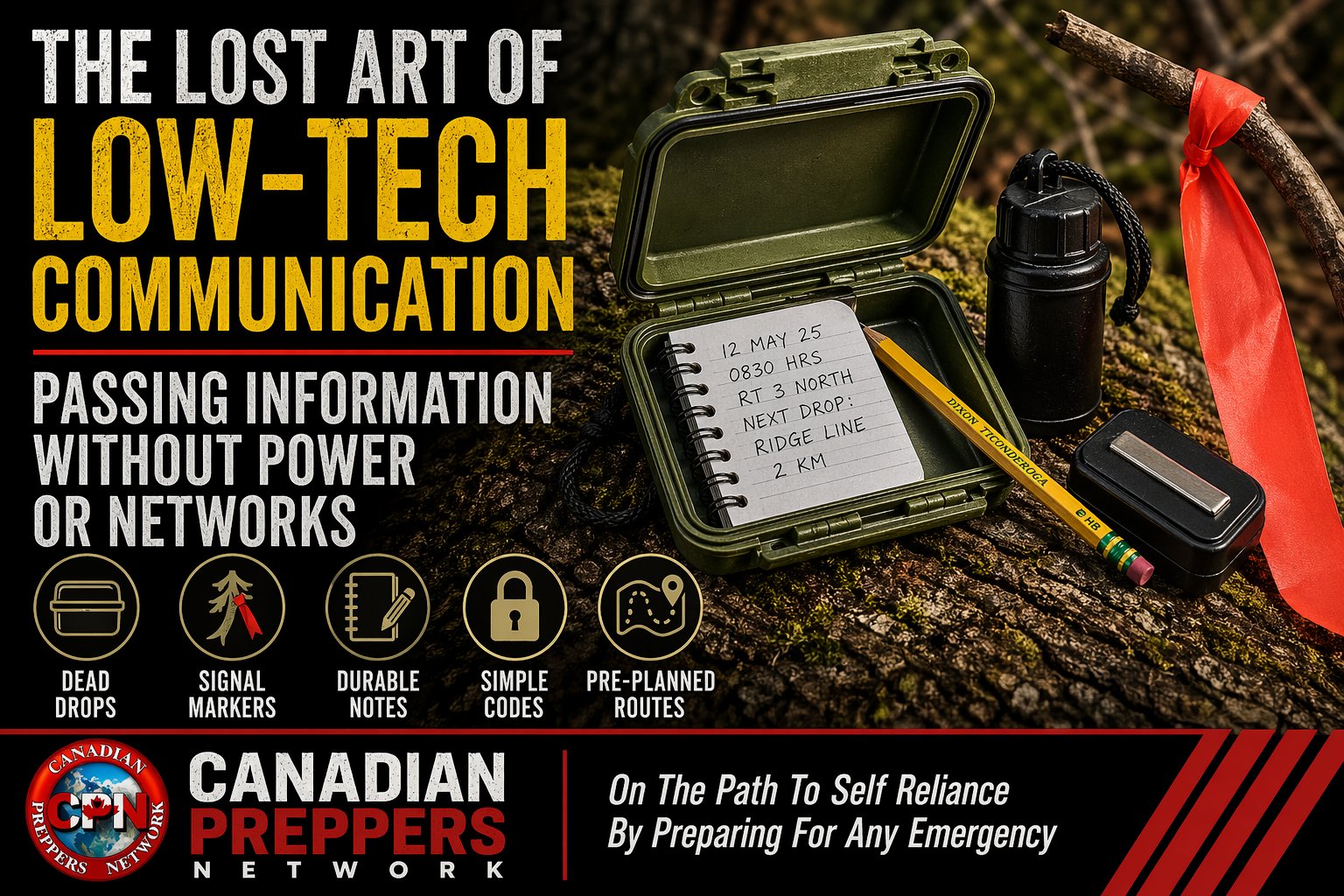
A dead drop allows one person to leave a message in a pre-arranged location for another to retrieve later. No timing. No direct contact.
In a real-world scenario—especially during evacuation—this becomes critical.
If your family is moving at different times and cell service is unreliable, dead drops prevent total loss of communication. They allow information to move forward even when people cannot.
But the system only works if the message survives.
Paper fails fast in Canadian weather. Rain, snow, and condensation will destroy a message long before it’s found. That’s why the container matters just as much as the message itself.
Instead of improvised solutions, purpose-built containers designed for outdoor caching offer a far more reliable option. Geocaching containers are specifically built to survive long-term exposure while remaining discreet and easy to access.
Good options include:
- https://www.amazon.ca/s?k=geocache+micro+container&tag=canadianprep-20
- https://www.amazon.ca/s?k=waterproof+geocache+container&tag=canadianprep-20
- https://www.amazon.ca/s?k=magnetic+key+holder+hide+a+key&tag=canadianprep-20
These are designed to be hidden, recovered, and reused repeatedly—exactly what a functioning dead drop system requires.
Pair them with a waterproof notebook:
https://www.amazon.ca/s?k=rite+in+the+rain+notebook&tag=canadianprep-20
And a writing tool that won’t fail in the cold:
- Mechanical pencils: https://www.amazon.ca/s?k=mechanical+pencil&tag=canadianprep-20
- Carpenter pencils: https://www.amazon.ca/s?k=carpenter+pencil&tag=canadianprep-20
- Graphite pencils: https://www.amazon.ca/s?k=graphite+pencils&tag=canadianprep-20
In Canadian winters, pens fail. Ink thickens or freezes. Pencils don’t. They write in cold, wet, and dirty conditions without hesitation.
For writing on non-paper surfaces—plastic, metal, or damp materials—add:
These allow you to mark containers or leave signals without relying on paper at all.
Keep messages simple:
- Time and date
- Direction of travel
- Next location
Nothing more than what’s needed.
Urban vs Rural Dead Drop Strategy
Where you place a dead drop matters just as much as how you build it.
In urban or suburban environments, concealment is critical. Magnetic key holder caches work well here—attached discreetly under vehicles or hidden within overlooked structures. The goal is to blend into an environment where objects are routinely ignored.
In rural or wilderness settings, durability becomes the priority. Waterproof capsules and micro containers can be concealed along trails, fence lines, or natural landmarks. Seasonal change must be considered—snow cover, flooding, and vegetation growth can all affect visibility and access.
The best dead drop isn’t the one that’s hardest to find.
It’s the one that’s consistently found by the right people—and ignored by everyone else.
Signal Markers: Fast Communication Without Writing
Dead drops require time. Sometimes you don’t have it.
Signal markers allow instant communication using pre-arranged visual cues:
- Tape tied to a branch
- Rocks placed deliberately
- Marks on structures
To anyone else, they mean nothing. To your group, they carry information.
Visibility is the limiting factor in Canadian terrain.
Useful tools include:
- https://www.amazon.ca/s?k=surveyor+flagging+tape&tag=canadianprep-20
- https://www.amazon.ca/s?k=chem+light+sticks&tag=canadianprep-20
Used sparingly, these extend your communication range without slowing movement.
Coded Notes: Simple, Fast, Effective
If you’re leaving messages in semi-public spaces, assume they may be found.
You don’t need complex encryption. You need controlled clarity.
Simple systems work best:
- Predefined locations (“Site A”, “Site B”)
- Short instructions (“Delay 6”, “Route 2”)
- Agreed phrasing with specific meaning
The goal is speed and usability—not secrecy for its own sake.
Anything more complex will fail under stress.
Pre-Planned Routes: Communication Without Constant Messaging
The strongest communication system reduces the need for communication.
If your group has defined routes between home, fallback locations, and secondary sites, you eliminate guesswork.
Dead drops and markers placed along those routes turn them into communication corridors.
If you haven’t structured this yet, start here:
https://canadianpreppersnetwork.com/be-ready-to-bug-out/
Movement without structure creates silence.
Structured movement carries information forward.
Layering Low-Tech with Modern Systems
This isn’t about replacing radios.
It’s about layering systems.
When everything works → use modern communication
When it degrades → adapt
When it fails → low-tech takes over
That’s real preparedness.
Build this on top of your existing comms plan:
https://canadianpreppersnetwork.com/emergency-communications/
And inside your overall preparedness framework:
https://canadianpreppersnetwork.com/step-two-make-an-emergency-plan/
The Discipline Factor
Low-tech communication works because it’s simple.
But it only works if it’s used consistently.
A dead drop not checked is useless.
A marker misread is dangerous.
A code forgotten creates confusion.
This isn’t a gear problem.
It’s a discipline problem.
Final Thoughts
Most people won’t think about communication this way until it’s too late.
They’ll rely on phones. Expect messages to go through. Assume delays are temporary.
And when that fails, they’ll have nothing.
Low-tech communication doesn’t depend on infrastructure. It doesn’t fail due to congestion or power loss.
It works—as long as you do.
You don’t need complexity.
You need clarity.
You need consistency.
And you need a system that still works when everything else doesn’t.