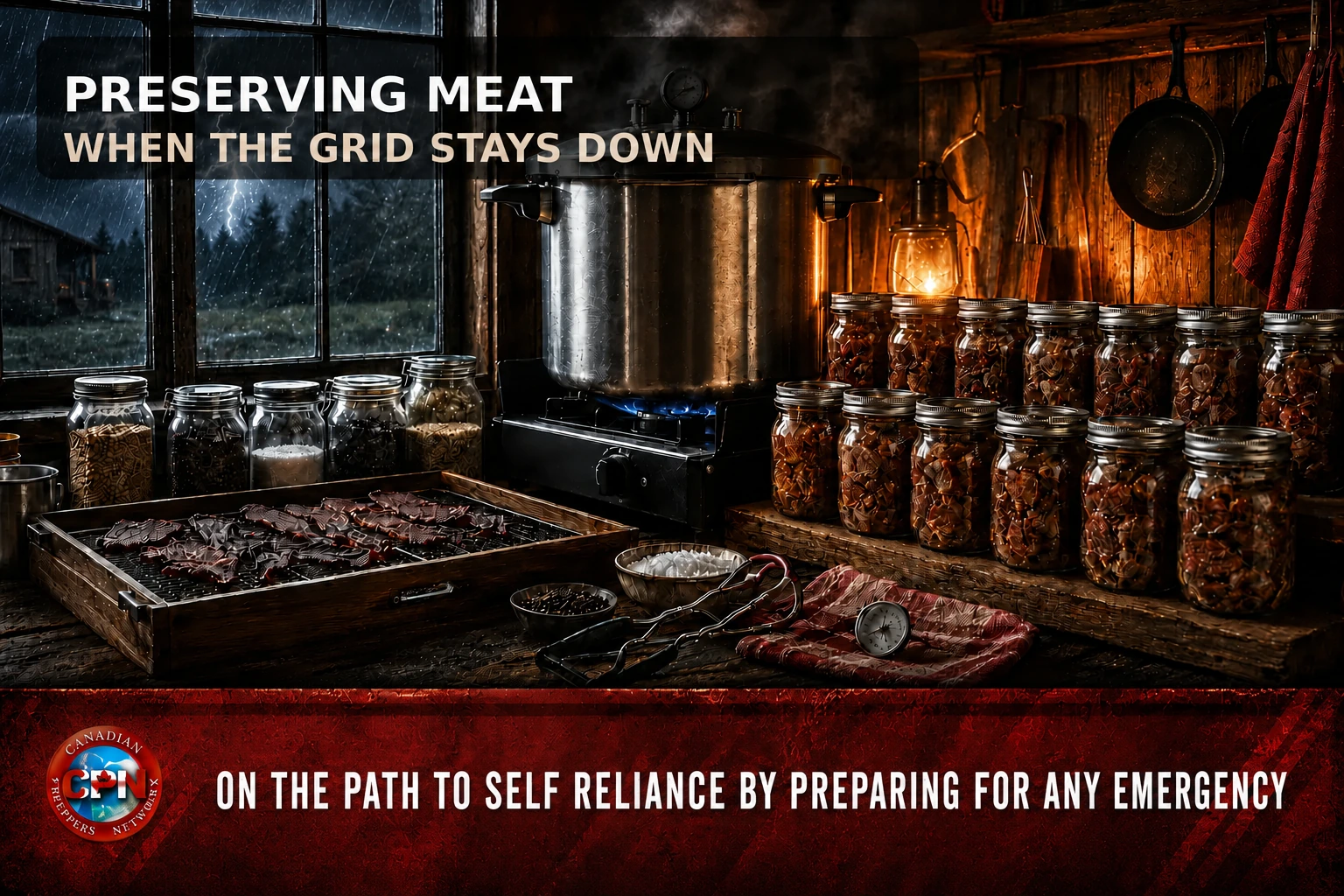
Safe meat preservation after refrigeration fails.
A freezer full of meat looks like food security—until the electricity fails.
During a short outage, a closed, well-packed freezer may hold its temperature long enough for power to return. During a prolonged grid failure, however, the freezer becomes a countdown clock. Once the meat begins thawing, the household must either eat it, preserve it safely, move it to dependable cold storage, or lose it.
The answer is not to depend upon one traditional technique. Pressure canning, drying, smoking, salting, and cold storage each have different requirements and limitations. A practical post-collapse system assigns the right cuts to the right method while accounting for fuel, weather, equipment, labour, and food safety.
Start Before the Meat Thaws
The first mistake is waiting until an entire freezer has softened before making a plan.
Keep the freezer closed while you assess the situation. Determine whether power is likely to return, whether generator fuel should be used, and how much meat the household can process with the equipment on hand. Consolidating frozen food into the most efficient freezer may help preserve the cold mass.
Create a processing order:
- Refrigerated meat and anything already partly thawed
- Ground meat, poultry, organs, and small pieces
- Larger cuts beginning to soften
- Solidly frozen roasts and densely packed packages
Do not rely upon smell or appearance to determine whether questionable meat is safe. If its temperature history is unknown, preservation cannot reverse spoilage or make unsafe meat safe again.
Pressure Canning Is the Main Shelf-Stable Method
For most households, pressure canning is the most dependable way to turn fresh meat into food that no longer requires refrigeration.
Meat, poultry, fish, stock, and mixed meals are low-acid foods. They must be processed in a true pressure canner using a tested recipe. A boiling-water bath, oven, open kettle, multicooker, or improvised sealed vessel is not a safe substitute.
Health Canada warns against changing the processing time, pressure, or proportions in a tested canning procedure. Altitude must also be considered because the required pressure may change as elevation increases.
Pressure-canned meat has several post-collapse advantages:
- It is fully cooked and ready to use.
- It can be stored without continuous electricity.
- Tough cuts become useful in soups, stews, and fillings.
- Bones and trimmings can become stock.
- Jars divide a large quantity into manageable portions.
- Opening one container does not expose the rest of the supply.
The disadvantages are equally real. Canning requires jars, sound lids, clean water, fuel, and a maintained pressure canner. Processing sessions are long, and the canner must be allowed to depressurize naturally. Trying to rush cooling can damage seals or cause liquid loss.
A household expecting to preserve meat during an outage should practise while the grid is operating. A pressure canner still wrapped in its original box is not a preservation system.
Sort the Meat by Its Best Use
Do not attempt to process every cut in the same way.
Large lean pieces may be suitable for tested jerky recipes. Tough meat can be cubed or prepared according to an approved canning method. Bones and connective tissue can contribute to stock. Fat may be rendered separately if the household already understands the process and has suitable storage.
Meal planning should guide the work. Plain canned meat is flexible, but tested soups and stews can reduce future cooking time and fuel consumption. Smaller jars may suit one- or two-person households, while larger groups may use bigger approved jar sizes efficiently.
Never invent processing times for an unusual jar, dense mixture, or family recipe. Thickness, fat content, jar size, and ingredient proportions affect heat penetration. A recipe being old or traditional does not establish that it is safe.
Free Canadian Grid-Down Starter Kit
A failed freezer is only one consequence of a prolonged outage. Use the free Canadian Grid-Down Starter Kit to examine your household’s food, water, cooking, lighting, sanitation, and communications systems before they are needed.
Drying Meat Requires More Than Warm Air
Drying reduces weight and storage space, but meat cannot be treated like herbs or sliced fruit.
A solar dryer, woodstove rack, or warm attic may remove moisture without reliably destroying pathogens. The exterior can also harden while moisture remains inside. That creates a product that appears dry but is not stable.
Use a tested jerky method that includes the required heat treatment. The National Center for Home Food Preservation provides validated procedures intended to reduce foodborne-illness risk.
Jerky is most useful as:
- Portable working food
- Shorter-term protein
- Food for travel or remote work
- An ingredient for cooked dishes
- A way to preserve selected lean cuts
It should not automatically be treated as indefinite room-temperature storage. Fat becomes rancid, moisture can return, and mould can develop. Make smaller batches, protect the finished product from humidity, and inspect it regularly.
Smoking Is Not Automatically Preservation
Smoke adds flavour, discourages some insects, and can contribute to a preservation process, but smoking alone does not necessarily make meat shelf-stable.
Hot smoking cooks meat, but the finished food may still require refrigeration. Cold smoking exposes meat to smoke without fully cooking it and normally forms only one stage of a carefully controlled curing process. Neither method should be improvised because an outdoor smoker looks traditional.
A dependable smoked product requires control over:
- Meat preparation
- Salt or cure concentration
- Temperature
- Time
- Airflow
- Humidity
- Finished moisture
- Protection from contamination
Use a validated recipe and measure curing ingredients accurately. Do not estimate quantities or substitute one curing product for another. Until the process has been mastered, treat smoked meat as cooked food rather than assuming it can hang unrefrigerated for months.
Salting and Curing Demand Precision
Salt was used to preserve meat long before refrigeration, but historical use does not make casual experimentation safe.
Successful curing depends upon the correct salt concentration reaching the entire piece of meat. Thickness, temperature, time, and moisture all matter. Some recipes also use precisely measured curing salts to control hazards that ordinary table salt cannot reliably address.
The safest preparedness approach is to learn one verified method at a time under normal conditions. Keep the recipe, measurements, and temperature requirements with the equipment. A crisis is not the time to reconstruct a curing process from memory.
Salt itself should be stored in substantial quantities. It does not provide a complete meat-preservation plan, but shortages would cripple curing, fermenting, pickling, and everyday cooking.
Cold Storage Buys Time but Does Not Stop Time
A root cellar, spring house, cold room, or winter cache may slow spoilage, but “cool” is not the same as safely refrigerated.
Canadian winters can provide valuable natural cooling, yet temperatures fluctuate. A sunny wall, mild afternoon, or insulated container can become warmer than expected. Outdoor storage must also be protected from animals, insects, precipitation, and repeated freezing and thawing.
Use a thermometer rather than assuming a location is cold enough. Cold storage is best considered a buffer that gives the household time to cook or preserve meat—not a universal replacement for a freezer.
Fuel Determines How Much You Can Save
Every preservation plan is also an energy plan.
Pressure canning requires bringing a heavy canner to pressure and holding it there for the full tested time. Boiling stock requires heat. Dehydration needs sustained warm airflow. Smoking consumes dry wood and demands attention.
Before an emergency, record how much propane, natural gas, or firewood a typical processing batch consumes. Check whether the pressure canner is compatible with the intended stove. Some large canners are too heavy for glass cooktops, while some outdoor burners produce excessive or poorly controlled heat.
Where appropriate, process full canner loads rather than repeatedly heating small batches. Prepare jars, tools, and ingredients before lighting the stove. Use bones, trimmings, and cooking liquid efficiently, but never shorten a tested preservation process merely to conserve fuel.
Clean Water and Sanitation Remain Essential
Grid failure often affects both refrigeration and water service.
Meat processing uses significant water for cleaning hands, washing equipment, and maintaining a sanitary work area. If potable water is scarce, the household may discover that it has enough fuel and jars but cannot operate safely.
Keep raw-meat tools separate from ready-to-eat food. Clean surfaces promptly, manage waste away from food and water areas, and prevent insects from reaching the work. Process manageable quantities so meat is not left waiting while an overloaded crew struggles to keep up.
A large animal or thawing freezer may require several people working defined jobs: cutting, preparing jars, managing the canner, washing equipment, recording batches, and controlling the fire.
Label Every Batch
When dozens of similar jars are produced under pressure, memory is unreliable.
Record:
- Product and cut
- Processing date
- Jar size
- Recipe source
- Processing time
- Pressure used
- Approximate batch number
- Any seal failures or irregularities
Store jars without screw bands after the seals have been checked and the jars cleaned. Rotate them deliberately, inspect before opening, and discard containers showing signs of seal failure, leakage, bulging, or other deterioration. Never taste food to decide whether a suspicious jar is safe.
Build the System While Conditions Are Easy
The household that waits for a freezer emergency to learn preservation has already surrendered much of its advantage.
Run practice batches. Learn how long each method takes. Determine the number of jars that fit the canner and how much fuel a batch consumes. Store replacement parts appropriate to the canner model, along with jars, compatible lids, salt, labels, and printed tested recipes.
The objective is not to save every package through frantic improvisation. It is to move the greatest safe quantity of meat from temporary frozen storage into several dependable forms before temperature, fuel, or labour runs out.
Meat-Preservation Tools and Equipment
A dependable meat-preservation system uses several methods. The equipment below supports pressure canning, drying, smoking, curing, temporary cold storage, safe processing, sanitation, and recordkeeping.
Pressure Canning
- Pressure canner for meat and low-acid foods
- Mason canning jars
- Replacement canning lids
- Jar lifter, funnel, headspace tool, and lid wand set
- Pressure-canner replacement gaskets and parts
Drying and Jerky Making
- Temperature-controlled food dehydrator
- Reusable dehydrator mesh sheets and trays
- Instant-read meat thermometer
- Food vacuum sealer
- Vacuum-sealer bags and rolls
Smoking
- Meat smoker with controllable vents
- Dual-probe smoker and meat thermometer
- Stainless-steel smoking racks and meat hooks
- Food-grade smoking chips and wood chunks
- Heat-resistant food-handling gloves
Salting and Curing
- Precision digital scale
- Non-iodized pickling and preserving salt
- Food-grade curing salt for validated recipes
- Food-grade brining containers with lids
- Stainless-steel brine injector
Cold Storage and Temperature Monitoring
- Refrigerator and freezer thermometers
- Wireless temperature monitor with alarm
- Insulated food-storage containers
- Heavy-duty cooler
Butchering and Batch Preparation
- Butcher-knife and boning-knife set
- Knife-sharpening stones and honing tools
- Large stainless-steel preparation bowls
- Large food-grade cutting boards
- Butcher paper and freezer paper
- Food-safe cut-resistant gloves
Sanitation, Labelling, and References
- Food-contact surface sanitizer
- Disposable food-handling gloves
- Canning labels and permanent markers
- Waterproof batch-record notebook
- Printed home-canning and food-preservation guide
Always follow a current, tested preservation recipe and the equipment manufacturer’s directions. Curing ingredients are not interchangeable and must be measured precisely. As an Amazon Associate, Canadian Preppers Network earns from qualifying purchases.
Preserve Deliberately, Not Desperately
When refrigeration cannot be restored, meat preservation becomes a race—but haste cannot replace safe technique.
Pressure canning offers the strongest foundation for shelf-stable storage. Tested drying methods provide portable food. Smoking and curing can broaden the system once they have been properly learned. Cold storage buys time, while fuel planning and sanitation determine how much of the supply can actually be saved.
A freezer is only a temporary container. Real food security begins when the household can convert its contents into safe meals that will remain usable long after the last ice has melted.
Related Reading
- Mastering Pressure Canning: The One Homestead Skill That Turns Food into Security
- Food Procurement and Storage in Canada
- Popular Dry Goods for Long-Term Food Storage
Safety details were checked against Health Canada’s home-canning guidance and the National Center for Home Food Preservation.