
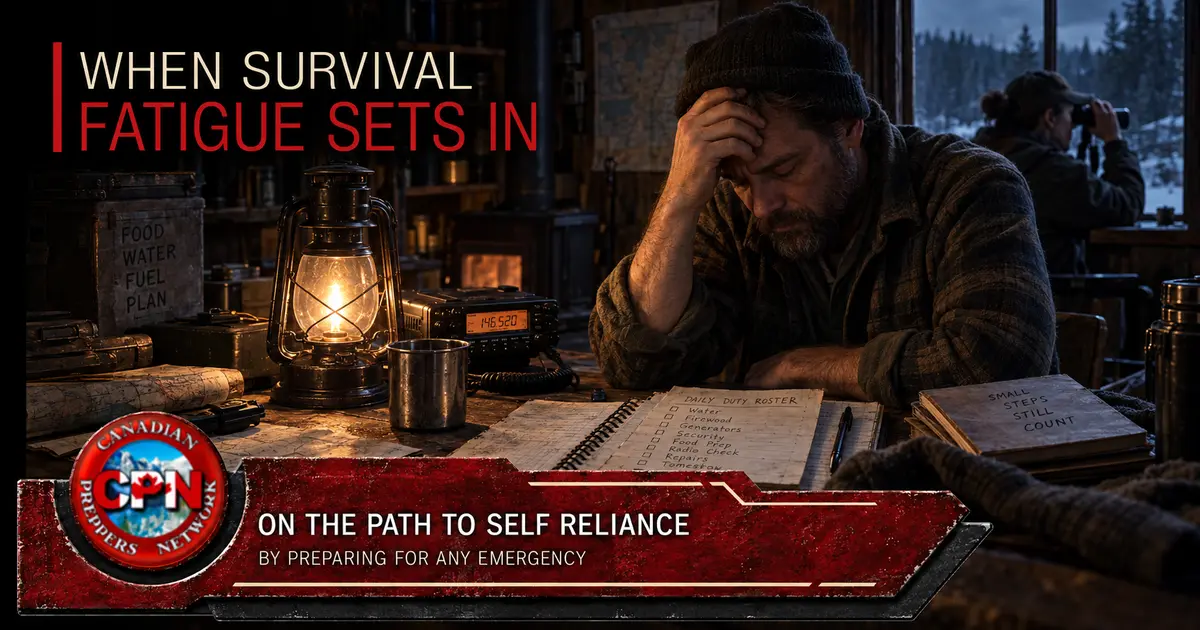
The supplies may still be holding—but the people using them are beginning to fail.
The first days of a serious collapse may be frightening, confusing and physically demanding, but they also produce energy. People move quickly. Supplies are inventoried, water is secured, watches are organized and immediate threats receive immediate answers.
Then the days begin running together.
FREE CANADIAN PREPAREDNESS DOWNLOAD
Canadian Grid-Down Starter Kit
Use this printable first-72-hours checklist to test your household’s food, water, sanitation, power, communications and operating routines before a short outage becomes a prolonged emergency.
The grid remains down. Fuel becomes difficult to obtain. Every unfamiliar vehicle raises suspicion. Meals become repetitive, sleep becomes shallow and minor repairs consume entire afternoons. Nothing feels finished because every completed task is replaced by another.
This is when survival fatigue begins to take hold.
It is not simply feeling tired. It is the gradual loss of judgement, discipline and motivation caused by prolonged stress without meaningful recovery. A household can still possess food, equipment and defensive capability while becoming dangerously ineffective because the people responsible for using those resources are mentally exhausted.
In a long emergency, fatigue may become as serious a threat as hunger.
The Dangerous Period After the Initial Crisis
Most emergency plans concentrate on the opening hours: fill containers, secure the property, contact family members and determine what happened. Those actions are important, but urgency temporarily hides exhaustion.
People can function remarkably well for a short period when adrenaline is high. The trouble begins when the emergency stops feeling temporary.
The first week may feel like a mission. By the third or fourth week, it has become life.
Everyone has heard the same rumours. The same equipment keeps breaking. The same person complains about the same meals. There is no reliable date when power, transportation or public order will return.
Without a clear finish line, people stop pacing themselves. They attempt to maintain emergency-level vigilance indefinitely—and eventually fail.
Survival Fatigue Does Not Always Look Like Exhaustion
A fatigued person may not admit to being overwhelmed. The condition often appears through changes in behaviour rather than an obvious physical collapse.
- Repeatedly forgetting simple tasks
- Leaving tools, gates or fuel containers unsecured
- Taking unnecessary risks to save time
- Becoming irritated by minor problems
- Withdrawing from meals or group discussions
- Obsessively checking radios and news reports
- Losing interest in hygiene or equipment maintenance
- Making impulsive decisions without consultation
- Sleeping at inappropriate times but poorly at night
- Treating every inconvenience as a personal attack
One of the most dangerous signs is indifference. A person who once checked every lock may begin assuming everything is fine. Someone who carefully rationed supplies may stop recording what is used. Another may decide that a distant noise is not worth investigating.
These shortcuts are rarely caused by ignorance. The person usually knows the correct procedure but no longer has the energy or concentration to follow it.
The Competent Person Is Often at Greatest Risk
Every household or preparedness group tends to depend heavily upon one or two capable people.
They know how the generator works, where the medical supplies are stored, which radio frequencies are used and how much food remains. They settle disputes, organize work and make decisions when information is incomplete.
That competence creates a dangerous trap.
Because the person can handle almost everything, everyone allows them to handle almost everything. Their workload steadily increases while the rest of the group becomes more dependent. The capable person may also refuse to delegate because explaining a task seems slower than doing it personally.
Eventually, the group has created a single point of failure.
If that person becomes sick, injured or mentally exhausted, several essential systems may fail at once. Knowledge that exists only in one person’s head is not a preparedness resource. It is a vulnerability.
Every critical responsibility should have at least one trained backup. Procedures for operating equipment, treating water, recording inventory and making radio contact should be written down while conditions are still manageable.
LIMITED-SPACE OUTDOOR EVENT
PLINKIN’ IN THE WOODS
Practical Rimfire Marksmanship With Frugal Gunnie
Spend a full day developing practical outdoor shooting skills from prone, standing, seated and kneeling positions. Work with slings, bipods, tripods and shooting bags while receiving individual instruction on fundamentals, ergonomics and technique.
Saturday, September 12, 2026
8:00 a.m.–5:00 p.m.
Great Ape Empire
267 Highway 6, Wiarton, Ontario
Event admission: $250 CAD
Weekend camping: $20 per person
Private event. Space is strictly limited.
Stop Running the Household as a Permanent Emergency
An emergency pace cannot be sustained forever.
During the initial crisis, it may be necessary to work late, sleep in short shifts and postpone non-essential chores. Once the immediate danger has passed, however, the household needs a routine designed for endurance.
That routine should establish predictable times for:
- Security watches
- Cooking and meals
- Water collection and treatment
- Equipment inspection
- Radio monitoring
- Cleaning and sanitation
- Rest and personal time
- Household meetings
Predictability reduces the number of decisions people must make. If the radio is checked at established times, nobody needs to monitor it continuously. If equipment inspections occur every morning, people do not spend the day wondering whether something has been overlooked.
A written schedule also makes workloads visible. It becomes much harder for one person to quietly carry most of the burden when every duty is recorded.
Protect Sleep as a Critical Resource
People often treat sleep as something that can be sacrificed whenever more work appears. That may be unavoidable for one night, but persistent sleep loss quickly damages attention, memory, patience and judgement.
A tired guard may miss movement near the property. A tired cook may mishandle a stove. A tired radio operator may misunderstand a message. A tired group leader may turn a minor disagreement into a lasting feud.
A proper watch schedule must allow people enough uninterrupted sleep to remain functional. The exact arrangement will depend on the size of the group and the threat level, but assigning the same reliable person to every difficult shift is not sustainable.
Sleeping conditions also matter. Darkness, warmth, dry bedding and reduced noise are operational requirements—not luxuries. Where possible, the person coming off watch should be protected from unnecessary interruptions.
Coffee can delay the sensation of fatigue. It cannot replace the judgement restored by sleep.
Reduce the Number of Daily Decisions
Prolonged emergencies produce hundreds of small choices. How much fuel should be used? Who receives the last clean pair of gloves? Is the weather safe for travel? Should an unfamiliar person be approached? Is a strange radio report credible?
Even minor choices become tiring when they never stop.
Some decisions can be made in advance through simple written rules. Establish minimum water reserves, generator operating hours, meal portions, radio schedules and conditions that justify leaving the property.
This does not remove flexibility. It prevents the group from reopening the same argument every day.
Checklists are especially valuable when people are tired. A generator shutdown checklist, sanitation routine or property-security inspection reduces dependence on memory. Laminated pages, waterproof notebooks, clipboards and grease pencils are unremarkable pieces of equipment—but they help prevent exhausted people from skipping essential steps.
Make Progress Visible
Long emergencies create the impression that nothing is improving. Every day appears to be another round of consumption, maintenance and bad news.
Visible progress fights that perception.
Keep a written record of completed repairs, food produced, water stored, firewood processed and skills learned. Break large problems into tasks that can be completed in a day. Repairing one section of fence may feel insignificant, but crossing it off a list proves that the group is not merely waiting to deteriorate.
Morale improves when people can see that their actions are producing results.
This is also why every capable person needs meaningful work. Someone who is constantly told to stay out of the way may begin feeling useless. Responsibilities should match ability, but almost everyone can contribute through cleaning, sorting, observation, food preparation, record keeping or carrying messages.
Purpose is one of the strongest defences against despair.
Control the Flow of Bad Information
Rumours thrive when reliable information is scarce. People may spend hours listening to conflicting broadcasts, discussing unverified reports or imagining threats that have not appeared.
More information does not always produce better decisions.
Designate specific periods for radio monitoring and require important reports to be recorded with the time, source and level of confidence. Separate confirmed information from rumour. Unless new information requires action, it should not be allowed to interrupt every meal or rest period.
The household needs awareness, but it also needs freedom from constant alarm.
Use an End-of-Day Reset
A short meeting at the end of each day can prevent fatigue from becoming chaos.
It does not need to become a lengthy debate. The group only needs to establish:
- What was completed?
- What failed or requires attention?
- What is the priority tomorrow?
- Who is responsible for each task?
- Does anyone need relief from their current duties?
This creates a stopping point. People know that unfinished work has been recorded and will not be forgotten overnight.
It also gives quieter members an opportunity to raise problems before frustration becomes resentment.
Morale Is Not Entertainment
Cards, books, music, decent meals and occasional celebrations may look frivolous beside security and food production. They are not.
A household that never allows relief will eventually manufacture its own conflict. People need moments when they are not discussing threats, shortages or repairs. A birthday, completed project or successful harvest should still be acknowledged.
Comfort should never consume essential resources recklessly, but neither should endurance be confused with constant misery.
The goal is not to pretend conditions are normal. It is to preserve enough humanity that the group remains worth protecting.
Prepare for the Long Middle
Many preparedness plans cover the dramatic beginning of a collapse and imagine eventual recovery. They give far less attention to the long middle—the period when supplies are dwindling, novelty has disappeared and nobody knows how much longer the situation will continue.
That is where discipline matters most.
Survival fatigue cannot always be eliminated, but it can be managed through routine, sleep, delegation, written procedures, controlled information and visible progress. Those measures cost very little compared with the supplies most households accumulate.
A group does not usually fall apart because every member becomes weak at the same moment. It fails because fatigue is ignored until mistakes, arguments and neglect begin reinforcing one another.
Prepare the people as deliberately as you prepare the pantry.
The household that can continue thinking clearly after everyone else has become exhausted holds one of the most valuable survival advantages there is.
If a prolonged emergency continued for a month, which person in your household would be carrying too many critical responsibilities?
Related Reading
BUILD A LOW-TECH HOUSEHOLD COMMAND SYSTEM
Useful Tools for Managing Survival Fatigue
Simple paper records, visible schedules and offline recreation help an exhausted household stay organized without depending on electricity, applications or cloud services.
- Waterproof notebooks for logs, radio messages and inventories
- Weatherproof clipboards for watch schedules and checklists
- Magnetic dry-erase boards for assignments and daily priorities
- Laminating supplies for protecting frequently used procedures
- Earplugs and sleep masks for protecting rest during rotating watches
- Cards and compact board games for low-power group downtime
As an Amazon Associate, Canadian Preppers Network earns from qualifying purchases.





One Comment