When you are out of action, five essential systems must keep working.
If you are out of action during a winter blackout, your household still needs heat, water, meals, lighting, and information. The firewood is stacked. Water is stored. The batteries are charged, and there is enough food to get through a serious disruption.
Then you hurt your back.
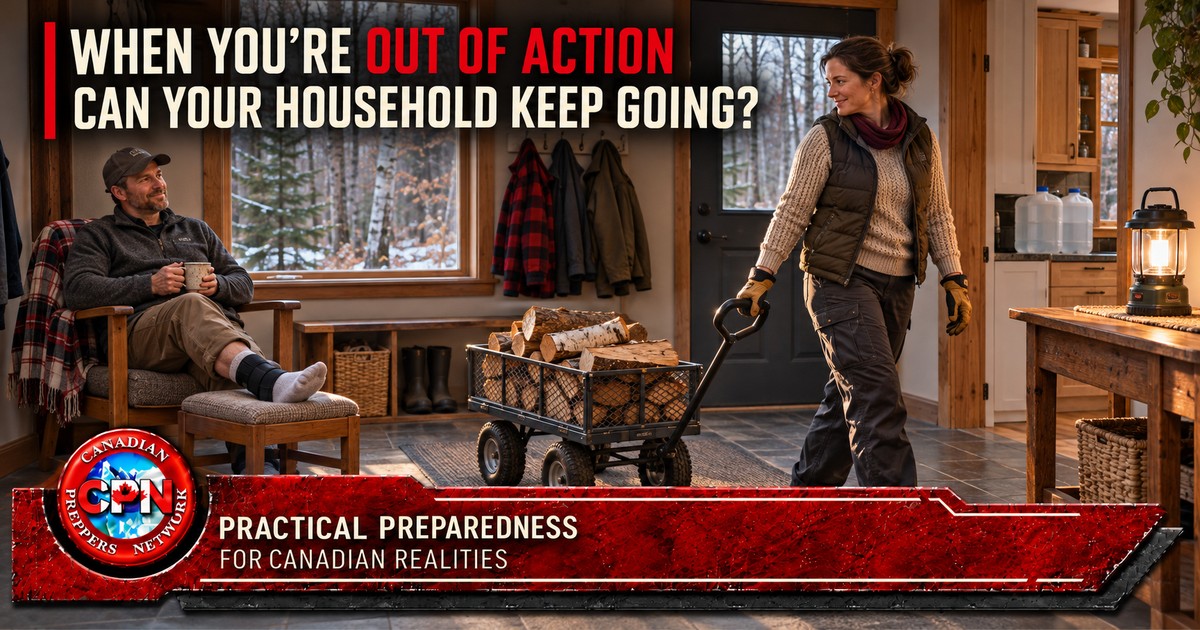
Suddenly, the person who carries the wood, moves the water, operates the backup power system, and knows where everything belongs cannot do much more than give directions from a chair.
Would your household keep functioning?
For many preppers, this is an uncomfortable weakness. Supplies are spread across several systems, but the knowledge and physical ability to use them are concentrated in one person. When that person becomes unavailable, a well-stocked home can become surprisingly difficult to run.
As a Canadian winter approaches, this deserves the same attention as fuel, food, and spare batteries. Preparing your household means making essential work manageable when its most experienced member cannot help.
Find the Jobs That Depend on You
Start with an ordinary day during an extended outage.
Someone needs to bring in fuel, prepare meals, distribute water, manage lighting, charge essential devices, and keep track of what is being used. Depending on your property, there may also be livestock, snow clearing, sanitation, or regular equipment checks.
Now imagine you are out of action and remove yourself from those jobs.
Can another adult find the equipment? Can they carry it? Do they understand how to operate it safely? Can they recognize when something is wrong?
“I could talk them through it” is a fragile arrangement. You might be asleep, away from home, or too unwell to explain anything. Even when you can give instructions, a task that feels obvious to you may contain half a dozen steps you no longer consciously think about.
Choose the three jobs whose failure would cause the most immediate trouble. In a winter household, those might be maintaining heat, getting drinking water to the kitchen, and preparing food.
Those are the first jobs to share—and the first jobs to make physically easier before you are out of action.
1. Out of Action? Make Water and Firewood Easier to Move
A large container can be convenient for storage and awkward for daily use.
Twenty litres of water weighs about twenty kilograms before you count the container. That may be manageable for you today and completely unsuitable for another household member—or for you with an injured shoulder.
If you are out of action, bulk storage must remain accessible to whoever takes over. Keep bulk storage, but create an easier way to draw from it. Smaller food-safe containers, a secure dispensing arrangement, or a pump suitable for drinking water can reduce the need to lift heavy vessels.
Choose the pump for the job. A general-purpose transfer pump is not automatically suitable for potable water. Check the manufacturer’s intended use, wetted materials, cleaning instructions, and any power requirements.
The same principle applies to firewood. A large armload may save trips, but smaller loads can keep the household supplied without leaving someone exhausted or injured.
This is where a utility cart, firewood trolley, or suitable hand truck can earn its storage space. Choose equipment around the actual route: doorway width, thresholds, slopes, wheel size, and the surface underfoot.
A cart that works beautifully on a garage floor may be useless between the woodshed and the house after a snowfall. Test it with the intended load before relying on it.
The objective is a job that another person can complete comfortably, several times a day. Several manageable trips are preferable to one load that becomes an injury.
2. Keep Heat Manageable When You Are Out of Action
A wood stove can become a household dependency when only one person understands its normal operation.
Another adult should know the manufacturer’s operating instructions, the usual lighting and refuelling routine, what fuel is appropriate, and which conditions mean they should stop and get help. They also need to know where gloves, suitable tools, and the ash container belong.
Teach during normal use, while you are available and conditions are calm. Let the learner perform the routine while you watch. Giving a running demonstration yourself does much less to reveal what they have understood.
Make the supporting work easier, too. Keep a manageable indoor wood supply at the required clearance from the stove, maintain a clear carrying route, and provide good lighting.
A headlamp and a stable rechargeable lantern can be more useful here than another high-output flashlight. One keeps hands free; the other lights the work area. A rechargeable work light can also illuminate a larger task area, provided its stand is secure and does not obstruct the carrying route.
Working smoke and carbon monoxide alarms remain essential. Nobody should have to improvise around an unfamiliar heating appliance because the experienced operator is unavailable.
3. Simplify Backup Power Before You Are Out of Action
You may understand every cable, charging adapter, and battery setting in your backup system. Someone else may see a collection of expensive boxes and be afraid to touch anything.
Give them a small number of clearly defined tasks they can complete when you are out of action.
They should know which light to use, where phones and radios charge, which outlets or ports serve those devices, and which appliances the system can support. Store the necessary cables with the equipment.
Practise the routine without your assistance. Ask another adult to set up the normal evening lighting and put essential devices on charge. Watch for uncertainty, missing adapters, awkward controls, and assumptions you have never explained.
Rechargeable lanterns, familiar charging cables, and a straightforward power station can support this arrangement when chosen for the household’s actual needs. Clear controls and understandable indicators deserve consideration alongside capacity.
Weight also matters. A power station that another household member cannot move should have a suitable operating location that does not require repeated lifting.
For generators, follow the manufacturer’s instructions: operate outdoors, well away from doors, windows, and vents, with exhaust directed away from occupied buildings. Any connection to household wiring requires properly installed transfer equipment. Never feed generator power into a wall receptacle. Review Honda Canada’s generator safety guidance alongside your own equipment manual.
4. Build a Meal Routine Someone Else Can Run
A pantry becomes more useful when several people can turn its contents into meals.
Plan meals for the days when you are out of action. Choose a handful of familiar dishes that another adult can prepare using the cooking arrangement you expect to have available. Include meals that require little preparation and a few options that need no cooking.
Keep ingredients accessible. Put the appropriate cookware and utensils together. Make sure someone besides you knows how to use the can opener and where the drinking water comes from.
Consider the physical demands as well. A heavy cast-iron pot full of stew may be difficult to lift with a sore wrist or limited strength. Smaller pots can make cooking and serving easier.
Manageable cookware, an easy-grip manual can opener, and insulated food containers are practical purchases when they remove a real obstacle. A suitable insulated carrier can help keep food warm during serving, but it does not replace safe cooking temperatures, holding temperatures, or timely refrigeration.
Any outdoor-only cooking equipment must remain outdoors and be used according to its instructions. A tired household should already have a workable cooking routine before conditions deteriorate.
5. Share Decisions Before You Are Out of Action
Teaching someone to carry wood is useful. Teaching them to notice that the indoor supply is running low is better.
A household still depends on one person if everyone waits for that person to assign each job.
Share the daily decisions: when to replenish water, which devices need charging, what food should be used next, and when fuel consumption needs attention. Agree on simple routines that reduce repeated decisions.
For example, replenish the indoor fuel supply before darkness, check essential batteries after breakfast, and discuss the evening meal while there is still daylight to prepare it.
This also supports morale. People have a clearer role when they understand their responsibilities and have already succeeded at them. Familiar work gives shape to a disrupted day.
Share responsibilities according to ability and experience. Build competence gradually, and leave room for rest. Replacing one exhausted operator with another does not solve the underlying problem.
Run a “You’re in Charge” Afternoon
Practise being out of action on a normal afternoon and let another adult manage a few essential routines.
Have them move a manageable amount of water, prepare a meal, set up the evening lighting, and use the household radio. If heating equipment is involved, supervise appropriately.
Remain available, but resist taking over at the first hesitation.
Check the entire task, including putting equipment away:
- Find it: Can they locate everything without asking?
- Move it: Can they handle the actual load along the actual route?
- Use it: Can they complete the routine safely?
- Stop it: Do they know when to shut equipment down or seek help?
- Reset it: Can they leave supplies and equipment ready for the next use?
Notice where the task breaks down. Perhaps the lantern is stored somewhere nobody would think to look. Perhaps the water container is too heavy, the cart cannot clear a threshold, or the charging setup requires an adapter kept in your vehicle.
Fix those specific problems. Repeat the exercise after making changes. A successful second attempt is stronger evidence of readiness than a reassuring conversation.
Make Yourself Less Essential
Being the capable person in the household is something to take pride in. Helping others become capable is part of that responsibility.
You may still be the person who maintains equipment, teaches unfamiliar skills, and handles difficult repairs. But the basic daily work should be shared well enough that you can rest, recover, or leave the property without everything waiting for your return.
Being out of action should trigger a familiar handover. This week, choose one essential job that currently depends on you. Make it easier, teach it, and let someone else complete it.
A prepared household should be able to look after its most capable member, too.
Which job would become your household’s biggest problem if you were out of action tomorrow?
Related Reading
- Can Your Household Manage Without You? — test the shared skills behind water, cooking, power, lighting, and communications.
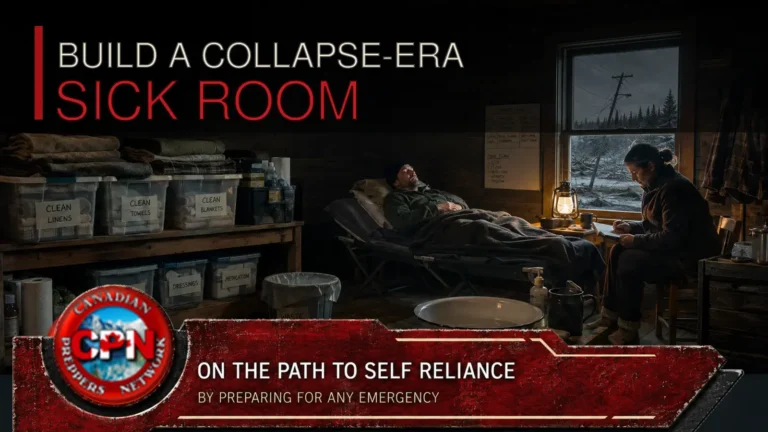
- Build a Collapse-Era Sick Room — prepare a workable space for someone who needs care during a prolonged disruption.
Equipment That Makes Essential Work Easier
Affiliate disclosure: As an Amazon Associate, Canadian Preppers Network earns from qualifying purchases. CPN is also a VEVOR affiliate and may earn a commission from qualifying purchases through the VEVOR links below.
Choose equipment around a problem identified during practice. Compare dimensions, loaded weight, operating instructions, and suitability for your household’s abilities and working conditions.
Amazon.ca: Water and Fuel Handling
Utility wagons and garden carts
Compare wheel size, braking or parking arrangements, load stability, storage space, and performance along your actual route. Do not assume wheels suitable for pavement will handle snow.
https://www.amazon.ca/s?k=utility+garden+cart&tag=canadianprep-20&ascsubtag=dailypost
Firewood carts and log carriers
Choose a manageable carrier or trolley that fits your doors and thresholds. Account for the weight of the carrier as well as the wood.
https://www.amazon.ca/s?k=firewood+cart+log+carrier&tag=canadianprep-20&ascsubtag=dailypost
Smaller drinking-water containers
Look for containers intended for potable water, with handles and closures the intended user can operate. Test the filled weight before buying several.
https://www.amazon.ca/s?k=5+litre+drinking+water+container&tag=canadianprep-20&ascsubtag=dailypost
Manual drinking-water pumps
Confirm drinking-water suitability and compatibility with your container. General fuel, utility, and workshop transfer pumps are not interchangeable with potable-water equipment.
https://www.amazon.ca/s?k=manual+drinking+water+pump&tag=canadianprep-20&ascsubtag=dailypost
Amazon.ca: Lighting, Charging and Information
Headlamps
Prioritize simple controls, comfortable fit, and useful working light. Match batteries or charging arrangements to supplies your household already maintains.
https://www.amazon.ca/s?k=headlamp&tag=canadianprep-20&ascsubtag=dailypost
Rechargeable lanterns
Choose a stable base, accessible controls, and suitable charging connections. Compare runtime at the brightness you expect to use.
https://www.amazon.ca/s?k=rechargeable+lantern&tag=canadianprep-20&ascsubtag=dailypost
Portable power stations
Compare usable capacity, supported loads, charging options, controls, and carrying weight. Size the system around essential devices another adult can confidently operate.
https://www.amazon.ca/s?k=portable+power+station&tag=canadianprep-20&ascsubtag=dailypost
Portable AM/FM radios
A familiar radio with understandable controls can make receiving information a shared household task. Check battery requirements and reception at home.
https://www.amazon.ca/s?k=portable+AM+FM+battery+radio&tag=canadianprep-20&ascsubtag=dailypost
Amazon.ca: Manageable Meal Preparation
Easy-grip manual can openers
Choose a mechanism that your household can comfortably turn and test it on the cans you actually store.
https://www.amazon.ca/s?k=easy+grip+manual+can+opener&tag=canadianprep-20&ascsubtag=dailypost
Manageable stainless-steel cooking pots
Check compatibility with your cooking equipment, handle security, and filled weight. Several smaller batches may be easier to handle than one heavy pot.
https://www.amazon.ca/s?k=stainless+steel+saucepan+with+lid&tag=canadianprep-20&ascsubtag=dailypost
Insulated food jars
Compare usable capacity, opening size, cleaning requirements, and manufacturer instructions for keeping food at safe temperatures.
https://www.amazon.ca/s?k=insulated+food+jar&tag=canadianprep-20&ascsubtag=dailypost
VEVOR Canada: Moving Loads and Lighting the Work Area
VEVOR Steel Garden Utility Cart
A wheeled option for moving secured water containers, fuel supplies, and other household loads along suitable routes. Compare its dimensions, turning space, empty weight, and wheel performance with your property. The cart’s rated capacity is not a recommended load for someone with limited strength.
VEVOR Firewood Log Cart
A dedicated alternative to repeated armloads between the wood supply and the house. Check doorway clearance, thresholds, balance, and the condition of the carrying route. Use a load the operator can comfortably control.
VEVOR Rechargeable LED Work Light with Stand
A portable lighting option for a shared work area when household electricity is unavailable. Check charging requirements, runtime at the intended setting, and stand stability. Position it clear of walking routes and heating appliances.