A real preparedness group is built through shared work, not shared opinions.
Most people do not build a preparedness circle too early. They build it too late.
They wait until the outage has already started, the roads are already bad, the evacuation notice has already been issued, the shelves are already thin, or the neighbour is already knocking at the door. By then, every conversation is harder. People are tired, worried, defensive, embarrassed, or desperate. Promises made under stress are rarely as useful as systems built before stress arrives.
The better time to build a preparedness circle is now, while life is still ordinary enough to test people without panic.
That does not mean inviting half the neighbourhood into your storage room. It does not mean showing everyone your food, fuel, firearms, tools, radios, or backup plans. It does not mean forming a dramatic survival group with titles, ranks, and fantasy scenarios.
It means finding a few reliable households and doing practical things together before an emergency proves whether they can be counted on.
The Canadian Preppers Network hub on Mental Resilience & Community Building in Canada is a good place to start because the human side of preparedness is often the weakest link. A household can stock food, water, heat, lights, tools, and medicine, but if the people around that household are confused, isolated, unreliable, or untested, the plan is still incomplete.
A real preparedness circle is not built by talking about collapse. It is built by doing small useful things together before disaster strikes.
Start With Work, Not Trust
Trust is important, but trust is not the starting point.
Work is.
People often say, “I know who I can count on.” Maybe they do. Maybe they do not. Normal life hides a lot. A person can be friendly and still unreliable. A person can be family and still avoid responsibility. A person can talk preparedness for years and still fail to show up for one Saturday work day.
Shared work reveals what conversation hides.
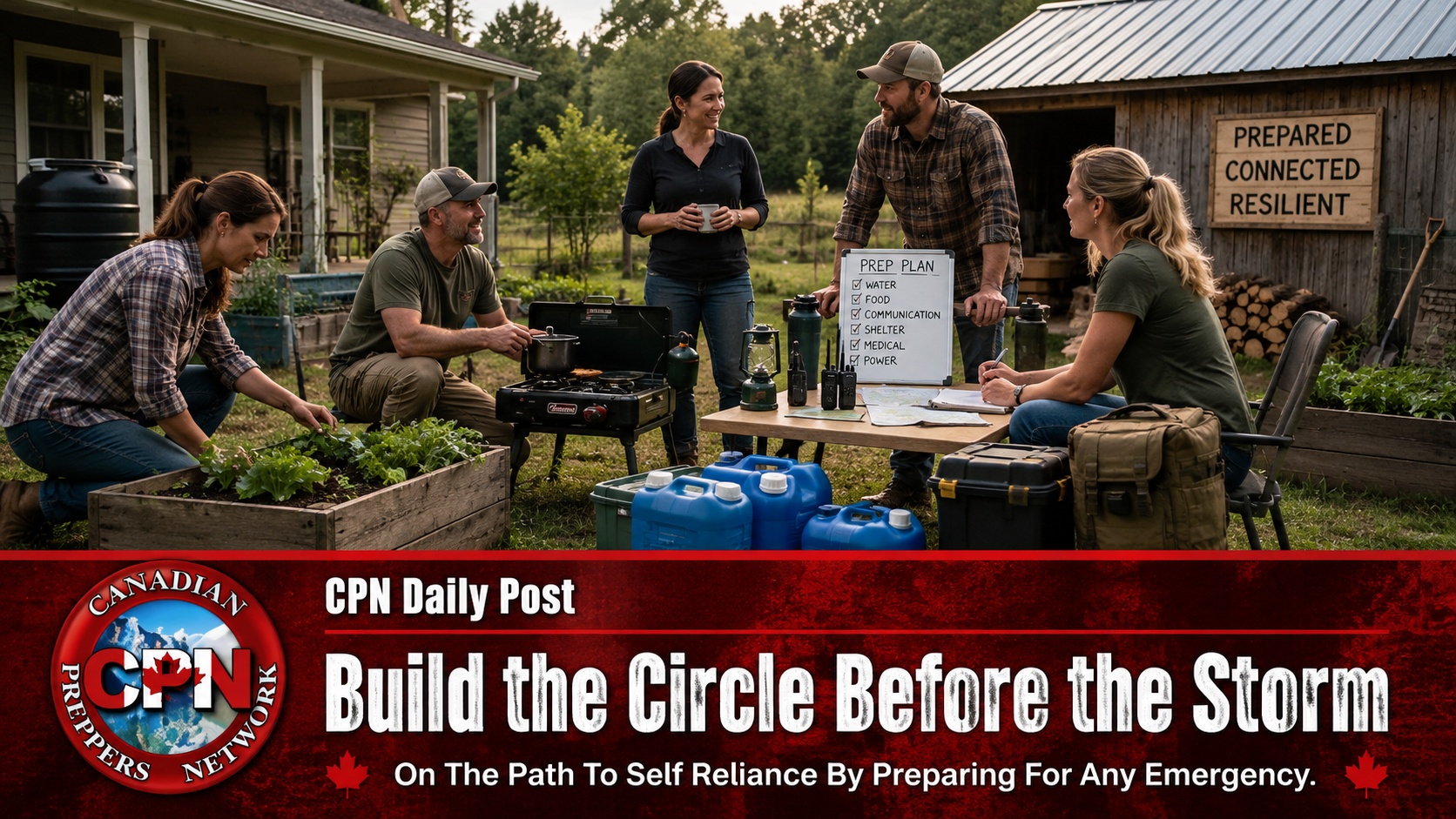
Invite a couple of trusted people to help with something practical. Stack firewood. Build raised beds. Pressure-test a blackout cooking plan. Run a water storage drill. Host a canning day. Split a bulk food order. Test radios across local roads. Cook one full meal without grid power. Help an older neighbour prepare for winter. Set up a temporary outdoor kitchen and feed a small group.
None of these activities require panic. None require exposing private inventories. None require declaring anyone a permanent member of anything.
But they show you a lot.
Who arrives on time? Who brings what they promised? Who works without being chased? Who handles correction well? Who creates drama? Who helps clean up? Who remembers safety? Who keeps private conversations private? Who treats the day like training instead of entertainment?
That is how a preparedness circle begins.
The First Circle Should Be Small
A large group sounds strong until it has to function.
More people can mean more skills, more hands, more vehicles, more land, and more options. It can also mean more noise, more loose talk, more hidden expectations, more family pressure, more uneven contribution, and more conflict.
The best early circle is usually small.
Two or three households can accomplish a lot without becoming unmanageable. A small circle can test communication, share skills, organize work days, and support each other during storms or outages without turning every decision into a meeting.
The article Building a 5-Family Mutual Aid Circle Without Looking Crazy is useful because it keeps the idea grounded. Five families is not an army. It is a practical support network if the people involved are serious, private, and useful.
Start with people who already show signs of reliability.
The person who maintains their home, helps neighbours, handles tools safely, follows through, keeps confidences, and shows up when there is boring work to do may be more valuable than the person with the loudest opinions about preparedness.
A circle is not built by finding the most excited people.
It is built by finding the most dependable ones.
Use Shared Meals as a Low-Pressure Test
Food is one of the easiest ways to begin.
A shared preparedness meal can test more than recipes. It can test planning, equipment, timing, sanitation, fuel use, cleanup, and whether people can cooperate around a simple task.
Invite a few people to a no-grid cooking night. The rule is simple: cook and serve the meal without using the normal kitchen stove, microwave, or electric appliances. Use a camp stove, rocket stove, propane burner, charcoal grill, Dutch oven, thermal cooker, or other backup method. Keep it legal, safe, and appropriate for the location.
The point is not to show off. The point is to learn.
Someone will forget a lighter. Someone will discover their camp stove is too small for family-sized cooking. Someone will realize they have no safe way to wash dishes if the tap is off. Someone will find out that their stored food takes too much water or fuel. Someone will bring a useful idea no one else considered.
That is the value.
A meal creates conversation without making the conversation feel forced. People talk about what worked, what failed, what they would do differently, and what they need to improve. It also shows who is comfortable contributing and who only expects to be served.
This naturally connects to the CPN Food Procurement & Storage in Canada hub because food preparedness is not only about calories on a shelf. It is about storage, preparation, fuel, cooking methods, rotation, and the ability to actually feed people under disrupted conditions.
Build Around Useful Skill Nights
A preparedness circle becomes stronger when members learn together.
Skill nights do not have to be complicated. In fact, they should be simple enough that people will actually attend and repeat them.
A few examples are water storage and filtration nights, blackout cooking nights, home canning or dehydrating days, radio check-in practice, winter vehicle kit reviews, first aid refreshers, map-reading evenings, portable power tests, backyard shelter drills, garden planning days, seed-starting sessions, freezer inventory nights, and food rotation reviews.
Each one gives people something to do before disaster. Each one exposes gaps. Each one builds confidence. Each one creates shared experience.
The important part is repetition.
One meeting creates interest. Repeated practical activity creates a circle.
Do a Water Day Before Water Is the Emergency
Water is one of the best tests for a preparedness circle because it exposes how much people assume.
Many households have some bottled water. Fewer have a realistic plan for storing, moving, filtering, heating, and rationing water during a longer disruption. Fewer still have actually tried carrying enough water for a household, washing dishes with limited water, or using a gravity filter for more than one person.
A group water day can be simple.
Have each household bring its current water containers. Compare sizes, handles, storage practicality, and how heavy they are when full. Test a gravity filter. Fill and move containers. Discuss where water could be sourced locally in an emergency, what would need treatment, and how much fuel or time treatment might require.
This is not about revealing private stockpiles. It is about making people confront the reality of water.
The CPN Water Collection & Purification in Canada hub is useful here because water planning crosses storage, collection, filtration, purification, sanitation, and local conditions.
A household that discovers its water plan is weak before an emergency can fix the problem. A household that discovers it during an outage becomes someone else’s burden.
Practise Communications Before Phones Fail
Communication is another area where people assume too much.
Most preparedness circles begin with phone numbers and a group chat. That is fine as a first layer, but it should not be the only layer.
A real circle should discuss what happens if cell service is unreliable, power is out, internet is down, roads are blocked, or someone cannot be reached. That does not mean everyone needs an advanced radio setup. It does mean the group should have a communication plan that has been tested.
Start simple.
Confirm phone numbers. Print contact lists. Pick a local meeting point. Choose a backup meeting point. Decide when check-ins happen during storms or outages. Test short-range radios around the neighbourhood, acreage, campground, or worksite. Find out where they work and where they do not.
The Communications in Canada hub is a natural reference because communications are not just about owning radios. They are about habits, schedules, range, power, privacy, and discipline.
A radio that has never been charged, labelled, tested, or used under real local conditions is not a communication plan.
Neither is a dead phone.
Use Work Bees to Build Quiet Confidence
One of the best pre-disaster group-building tools is the old-fashioned work bee.
A work bee is not flashy. That is why it works.
Cut and stack firewood. Clean up storm debris. Build garden beds. Move compost. Repair fencing. Help set up a rain barrel system. Build a simple outdoor washing station. Organize a community seed-starting day. Help an older member prepare for winter. Do a driveway, trail, or drainage cleanup before bad weather.
Work bees build quiet confidence because they show competence without bragging.
They also expose important realities. Some people are strong but careless. Some are skilled but impatient. Some are steady and teach well. Some avoid hard jobs. Some bring tools. Some borrow everything. Some look for ways to help. Others disappear when the work starts.
That information matters.
It is better to learn who avoids a wood-stacking day now than to learn it during a winter outage.
Keep Privacy Built Into the Culture
A preparedness circle should not become a gossip network.
Privacy has to be part of the culture from the beginning. Members should not casually discuss who has what, where things are stored, who has medical needs, who owns equipment, who has fuel, or which household is better prepared.
Loose talk damages trust.
This is why early activities should focus on skills and general readiness rather than detailed inventories. A group can test a camp stove without discussing how much food everyone has. It can practise water filtration without revealing stored water quantities. It can run a radio drill without sharing sensitive plans. It can help stack firewood without turning the day into a supply audit.
As trust grows, some information may be shared within smaller layers. But access should be earned through behaviour.
Friendliness is not the same as trust.
Build the Circle Through Local Events
Not every useful connection has to be private from the beginning.
Preparedness events, first aid courses, radio clubs, gardening groups, canning workshops, hunting and fishing clubs, ham radio field days, volunteer organizations, and local emergency training can all help identify serious people.
The key is not to recruit everyone.
The key is to observe.
Who asks practical questions? Who has useful skills? Who follows safety rules? Who respects privacy? Who is there to learn instead of perform? Who seems steady? Who seems like they would be useful in bad weather, not just loud during good weather?
Events like Preppers Meet matter because they give people a way to meet others in the preparedness world without immediately exposing personal plans. A short conversation at an event may lead to a later training day, a radio contact, a barter relationship, or a trusted work bee.
Good circles often begin indirectly.
They grow from repeated contact, useful skills, and proven reliability.
Practical Gear for Building a Preparedness Circle
Disclosure: As an Amazon Associate, Canadian Preppers Network may earn from qualifying purchases.
This buying box is not about office supplies. These are practical tools that support real pre-disaster group activities: cooking nights, water drills, work bees, training days, communications practice, and outdoor skill sessions.
Outdoor propane burner or camp stove
For blackout cooking nights, group meal drills, canning support, and testing whether a household can actually cook when the power is out.
https://www.amazon.ca/s?k=outdoor+propane+burner+camp+stove&tag=canadianprep-20
Cast iron Dutch oven
Useful for outdoor cooking practice, shared meals, bread, stews, and learning slow, fuel-conscious cooking methods.
https://www.amazon.ca/s?k=cast+iron+dutch+oven+camping&tag=canadianprep-20
Gravity water filter system
For group water days, camping, cottage use, and testing how long filtration actually takes for more than one person.
https://www.amazon.ca/s?k=gravity+water+filter+system+camping&tag=canadianprep-20
Portable water containers with spigot
For water storage drills, outdoor handwashing, camp kitchens, group meals, and learning how heavy water really is when it has to be moved.
https://www.amazon.ca/s?k=portable+water+container+spigot+camping&tag=canadianprep-20
Pop-up canopy shelter
For outdoor training days, rain-or-shine work bees, field kitchens, first aid practice, radio tables, and shaded summer gatherings.
https://www.amazon.ca/s?k=pop+up+canopy+shelter+10×10&tag=canadianprep-20
Folding camp kitchen table
For group cooking practice, water filtration demos, canning days, radio setups, and outdoor preparedness workshops.
https://www.amazon.ca/s?k=folding+camp+kitchen+table&tag=canadianprep-20
Garden cart or folding utility wagon
For work bees, firewood, garden projects, water hauling, event setup, and helping less mobile members move supplies without strain.
https://www.amazon.ca/s?k=folding+utility+wagon+garden+cart&tag=canadianprep-20
Food dehydrator
For skill nights focused on food preservation, lightweight trail meals, garden surplus, and rotating stored food into usable meals.
https://www.amazon.ca/s?k=food+dehydrator&tag=canadianprep-20
Vacuum sealer
For group food-prep days, bulk-buy splitting, freezer organization, dry goods protection, and making storage more manageable.
https://www.amazon.ca/s?k=vacuum+sealer+food+saver&tag=canadianprep-20
FRS/GMRS-style family radios
For property coordination, event setup, local check-in drills, storm practice, and learning the real limits of short-range radio before relying on it.
https://www.amazon.ca/s?k=frs+gmrs+radios+canada&tag=canadianprep-20
Portable power station
For communications practice, charging radios and phones during training days, running small devices, and testing blackout routines before an outage.
https://www.amazon.ca/s?k=portable+power+station&tag=canadianprep-20
Solar panel for portable power stations
For testing realistic recharge times, outdoor training days, communications support, and learning what solar backup can and cannot do.
https://www.amazon.ca/s?k=solar+panel+portable+power+station&tag=canadianprep-20
Do Not Let the Circle Become a Free Ride
A preparedness circle should be helpful, but it should not become a substitute for household responsibility.
Every household still needs its own food, water, heat, lights, medicine, sanitation plan, documents, transportation plan, and basic emergency supplies. The circle can help with training, coordination, labour, communication, and mutual aid. It should not become one prepared household supporting several unprepared ones.
That boundary needs to be clear before disaster.
A good circle encourages each household to improve. It shares skills. It helps identify gaps. It may organize group purchases, training days, or work bees. But each household still carries its own load.
This prevents resentment.
It also prevents the quiet assumption that “the group” will solve problems that individual households refused to handle.
Use Repetition to Separate Talkers From Doers
The first meeting may be encouraging. The second activity is more revealing. The third is where patterns appear.
Some people will show up once and disappear. Some will talk endlessly but never act. Some will always have a reason they could not prepare, could not attend, could not bring anything, could not help clean up, or could not follow through.
Others will quietly become dependable.
They will bring the stove. They will remember the fuel. They will help wash dishes. They will check on someone who missed the meeting. They will lend a hand without making a performance out of it. They will improve their own household plan between gatherings.
Those are the people a circle is built around.
Preparedness does not need perfect people. It needs reliable people.
Final Thought
A real preparedness circle is built before the storm, before the blackout, before the evacuation, before the supply disruption, and before people are scared enough to make promises they cannot keep.
Start small. Keep privacy. Build through work. Practise useful skills. Test communication. Cook together. Haul water. Run drills. Help with practical projects. Watch who follows through.
The strongest preparedness circle may not look dramatic from the outside. It may simply be a few households that have already cooked together without power, filtered water together, checked radios together, worked in bad weather together, and learned who can be counted on before anything goes wrong.
That is real community preparedness.
Not talk.
Not panic.
Not fantasy.
Work done together before the emergency.