
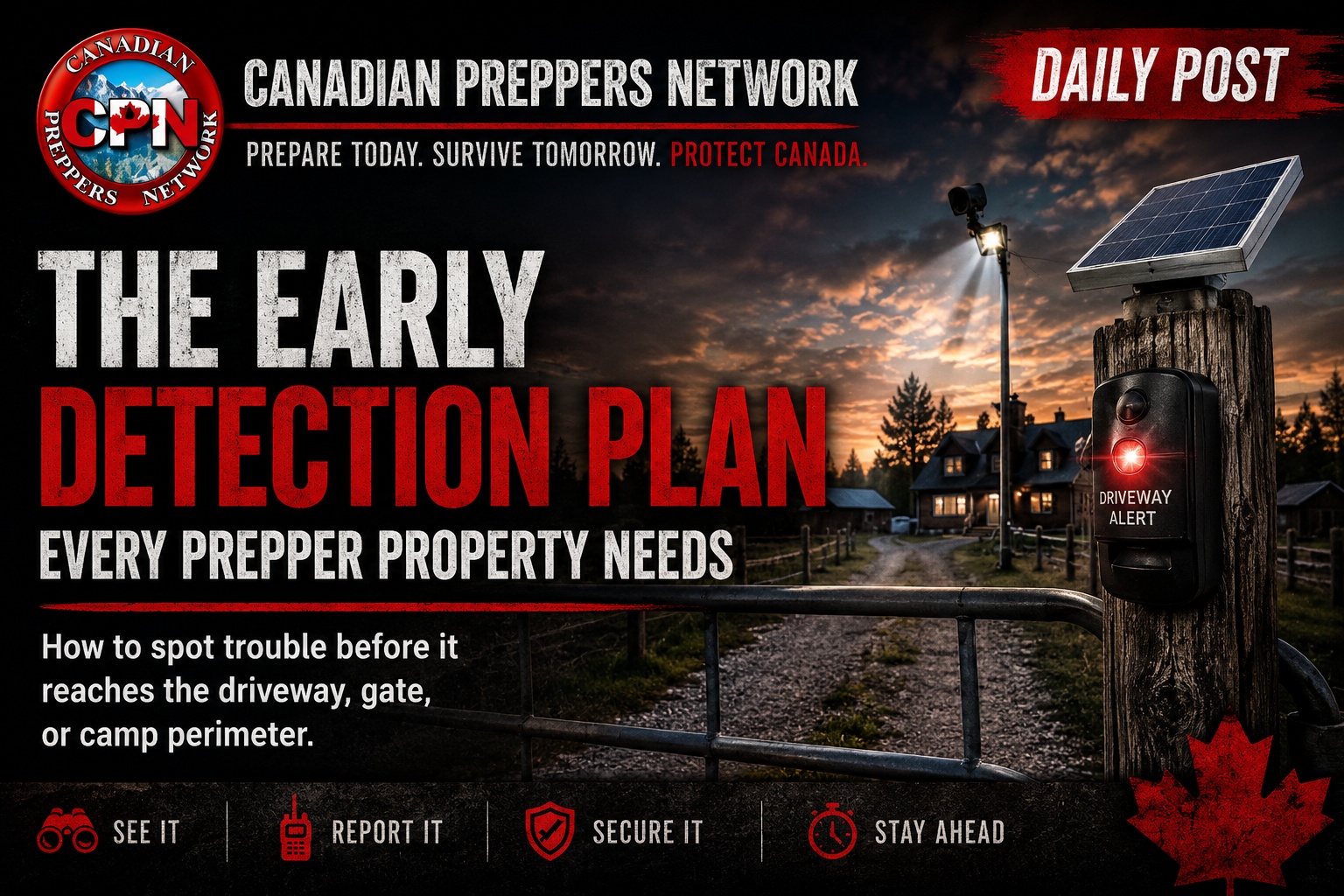
How to spot trouble before it reaches the driveway, gate, or camp perimeter
Most people think about security too late.
They imagine the problem at the door, at the window, at the shed, at the fuel tank, or already standing in the driveway. By that point, time has already been lost. The best security layer is not the final barrier. It is the first hint that something is moving where it should not be moving, stopping where it should not be stopping, or approaching in a way that does not fit the normal pattern.
That is what early detection is for.
For Canadian preppers, this matters whether we are talking about a rural homestead, a bug-out location, a hunting camp, an acreage, a suburban home, or a multi-family retreat. Locks, lights, cameras, gates, and radios all have their place, but they should not exist as disconnected gadgets. They should work together to give you one thing above all else: time.
Time to wake up.
Time to look.
Time to call someone over.
Time to turn on lights.
Time to secure animals.
Time to move vulnerable people inside.
Time to avoid guessing.
That is the difference between reacting and responding.
A proper security plan starts long before anyone reaches the house. This ties directly into the broader concepts covered in the CPN Security & Defence hub.
Detection Comes Before Defence
The most common preparedness mistake is treating security as a last-line problem.
People focus on the door, the confrontation, or the dramatic moment. That may make for interesting conversation, but it is not how real household security should be built. Real security is usually boring. It is distance, visibility, routine, and clear habits repeated until they become automatic.
A gate is better if you know someone is at it.
A camera is better if someone checks it.
A dog is better if the household understands the difference between normal barking and an unusual alert.
A radio is better if everyone knows what channel to use.
A locked door is better if you had five minutes of warning before anyone reached it.
Early detection is not about paranoia. It is about reducing surprise.
Surprise is what turns small problems into big ones. A vehicle turning around in the driveway may be nothing. Someone walking along the edge of the property may be lost. A noise near the barn may be an animal. But if you do not know it is happening until the moment it reaches the house, every decision becomes rushed.
Early detection lets you observe first.
Know Your Normal Pattern
Before you can spot something unusual, you need to know what normal looks like.
Every property has patterns. The mail arrives at a certain time. Neighbours drive past in familiar vehicles. Delivery trucks stop in obvious places. Wildlife uses the same routes. Wind moves certain branches. The dog barks differently at deer than at people. Gravel sounds different under a car than under a person walking.
A household that pays attention to those patterns has an advantage.
Start by walking the property during the day. Then walk it again at dusk. Then observe it from inside the house at night. Look for the places where someone could approach unseen. Look for corners where headlights appear late. Look for dark gaps between buildings. Look for the blind side of sheds, barns, fuel storage, chicken coops, garages, and wood piles.
The question is not simply, “Can someone get in?”
The better question is, “How soon would we know they were coming?”
That one question changes the whole plan.
The Driveway Is Often the First Detection Point
For many rural and semi-rural homes, the driveway is the first serious warning line.
A long driveway is not just access. It is a detection zone. If you only notice visitors when they are already beside the house, the driveway is wasted. A simple wireless driveway alarm can give the household a few extra seconds or minutes of awareness. That may not sound dramatic, but in a real emergency those seconds matter.
Driveway alarms are especially useful where visibility is poor. Curves, tree cover, long laneways, snowbanks, outbuildings, and uneven terrain can hide movement until it is close. A sensor placed near the entrance or along a key approach can alert the house before the visitor is in the yard.
Placement matters. Too close to the road and you may get constant false alerts. Too close to the house and you lose the warning advantage. The goal is to create a useful alert point where movement deserves attention.
For a retreat or group property, the driveway alarm should also be tied to a simple routine. Who checks it? Who looks outside? Does someone verify by camera? Does someone radio the barn, shop, cabin, or gate? Does the household have a phrase for “unknown vehicle at the driveway” that does not cause panic but gets attention?
Gear without routine is just noise.
Cameras Should Watch Approaches, Not Just Doors
Most people put cameras where they are easy to install. That usually means pointing them at the front door, the driveway, or the garage. Those are useful, but they are not enough.
The early detection layer should include approach routes.
Think about the back side of the property. The footpath behind the shed. The trail that comes out near the woodlot. The old farm lane. The ATV track. The blind side of the barn. The low spot where someone could walk below the sightline of the house. These are the places where a trail camera or off-grid camera may be more useful than another view of the front step.
Trail cameras are especially valuable because they can function without household internet. Some are better for routine wildlife and property monitoring. Others are better suited for recording activity at gates, trails, equipment areas, or storage locations. In normal times, they help you learn movement patterns. In stressed times, they help you identify whether something is changing.
The important point is that cameras should answer useful questions.
Who is using that trail?
When are vehicles stopping near the gate?
Are people approaching the shed from the back?
Are animals damaging fencing?
Is the fuel area being visited at night?
Did the alert come from a person, a vehicle, or wildlife?
A camera does not stop a problem by itself. It gives you information. That information is only valuable if someone checks it and acts on it calmly.
This is the same principle behind CPN’s earlier article on building a defensive home after normal systems fail.
Light Should Reveal, Not Advertise
Lighting is often misunderstood.
Some people want everything blazing bright all night. Others want total darkness. Both approaches can create problems. Constant bright lighting may reveal useful information about your property, your layout, and your movement. Total darkness may leave the household blind.
A better approach is controlled lighting.
Motion sensor lights near doors, sheds, gates, fuel storage, animal pens, and parking areas can be extremely useful. They do not need to make the property look like a prison yard. They simply need to expose movement at decision points. A light that comes on near the woodshed tells you something changed. A light near the chicken coop may reveal predators, loose animals, or people. A light on the blind side of the garage may remove a hiding place.
For preparedness use, battery backup and solar options deserve attention. Grid-tied lighting is useful during normal times, but blackouts are exactly when security awareness becomes more important. A few independent lights in key locations can preserve visibility when the rest of the street or rural road is dark.
The goal is not to impress anyone. The goal is to see what is happening before it reaches the vulnerable point.
Dogs, Neighbours, and Human Observation Still Matter
Technology is useful, but people are still the core of the early detection layer.
A dog may hear what you miss. A neighbour may notice a strange vehicle. A family member may recognize that the same truck has passed twice. A retreat member on a quiet walk may spot tracks, cut fencing, fresh tire marks, disturbed snow, or a gate left differently than usual.
These observations should not live only in someone’s memory.
A simple property log can be surprisingly useful. Note unusual vehicles, repeated visits, gate alarms, camera captures, broken lights, damaged locks, missing fuel, livestock disturbances, and unexplained noises. Over time, patterns emerge. A single odd event may mean nothing. Three odd events around the same location may deserve attention.
For a multi-family retreat or preparedness group, this becomes even more important. People need a shared understanding of what should be reported. That does not mean turning the property into a drama factory. It means having enough discipline to notice changes and communicate them clearly.
This connects naturally with group preparedness and mutual support planning, especially when trusted groups begin coordinating security, communications, and retreat routines.
Radios Turn Detection Into Action
An alert is only useful if it reaches the right people.
On a larger property, yelling is not a communications plan. Cell phones may work during normal times, but they may be dead, charging, muted, out of range, or unavailable during an outage. Radios fill that local gap.
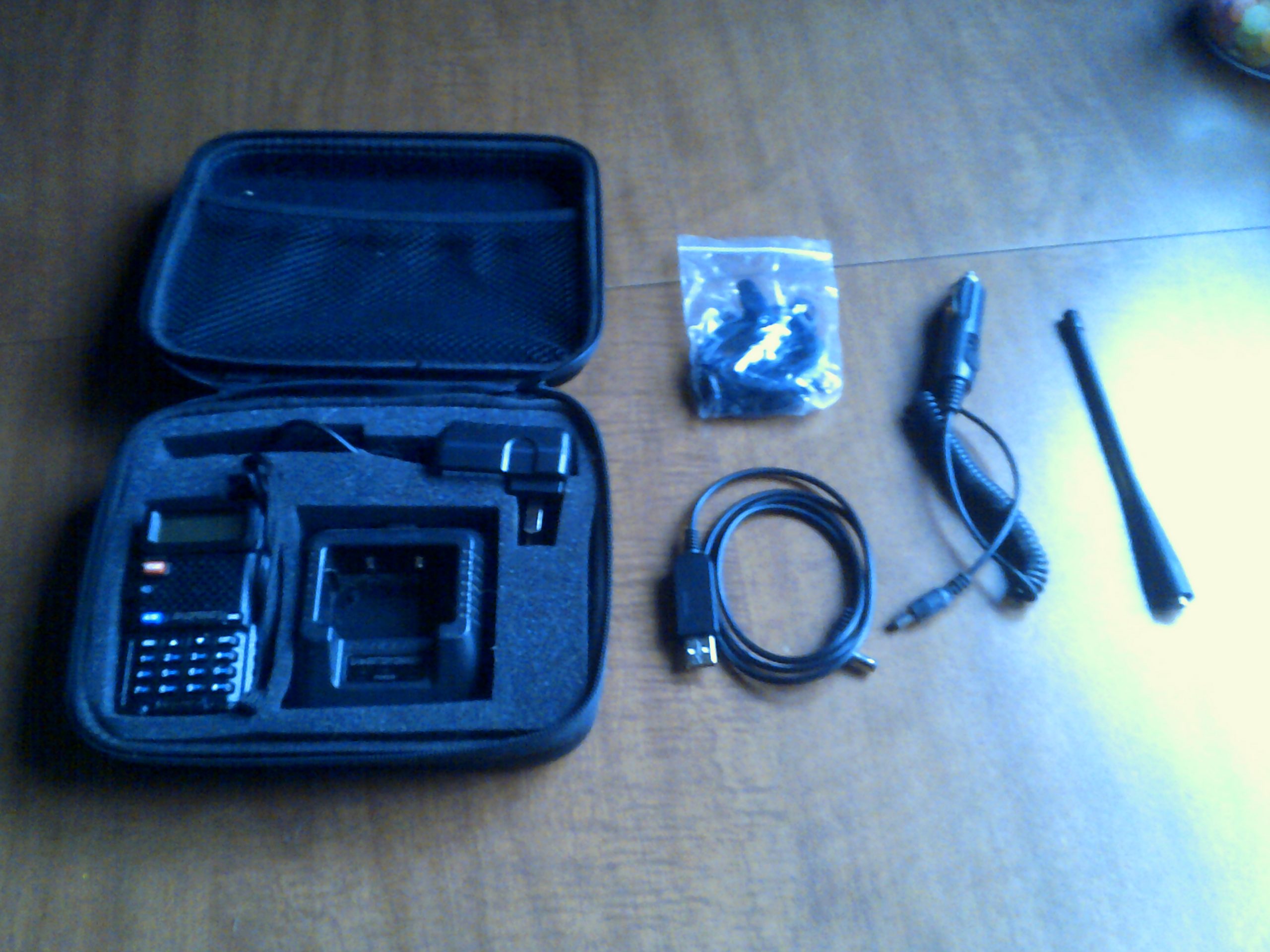
FRS/GMRS-style household radios, amateur radio where appropriate, or other agreed communication tools can connect the house, barn, shop, gate, garden, camp area, and observation points. The equipment matters, but the habits matter more.
Everyone should know what channel is monitored, when check-ins happen, what words are used for routine alerts, who answers first, when to keep radio traffic short, and where spare batteries or chargers are kept.
A useful early detection system does not need constant chatter. In fact, constant chatter makes people tune out. What it needs is discipline. Short messages. Clear locations. No exaggeration. No panic.
“Motion light at the fuel shed.”
“Unknown vehicle stopped at the gate.”
“Dog alerting toward the lower trail.”
“Camera picked up movement behind the barn.”
“Checking now. Stand by.”
That is enough to get attention without creating confusion.
CPN’s Communications in Canada hub is a good companion to this topic because security and communications are tightly linked.
Build Decision Points
The purpose of early detection is not just to know something happened. It is to create decision points.
A driveway sensor is a decision point.
A gate camera is a decision point.
A motion light near the shed is a decision point.
A dog alert at the back door is a decision point.
A radio check-in that goes unanswered is a decision point.
Each point gives you a chance to choose the next calm action.
Maybe you simply look through a window. Maybe you check a camera. Maybe you turn on exterior lights. Maybe you call another adult in the house. Maybe you secure animals. Maybe you contact a neighbour. Maybe you avoid going outside until you know more. Maybe the answer is simply to observe and record.
The important thing is that you are not making your first decision under pressure at the door.
The Simple Early Detection Audit
Walk your property and ask these questions:
Where would someone naturally enter?
Where could someone approach without being seen?
Where do vehicles stop?
Where are the blind spots?
Where are fuel, tools, animals, generators, and stored supplies most exposed?
What would wake us up at night?
What still works during a power outage?
Who receives the alert?
What happens next?
That audit will usually reveal the first upgrades.
For some households, the first upgrade is a driveway alarm. For others, it is motion lighting. For others, it is pruning brush near windows, moving fuel storage, adding a lock to a shed, relocating cameras, buying radios, or creating a basic night routine.
The right answer depends on the property. The principle is always the same: detect early, confirm calmly, communicate clearly, and avoid being surprised.
Preparedness Buying Box: Off-Grid Early Detection Gear
Disclosure: As an Amazon Associate, Canadian Preppers Network may earn from qualifying purchases.
Early detection gear should not depend entirely on household internet, grid power, or cloud services. The best options for preparedness use are simple, portable, battery-powered, solar-capable, or able to keep working during outages.
Solar Wireless Driveway Alarms
Useful for rural driveways, long laneways, gates, and retreat entrances. Look for solar-capable systems with long sensor range, rechargeable batteries, and multiple receivers if the property has several buildings.
Search Amazon.ca for solar wireless driveway alarms
Solar Trail Cameras
Useful for monitoring back trails, gates, sheds, fuel areas, animal pens, and remote approaches without relying on household power or Wi-Fi. Models with SD card storage are especially useful where internet access is unreliable.
Search Amazon.ca for solar trail cameras with SD card storage
Battery or Solar Motion Sensor Lights
Useful for exposing movement near sheds, barns, gates, wood piles, fuel storage, animal pens, and blind corners. Solar models can keep working through normal outages, while battery models can be moved where needed.
Search Amazon.ca for solar motion sensor outdoor lights
Battery-Powered Door and Window Alarms
Useful for sheds, cabins, trailers, storage rooms, pump houses, garages, and secondary buildings where a full wired alarm system is unrealistic.
Search Amazon.ca for battery-powered door and window alarms
Rechargeable FRS Two-Way Radios
Useful for household, retreat, campground, worksite, and property coordination when cell phones are unreliable or inconvenient. USB-rechargeable models are easier to support from solar panels, power banks, or portable power stations.
Search Amazon.ca for USB rechargeable FRS two-way radios
USB Battery Chargers and Rechargeable AA/AAA Batteries
Useful for keeping radios, flashlights, driveway sensors, small lights, and other early detection gear running from power banks, solar chargers, or portable power stations.
Search Amazon.ca for USB AA/AAA battery chargers and rechargeable batteries
Waterproof Notebooks and Pencils
Useful for property logs, observation notes, camera checks, radio logs, shift notes, gate activity, and pattern tracking without depending on phones or computers.
Search Amazon.ca for waterproof notebooks and pencils
For more practical security supplies, see CPN’s Security & Defence Buying Guide.
Final Takeaway
Security does not begin at the front door.
It begins at the edge of awareness.
A household that knows what is normal, watches the approaches, controls lighting, uses simple alerts, communicates clearly, and keeps a basic log is already ahead of most people. It does not need to look like a fortress. It needs to buy time, reduce surprise, and support calm decisions.
The best early detection layer is not one device. It is a system of habits.
A sensor alerts.
A camera confirms.
A light reveals.
A person observes.
A radio connects.
A log preserves the pattern.
That is how preparedness security becomes practical instead of theatrical.

2 Comments