When conflicting reports become a survival threat.
Two neighbouring communities depend on the same road.
One controls a grain store and several working tractors. The other has fuel, medical supplies and access to a reliable well. Neither community can remain fully independent for long, so representatives begin negotiating an exchange.
Before the meeting is over, someone reports that an agreement has been reached.
An hour later, another source claims the talks have collapsed. A radio operator hears that access to the road will be restricted. Someone else insists the restrictions were removed. One leader says progress is being made. Another warns that the other side is acting in bad faith.
None of the reports includes a written agreement.
That does not stop people from reacting.
Families begin hiding food. Fuel is moved out of sight. Work crews refuse to cross the boundary. Someone closes the road “as a precaution.” A frightened resident confronts a delivery driver. By nightfall, the rumour has changed conditions on the ground more than the negotiation itself.
The agreement may not exist, but its consequences already do.
Emergency misinformation does not need to convince everyone. It only needs to make enough people act before the facts are known.
Uncertainty Creates Its Own Emergency
Preparedness discussions often assume that information will be either available or unavailable.
Reality is more dangerous.
Information may arrive constantly while remaining incomplete, contradictory and deliberately vague. There may be official statements, unofficial briefings, overheard conversations, anonymous claims, confident predictions and reports attributed to people who are supposedly close to the negotiations.
The group is not operating in darkness. It is operating in fog.
That distinction matters because people tolerate a lack of information better than they tolerate competing versions of reality. When nobody knows which account is true, individuals begin choosing the version that fits their existing fears, loyalties or hopes.
- The nervous person believes the worst report.
- The optimist accepts the most reassuring one.
- The angry person assumes betrayal.
- The person with supplies begins hiding them.
- The person seeking influence claims to possess information nobody else has.
Soon the dispute is no longer about facts. It becomes a test of identity: which side are you on, and whose version do you believe?
A 2025 review of misinformation during natural disasters found that misleading reports can increase confusion, fear and distrust, redirect resources and encourage inappropriate action. The practical lesson is simple: bad information can become a second emergency layered on top of the first.
LIMITED-SPACE OUTDOOR EVENT
PLINKIN’ IN THE WOODS
With Frugal Gunnie
Spend a full day developing practical outdoor rimfire marksmanship skills in a controlled setting. Instruction covers multiple shooting positions, stability aids and individual technique.
Saturday, September 12, 2026
8:00 a.m.–5:00 p.m.
Great Ape Empire
267 Highway 6, Wiarton, Ontario
Event admission: $250 CAD
Weekend camping: $20 per person
Space is strictly limited. Adult participants must meet all applicable legal and organizer requirements.
Negotiations Produce Messages, Not Just Agreements
A statement made during a negotiation may be intended to accomplish several things.
It may reassure one group, pressure the other side, buy time, test public reaction, conceal a concession or create the appearance of progress. A deadline may be real, flexible or primarily theatrical. A positive statement may mean that an agreement is close—or merely that someone wants the public to think it is.
This does not automatically mean every leader is lying.
It means that statements made during negotiations are part of the negotiation.
A prepared group must understand the difference between information intended to explain events and communication intended to influence them. Treating every public claim as a neutral description of reality makes the group easy to manipulate.
Until the terms are written, confirmed and implemented, the practical situation has not necessarily changed.
Repetition Does Not Create Confirmation
A rumour can appear to have several sources when every version originated with the same person.
One operator hears a report and passes it to a neighbouring radio net. Someone on that net posts it on a message board. Another person repeats the post during a community meeting. By the time the story returns to its point of origin, it seems to have been independently confirmed three times.
It has not. It has completed a circle.
This becomes especially dangerous when normal communications are damaged. People may receive fragments through amateur radio, commercial broadcasts, travellers, printed notices, word of mouth and intermittent internet access. The same unverified claim can travel through every channel and acquire authority simply because it is heard repeatedly.
“Everyone is saying it” is not confirmation. It may only mean that one rumour travelled efficiently.
Separate Facts, Claims and Predictions
A functioning group needs a simple way to classify incoming information.
Confirmed facts are directly observed or supported by a written, attributable source. The bridge is physically closed. The delivery did not arrive. A signed agreement has been distributed. The fuel depot has changed its operating rules.
Reported claims come from an identifiable source but have not been independently verified. A representative says an agreement is close. A driver reports being turned back. A radio station says new restrictions are expected.
Predictions are assessments of what may happen next. Prices will rise. The road will close. Negotiations will fail. Supplies will be restricted.
Predictions can be useful, but they must never be disguised as facts.
The group should also maintain a fourth category: unknown.
Saying “we do not know yet” is not weakness. It is considerably safer than filling the gap with whatever answer produces the strongest emotional reaction.
FREE CANADIAN PREPAREDNESS DOWNLOAD
Canadian Grid-Down Starter Kit
Use this printable first-72-hours checklist to test your household’s water, food, sanitation, power, communications and operating routines before a short outage becomes a long-term grid-down emergency.
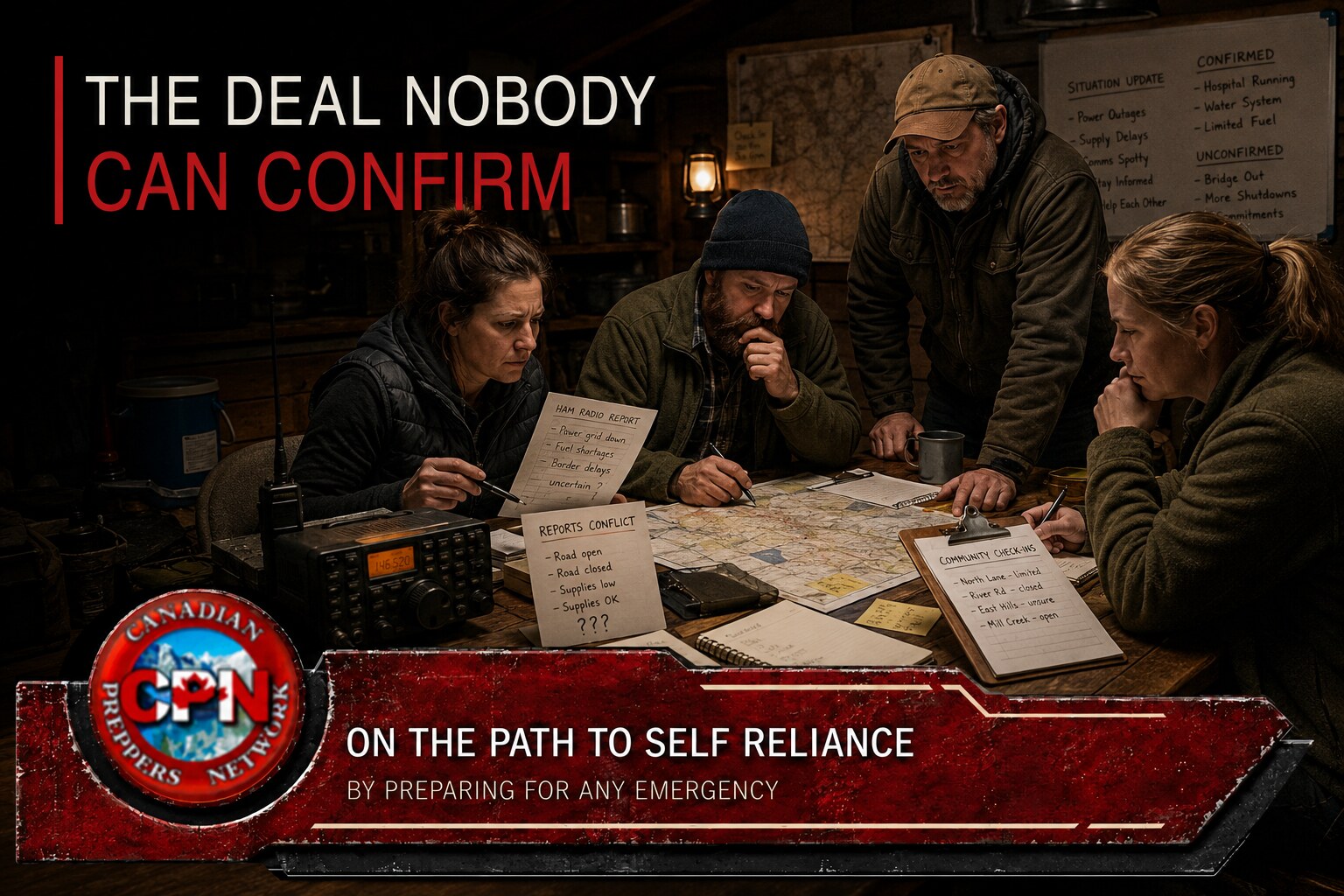
Build an Information Board
A whiteboard, chalkboard or large sheet of paper can prevent hours of argument.
Divide it into four columns:
- Confirmed
- Reported but unconfirmed
- Unknown
- Action trigger
Every important claim goes onto the board with its source and the time it was received. If a second report arrives, record whether it is genuinely independent or merely repeating the first.
The action-trigger column is the most important.
Instead of reacting to every new rumour, decide in advance what evidence would justify a change. The group may continue normal fuel distribution unless an actual delivery is missed. Access rules may remain unchanged unless a written notice is received or the road is physically blocked. Additional inventory controls may begin if two scheduled shipments fail rather than because someone predicts a shortage.
This prevents emotion from rewriting policy every hour.
Silence Must Have a Schedule
Leaders often delay speaking because they do not yet have complete information. That silence creates a vacuum.
If nothing authoritative is said, the person with the most dramatic story becomes the group’s unofficial information officer. Even a short scheduled briefing is better than leaving everyone to speculate.
A useful briefing answers four questions:
- What has been confirmed?
- What is being reported but remains unverified?
- What has not changed?
- When will the next update be given?
The third question is easily overlooked. People need to know which rules, supplies, routes and agreements remain in effect while uncertainty continues.
A leader who says, “We have nothing new, the present arrangement remains in place, and the next briefing will be at 1800,” provides more stability than one who disappears until every detail is settled.
CPN’s Mental Resilience and Community Building in Canada treats clear roles, written records, calm communication and routine as survival infrastructure rather than optional comforts.
PRESERVE THE KNOWLEDGE YOU MAY NEED LATER
CPN Gold Membership
Gold Membership includes access to the CD3WD collection and hundreds of practical offline manuals covering water, sanitation, shelter, food production, repairs, agriculture, health, energy and low-technology self-reliance.
Gold members also receive the monthly Canadian Preparedness Intelligence Briefing, examining global geopolitics, domestic economic pressures, employment, food and energy security, civil-defence developments and other emerging risks.
Only $5 per year.
Do Not Punish Honest Corrections
Bad information cannot be corrected if people are afraid to admit they were wrong.
If every mistaken report leads to public humiliation, sources will defend their claims long after the evidence has changed. They will alter details, blame someone else or insist that the original report was “basically true.”
Correct the information without turning every correction into a trial.
Deliberately fabricated claims are different. Someone who knowingly invents reports to manipulate supplies, undermine leadership or provoke conflict presents a serious threat to the group. That behaviour should be documented and addressed.
However, confusion, mishearing and premature conclusions will occur even among trustworthy people. The objective is to improve the information system, not create a community in which nobody is willing to report anything.
Make Reversible Decisions First
When information is incomplete, the safest response is usually the one that preserves options.
- Increasing observation may be reasonable. Permanently closing a route may not be.
- Checking inventory makes sense. Seizing private supplies based on a rumour does not.
- Preparing alternate arrangements is prudent. Publicly accusing a neighbouring community of betrayal may make an agreement impossible.
A reversible decision buys time without creating unnecessary enemies. An irreversible decision made from bad information can turn a manageable dispute into a lasting conflict.
Preparedness is not the ability to react fastest. It is the ability to act at the right speed for the evidence available.
Confusion Can Be Deliberately Useful
Not every rumour begins accidentally.
A person may release an exaggerated claim to test how the group reacts. A negotiating party may hint that talks are failing to pressure the other side. Someone hoping to profit from shortages may encourage panic. A rival inside the group may use outside uncertainty to weaken confidence in existing leadership.
The best defence is not trying to guess every motive. It is refusing to let unverified information produce automatic action.
When the group already has source standards, scheduled briefings, written records and predetermined triggers, manipulation becomes harder. A dramatic claim may still create concern, but it cannot immediately change access, rationing, security or trade arrangements on its own.
Health Canada emergency-recovery guidance similarly emphasizes monitoring misinformation, correcting rumours quickly and maintaining consistent ongoing messages. The setting may differ, but the human problem is the same.
Practise Before Information Becomes Scarce
Rumour control should be exercised like any other preparedness procedure.
During a drill, introduce several reports:
- A supply vehicle was allegedly stopped.
- A neighbouring group supposedly changed its terms.
- An official announcement is expected.
- A deadline has reportedly moved.
- Two apparently separate sources repeat the same claim.
Then observe what happens.
Who records the information? Who checks its origin? Who decides whether it changes operations? How quickly does speculation become accepted as fact? Does the group demand certainty that does not exist, or can it continue functioning while important questions remain unresolved?
The exercise is not testing whether people can discover the hidden answer. It is testing whether they can remain disciplined without one.
The Group Information Kit
Tools for Verifying Reports and Coordinating Decisions
These simple supplies support visible records, scheduled updates and disciplined information handling when normal communications become unreliable.
- Dry-erase whiteboards for confirmed, unconfirmed and unknown reports
- Waterproof notebooks for source and decision logs
- Storage clipboards for briefing sheets and standing orders
- Battery-powered AM/FM radios for official broadcasts
- Index cards for time-stamped message handling
- Laminating pouches for durable procedures and source standards
Disclosure: This article contains Amazon affiliate links. As an Amazon Associate, Canadian Preppers Network may earn from qualifying purchases.
Related CPN Reading
- The People You Ignore Now May Decide Whether You Survive Later
- Building a 5-Family Mutual Aid Circle
- Mental Resilience and Community Building Buying Guide
Research Sources
- The Impact of Misinformation on Social Media in the Context of Natural Disasters
- Health Canada: Guidance on Planning for Recovery Following a Nuclear or Radiological Emergency
- Public Health Agency of Canada: Emergency Resilience, Social Cohesion and Trust
The Real Preparedness Skill Is Tolerating Uncertainty
A group that needs immediate certainty will eventually accept false certainty.
It will follow the most confident speaker, believe the most repeated report or take drastic action simply to escape the discomfort of not knowing. That makes the group vulnerable to panic, manipulation and internal division.
A resilient community can say:
We know this.
We have heard this.
We cannot yet confirm this.
Nothing changes until this specific trigger occurs.
That language may sound cautious, but caution is not passivity. It allows preparations to continue without letting every claim become a command.
In a prolonged emergency, the rumour may arrive before the shortage, the restriction or the conflict.
If the group cannot control the rumour, it may create all three.
How would your group decide which report is credible when every side insists it is telling the truth?