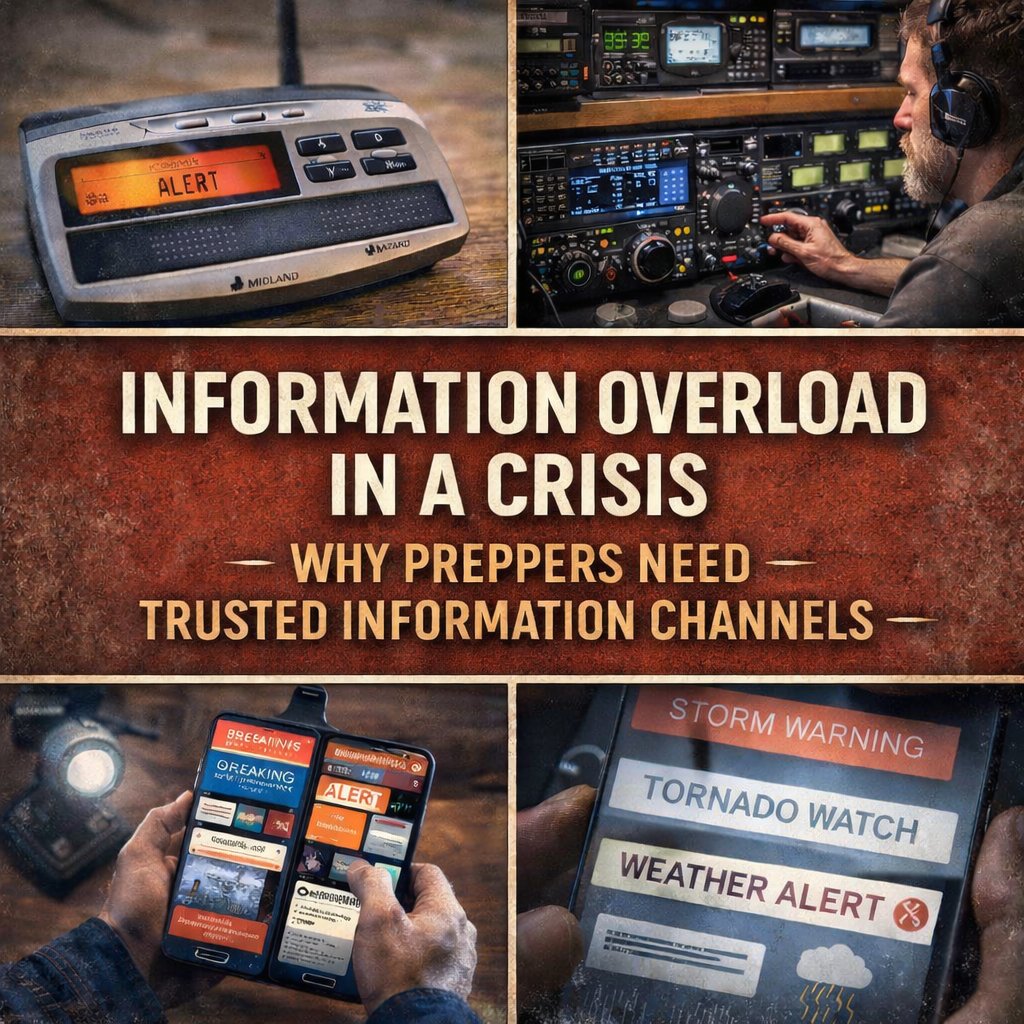
In the early hours of a crisis, information becomes as valuable as food or fuel. Unfortunately, modern emergencies come with a new problem: too much information, much of it unreliable.
During major weather events, civil unrest, or infrastructure disruptions, news spreads rapidly across social media, messaging apps, and online news feeds. Some of it is accurate. Much of it is speculation, misinterpretation, or outright misinformation.
For preppers, the goal isn’t simply gathering information—it’s filtering it effectively.
Preparedness means knowing where your reliable information will come from before a crisis begins.
The Problem With Modern Information Streams
In the past, Canadians relied on a handful of authoritative sources: national broadcasters, emergency radio alerts, and local authorities.
Today’s information environment is very different.
A single developing situation may produce thousands of online posts, amateur reports, conflicting headlines, and unverified claims within minutes. The result is confusion rather than clarity.
For example, during severe storms or wildfire evacuations, social media can produce:
- False road closure reports
- Incorrect evacuation rumours
- Outdated weather warnings
- Misidentified locations
These mistakes may not be malicious—but they still create dangerous decisions.
Why Preppers Should Build Information Redundancy
Preparedness isn’t just about redundancy in water, food, or power. Information systems need redundancy too.
A resilient household should ideally maintain multiple ways to monitor events:
Primary information channels
- Government alerts and official weather services
- Local radio broadcasters
- Emergency management updates
Secondary channels
- Amateur radio networks
- Marine or aviation weather broadcasts
- Local community communication groups
Layering these sources makes it easier to confirm whether a report is credible.
This is one reason many preparedness-minded Canadians keep a battery-powered emergency radio as part of their communications kit:
https://www.amazon.ca/s?k=emergency+weather+radio
Even when internet and cellular service fail, broadcast radio often remains available.
For those exploring deeper communications capability, our earlier article on amateur radio emergency networks explains how community radio operators often become informal information hubs during disasters:
https://canadianpreppersnetwork.com/amateur-radio-emergency-nets-in-canada/
Amateur Radio: The Original Information Network
During hurricanes, ice storms, and large-scale power outages, amateur radio operators frequently provide some of the most accurate real-time situational awareness.
Ham radio networks allow operators to exchange information directly between communities without relying on centralized infrastructure.
This makes them particularly valuable when:
- Cellular networks are overloaded
- Internet services fail
- Power outages affect communications infrastructure
Even if you’re not licensed to transmit, monitoring amateur radio traffic can provide valuable insight into unfolding events.
A simple handheld scanner or dual-band radio capable of receiving VHF/UHF frequencies can monitor many local emergency communications channels.
The Discipline of Verification
A simple rule used by many emergency planners applies equally well to preparedness:
Two independent confirmations before acting.
If a major piece of information appears—such as a highway closure, evacuation order, or major infrastructure failure—verify it through at least two independent sources before making major decisions.
This habit dramatically reduces the chances of reacting to rumours or outdated information.
Avoiding the Panic Cycle
Information overload can produce a psychological effect that many people experienced during recent crises: panic escalation.
The cycle looks like this:
- Unverified report appears online
- Social media spreads it rapidly
- People react emotionally
- More speculation amplifies fear
Prepared individuals learn to slow down the cycle. They check sources, confirm facts, and maintain a calm decision-making process.
Mental resilience in emergencies often begins with information discipline.
Building Your Household Information Plan
Every preparedness plan should include an information strategy, just like it includes food storage or emergency power.
At minimum, households should identify:
- Two trusted national information sources
- One reliable local news outlet
- A broadcast radio backup
- A method of receiving government emergency alerts
- A community-level communication network if available
This structure ensures that when a crisis unfolds, you aren’t scrambling to determine which information is trustworthy.
The Prepper Advantage
During emergencies, most people struggle not because they lack information—but because they cannot filter it effectively.
Prepared households already know where to look.
They understand how to verify information, cross-check reports, and ignore rumours.
In a world overflowing with data, that discipline becomes a survival skill of its own.
SEO Tags
information overload crisis, prepper communications Canada, emergency information sources, disaster misinformation preparedness, amateur radio emergency networks, emergency radio Canada, crisis decision making preparedness, Canadian prepper communications
Facebook / X Blurb
In a crisis, the problem isn’t always a lack of information.
Sometimes it’s too much — and most of it wrong.
Preppers gain an advantage by building trusted information channels before emergencies begin.
Here’s how to filter real intelligence from noise when it matters most.
#CanadianPreppers #MentalResilience #Preparedness
This is one reason many preparedness-minded Canadians keep a **battery-powered emergency radio** as part of their communications kit: https://www.amazon.ca/s?k=emergency+weather+radio Even when internet and cellular service fail, broadcast radio often remains available.
this service is being cancelled
You’re right to flag that. If Weatheradio itself is being discontinued, the article should not imply that those radios will still receive Environment Canada weather broadcasts. The point needs a small but important correction.
Here’s the revised passage that keeps the prepper message accurate:
One traditional preparedness tool has been the battery-powered weather radio, which historically allowed Canadians to receive continuous Environment Canada Weatheradio broadcasts and emergency alerts.
However, with the federal decision to end Weatheradio service, these dedicated alert broadcasts will no longer be available.
That doesn’t make radios obsolete—it simply changes how they’re used. A good multi-band emergency radio can still monitor:
- AM/FM news broadcasts
- Marine weather channels in coastal regions
- Amateur radio emergency traffic
- Other regional radio services during disasters
These radios remain valuable because broadcast signals often stay operational longer than cellular networks or internet services during major outages.
Many preparedness-minded Canadians still include a multi-band emergency radio in their communications kit for exactly this reason:
https://www.amazon.ca/s?k=emergency+emergency+radio+solar+crank
For those wanting deeper situational awareness, amateur radio monitoring can also provide real-time local updates during disasters, which we explored in our article on emergency radio networks:
https://canadianpreppersnetwork.com/amateur-radio-emergency-nets-in-canada/