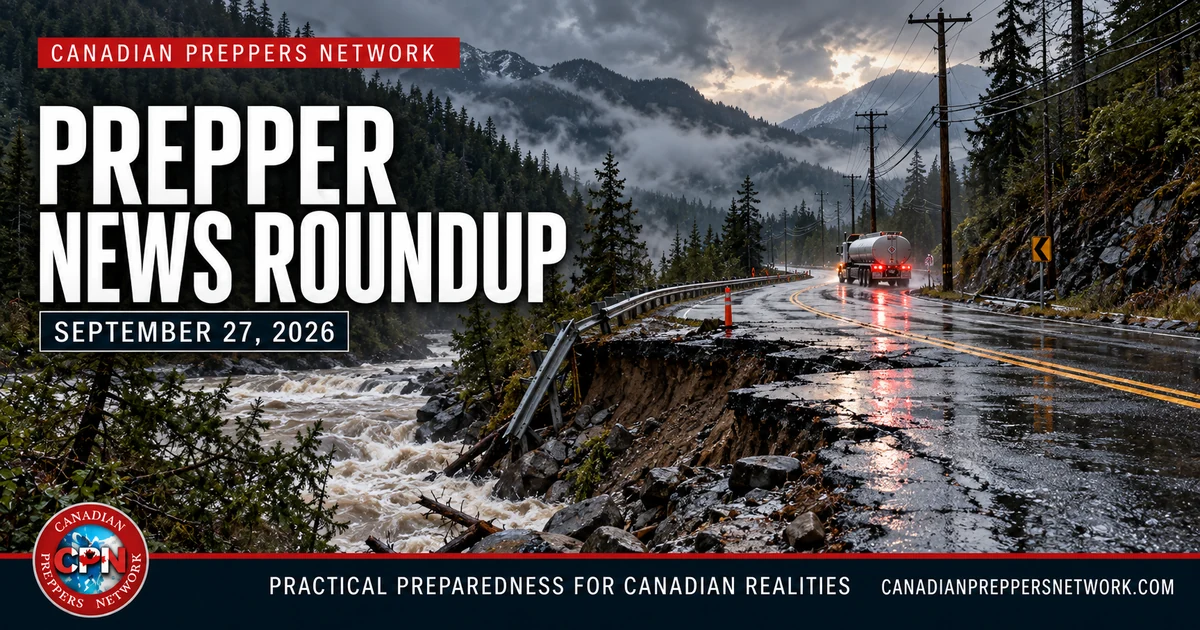
Trade pressure, fuel uncertainty and disruptions close to home
Every Sunday, Canadian Preppers Network reviews the week’s most important Canadian preparedness news and separates useful signals from the noise.
A weaker Canadian dollar, renewed trade friction and an unsettled oil market set the tone this week. Overseas conflicts matter here when they affect fuel, shipping and the cost of supplies. In British Columbia, a road washout offered a more immediate reminder that a familiar route can disappear in a single storm. Here are the developments worth following and the decisions they suggest for Canadian households.
Missed the previous edition? Read Prepper News Roundup — September 20, 2026.
The Loonie Weakens
On September 23, the Canadian dollar touched its lowest level in roughly eight weeks against the U.S. dollar. Reuters reported that investors were weighing new U.S. tariffs, slower Canadian growth and a stronger U.S. currency. The loonie traded near 70.92 U.S. cents at the time of the report.
A weaker dollar can make U.S.-priced imports more expensive, but Canadian retail prices do not move in lockstep with the daily exchange rate. Existing inventory, shipping costs and retailer pricing all matter. If a generator part, water filter or radio component is already on your replacement list, compare current Canadian prices and availability. A functioning spare for essential equipment may be worthwhile; an impulse purchase driven by one day’s currency movement usually is not.
Source: Reuters, September 23.
B.C. Storms Expose a Road Vulnerability
The Regional District of Okanagan-Similkameen reported on September 25 that its emergency operations centre was monitoring a severe thunderstorm watch and washouts affecting Fish Lake Road near Faulder. Road authorities were assessing the damage and travel conditions. The district was also still supporting wildfire recovery in the area.
A local washout is not a national disaster, but it can be a serious problem for anyone who depends on that road for work, medical appointments or supplies. The emergency is different when a road is the only practical connection to a community. Before a longer trip, check current road reports, identify an alternate route and carry enough water, medication, fuel and warm clothing to tolerate a delay.
Never drive into water or across a visibly damaged road. Its surface and supporting ground may be missing even when the water looks shallow. Another vehicle making it through earlier does not establish that the route remains safe.
Source: Regional District of Okanagan-Similkameen emergency update, September 25.
Hormuz Talks and Fuel Prices
Iran put forward a seven-day proposal concerning the Strait of Hormuz and a halt to regional fighting. Reports on September 25 and 26 described disagreement over whether Washington had rejected the proposal and what mediators had formally conveyed. At the time of this roundup, there was no confirmed settlement.
The economic stakes are already visible. Reuters reported that Brent crude settled at US$104.32 a barrel on September 25, down about 2% that day amid hopes for talks. Shipping through the strait and attacks affecting Saudi oil flows remained concerns. One day’s oil move does not translate directly into the next day’s pump price in Canada; refining, taxes, distribution and local competition also affect what drivers pay.
For households that rely on a vehicle, generator or farm equipment, the useful step is to know actual fuel consumption. Maintain the equipment, combine trips where practical, and keep any reserve in approved containers under applicable local rules. Match the reserve to equipment you own and rotate fuel appropriately. A poorly stored stockpile creates a new hazard without improving resilience.
Sources: Reuters on Iran’s proposal, Reuters on the disputed response and Reuters on oil prices and shipping.
Ukraine’s War Continues to Disrupt Industry
Russian strikes reported on September 25 killed people in Ukraine and forced the country’s largest steel plant to suspend production, according to Reuters. Poland also launched military aviation operations in response to Russian attacks on Ukraine during the week; its military later said there had been no violation of Polish airspace in that incident.
The plant shutdown shows that a war can damage production and employment far beyond the immediate strike site. The Polish response shows vigilance near NATO territory. It should not be recast as a confirmed attack on Poland.
Canadian preparedness does not require a countdown to a wider war. It requires dependable information, a household communications plan and an honest look at how long essential systems can operate if imports, prices or services are disrupted. Verify consequential claims before changing plans: a precautionary aircraft launch and an airspace breach are different events.
Sources: Reuters on the strikes and steel plant and Reuters on Poland’s air operations.
South China Sea Resupply Dispute
The Philippine Coast Guard accused China on September 25 of obstructing a resupply mission to Philippine troops in the disputed South China Sea. The accusation is the Philippines’ account of the encounter; this incident by itself does not establish that a broader conflict has begun.
The waterway matters to international shipping and regional security. For a Canadian household, the useful lesson is about replacement chains rather than immediate danger at home. Which essential items would be difficult to replace if trade or shipping slowed? Keep serviceable spares for equipment you actually use, maintain what you own and learn which repairs can be done locally. There is no reason to stockpile electronics after every maritime confrontation.
Source: Reuters, September 25.
Northeastern U.S. Storm Brings Flooding and Outages
A powerful nor’easter affected the northeastern United States on September 26, bringing coastal flooding, wind and widespread electricity outages. An Associated Press report carried by CityNews put the number without power at around 100,000 customers at one point Saturday. That was a snapshot, not a final storm total.
The practical lesson travels across the border. Charge communications equipment ahead of a forecast storm, secure loose outdoor items and keep a safe source of light ready. If your home is exposed to flooding, move critical documents and supplies above likely water levels before conditions deteriorate. Know when to leave; an evacuation decision becomes harder once roads are flooded or power and mobile service are lost.
Source: Associated Press via CityNews, September 26.
Three Useful Checks This Week
- Budget: List the monthly fuel, food and borrowing costs that would hurt most if they increased. Leave room to replenish necessities without relying on credit.
- Routes: Check one alternate way out of your area and the official road-condition source you would use before travelling.
- Outage: Locate lighting, charge backup communications and confirm that water, medication and basic meals remain available without electricity.
These checks are more useful than trying to predict the date of the next crisis. A proposal is not a peace agreement, a precautionary military flight is not an airspace breach, and a market price is not a guaranteed local retail price. Which of the three checks would expose the biggest weakness in your household?
Stress-Test Your First 72 Hours
Power, water, transport and communications can fail together. Use the free Canadian Grid-Down Starter Kit to find your household’s weak points before an emergency does.
Related Reading
- Prepping 101: Canadian preparedness guides
- Which Generator Fuel Wins?
- Preparing to Bug Out by Vehicle During an Evacuation
The next Prepper News Roundup will appear Sunday, October 4, 2026.