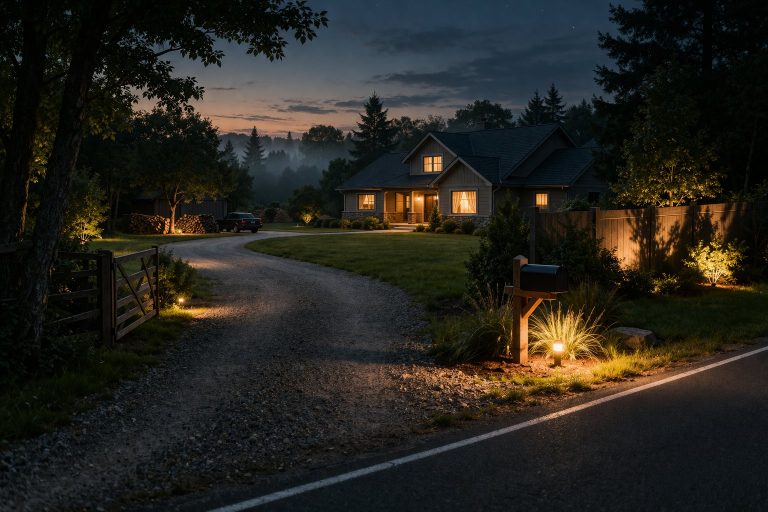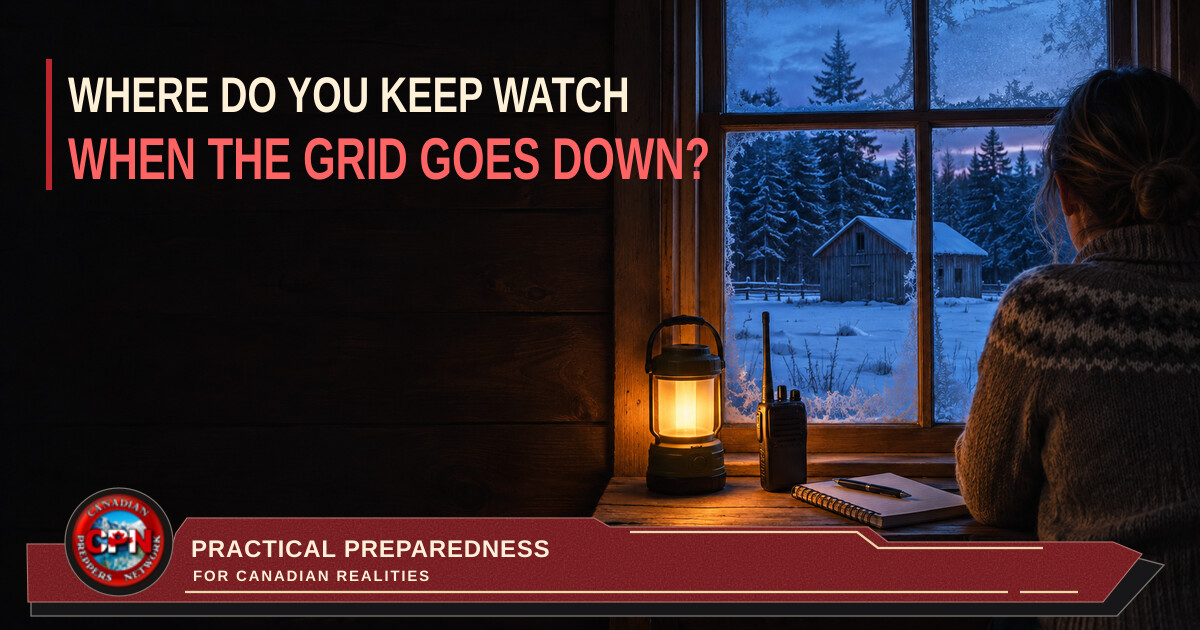
Blackout watch posts for a Canadian winter, from the upstairs window to the walkout basement.
It’s the third week of a winter blackout. Freezing rain came down overnight, the afternoon thaw sent water across the yard, and by sunset everything was hard again. The upstairs observer can see a light near the outbuildings but can’t tell where it’s coming from. The relief observer is late. The radio on the kitchen table hasn’t made a sound in twenty minutes.
Now the group has to decide whether to wake everyone, send a message to the neighbours, or move people to the fallback shelter. That decision depends on whether the lookout can report what they actually saw and whether anyone is still listening.
Blackout watch posts have four jobs. It needs to give someone a useful view, keep them fit to observe, let them pass a report, and give them a safe way back. The more elaborate the structure, the more important it is to ask who will keep it usable when the weather turns and everyone is already stretched thin.
Blackout watch posts indoors
The fixed indoor post
An existing room in the main building is the simplest place to start. There’s usually someone nearby to receive a report, and the observer can change shifts without putting on boots. The real test is what the window shows after dark. A room that gives you a good view at noon can turn into a mirror once the lights come on inside.
Test it during normal evening use. Can the observer identify a familiar person walking up the usual path, or only see movement? Have that person tell you, afterward, what they could see into the room. The answers tell you both how much confidence to put in a report and how much of your household’s routine is visible from outside.
The elevated lookout
An existing upper-floor room can give a wider view across a yard or road. In elevated blackout watch posts, a wider view can also make people overconfident. A figure seen at a distance in blowing snow can be hard to identify, especially when the observer is tired and expecting someone.
The elevated lookout works best with a clear reporting standard. “One light moving near the drive, source unknown” gives the person in charge something to work with. “Someone’s coming for the generator” assigns a motive the observer can’t confirm. If the upstairs room is cold or the stairs are difficult to manage in the dark, factor that into who can take the shift and how easily they can be relieved.
|
||||
| Approval and kit contents depend on clinical assessment. Does not replace emergency or regular medical care. Affiliate link: CPN may earn a commission. |

The enclosed porch or entryway
A porch can make a good intermediate post. It stays close to the household and may offer a different view from the upstairs room. It can also be the coldest occupied space in the building. Sit there for part of an evening before you count on it for a full shift. Pay attention to drafts, fogged glass and how well you can hear a message from indoors.
The porch still has to serve as an entrance. Keep the route usable for everyone who might need it after dark. A chair, blankets and watch gear take up surprisingly valuable space when several people need to move through the same doorway at once.
Detached blackout watch posts
An existing outbuilding or separate above-ground shelter puts the observer away from the main household. That separation changes the job. Someone has to keep the route passable, verify that messages are getting through, and notice if the observer misses a check-in. If the building is too cold or damp to spend a shift in, the group still needs somewhere else to put the watch.
Check the walk between buildings in daylight after real winter weather. If the route is safe, repeat it after dark. Can the relief observer get there and back without help? Can the person inside the main house tell the difference between a quiet shift and a radio that has stopped working? Agree on what happens after a missed check-in while everyone is warm and awake.
The dug post and the walkout basement
A dug post is a partly or fully below-grade shelter. It has a place in the history of military observation and shelter, and that history also shows what wet ground does to a position over time. The Canadian War Museum’s First World War photographs document trenches that filled with mud and standing water. The Canadian Centre for Occupational Health and Safety identifies cave-ins and water accumulation among the hazards of excavation work.
For below-grade blackout watch posts, the practical comparison is with an existing walkout basement. It already belongs to a building the household uses, and you can judge it through a real thaw. Does water collect by the exterior door? Is the exit usable after the next freeze? Does the basement rely on a sump pump, and has its backup been checked during a power outage? Rapid snowmelt and heavy rain can overwhelm normal drainage, which is exactly when you need to know whether the sump pump and its backup will work.
The same concerns about water, ventilation, communication and exits apply whenever people consider using an existing below-grade space. Who checks it after the thaw, and who has the authority to take it out of use? Once the group depends on a post being occupied, there can be pressure to keep using it. Decide ahead of time what condition ends a shift.
|

The relief post and the roving observer
Before assigning shifts to your blackout watch posts, choose a relief post that can take over. The enclosed porch might take over when the upstairs room loses contact, or the main house might take over when the route to the detached shelter ices up. The handover should cover who is on duty, what they observed, and which reports are still unresolved. The person coordinating the watch should hear who has taken over.
A roving observer makes periodic checks for problems that somebody sitting at a window might miss. That can mean checking for storm damage, looking in on an occupied outbuilding, or finding out whether someone needs help. Give the observer a check-in time and a person who expects to hear from them. If conditions make the walk unsafe, the group can suspend the check and account for everyone from indoors.
Give the fallback shelter a separate job
Blackout watch posts serve one purpose here: observe and report. The interior refuge gives the household a place to gather, get a head count and hear what’s happening. A purpose-built storm shelter has a role when the hazard matches what the shelter was designed for. A fallback shelter is where the group can go if the main building becomes unsafe. Its usefulness depends on whether everyone can reach it in the same conditions that forced them to leave.
Assign those roles out loud. If one person hears “go to the shelter” and thinks basement while another heads for the outbuilding, the group has created a second problem before it has dealt with the first.
Test your blackout watch posts for one evening
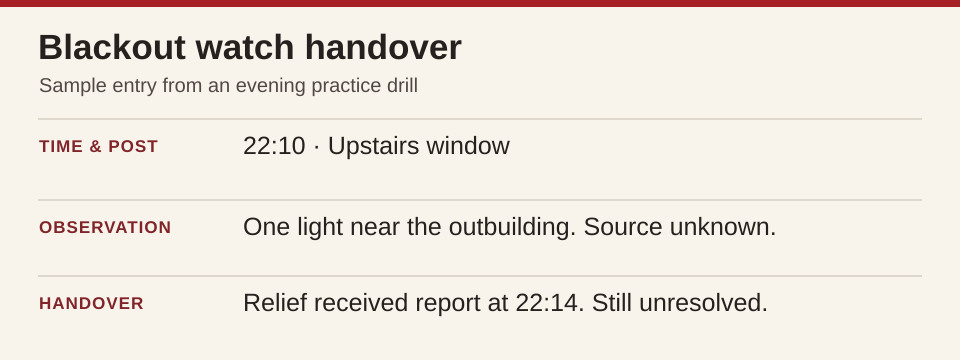
Give two people the same observation exercise from different posts. Have someone familiar approach by the usual route at an agreed time. Let each observer report independently. Then simulate a lost radio and have the backup take over.
- What could each person actually see?
- How long did the report take to reach the coordinator?
- Did the handover preserve the original wording?
- Could everybody get back to the agreed meeting point?
Recheck your blackout watch posts after a storm or a thaw, when conditions are safe. If the simplest indoor post gives you reliable reports, warm observers and clean handovers on the worst night you can safely test, you know which post you can count on.
Plan the first 72 hours
Use CPN’s free Canadian Grid-Down Starter Kit to check the lighting, power and communications your watch depends on.
Related Reading
- Grid-Down Night Security: Securing Your Home After Dark
- The Early Detection Plan Every Prepper Property Needs
- Security & Defense in Canada
Equipment Buying Box
As an Amazon Associate, Canadian Preppers Network earns from qualifying purchases. CPN may also earn a commission on qualifying purchases through the VEVOR affiliate links below.
Amazon.ca
- Headlamp with replaceable batteries. Keeps both hands free on stairs and during shift changes.
https://www.amazon.ca/s?k=headlamp+replaceable+batteries&tag=canadianprep-20&ascsubtag=dailypost - Battery-powered LED lantern. Set one in the room where people gather for a head count or handover.
https://www.amazon.ca/s?k=battery+powered+LED+camping+lantern&tag=canadianprep-20&ascsubtag=dailypost - Rechargeable AA batteries and charger. Buy the size and chemistry your gear supports, and test the charger with your backup power supply.
https://www.amazon.ca/s?k=AA+NiMH+rechargeable+batteries+charger&tag=canadianprep-20&ascsubtag=dailypost - USB-C power bank. Recharge compatible lights and phones during short outages. Match the output and cable to the gear you use.
https://www.amazon.ca/s?k=USB-C+power+bank&tag=canadianprep-20&ascsubtag=dailypost - FRS two-way radio pair. Look for a model certified for use in Canada. Test voice check-ins between the main building and any occupied outbuilding before relying on the radios.
https://www.amazon.ca/s?k=FRS+two+way+radios+pair&tag=canadianprep-20&ascsubtag=dailypost - Battery-powered min/max thermometer. Check how cold a porch or outbuilding gets over a full shift.
https://www.amazon.ca/s?k=battery+powered+min+max+thermometer&tag=canadianprep-20&ascsubtag=dailypost - Clip-on boot traction cleats. Keep a pair near the door for icy routes between buildings. Check the fit on the boots you actually wear.
https://www.amazon.ca/s?k=clip+on+boot+ice+traction+cleats&tag=canadianprep-20&ascsubtag=dailypost - Compact snow shovel. Keep one near the porch or walkout door to clear drifts in tight spaces.
https://www.amazon.ca/s?k=compact+snow+shovel&tag=canadianprep-20&ascsubtag=dailypost - Insulated sitting pad. Makes a cold chair or bench more comfortable during a long shift.
https://www.amazon.ca/s?k=closed+cell+foam+insulated+seat+pad&tag=canadianprep-20&ascsubtag=dailypost - Weather-resistant notebook. Use it to pass along check-in times and the original wording of unresolved reports.
https://www.amazon.ca/s?k=weatherproof+field+notebook&tag=canadianprep-20&ascsubtag=dailypost
VEVOR Canada
- Rechargeable LED work light. Light an entryway or stair landing during a shift change. Set it where it leaves the walking route clear.
https://s.vevor.com/QT115M - Indoor/outdoor weather station. Compare temperatures through a thaw and refreeze. Check how the display and wireless sensor are powered.
https://s.vevor.com/QT115G - 296 Wh portable power station. Set up a shared charging point for compatible lights, phones and radio chargers. Check what a full evening of charging draws before sizing your reserve.
https://s.vevor.com/QT115U - 37.8-inch wheeled snow pusher. Clear fresh snow along wide, firm routes between buildings. Measure the route at its narrowest point before choosing a blade width.
https://s.vevor.com/QT1158 - Rolling weatherproof hard case. Store shared lights, chargers and other electronics together. Check the interior dimensions against the gear your group needs to carry.
https://s.vevor.com/QT116M - One-inch rubber threshold ramp. Consider it where a raised lip makes a doorway harder to cross. Measure the rise and check that the door swings freely and the exit stays clear.
https://s.vevor.com/QT116R