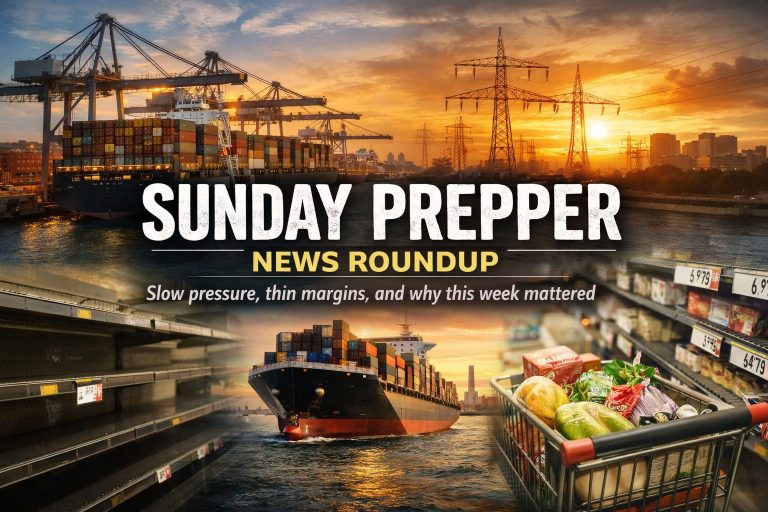
Risk, Resilience, and the Signals Behind the Headlines
Every Sunday we step back from gear and drills and look at the larger environment. Preparedness is not just about what’s in your basement — it’s about understanding the pressures shaping the world around you.
This week’s signals fall into four major categories: insurance contraction, geopolitical tension, domestic security reflection, and national morale.

None of them exist in isolation.
🇨🇦 Insurance Tightens as Weather Risk Rises
Reporting from CityNews Toronto and other Canadian outlets this week confirms what many homeowners have already noticed: property insurance across Canada is becoming more expensive — and more restrictive.
Premium increases are only part of the story.
More significant is how coverage itself is tightening. Insurers are:
- Increasing deductibles for water and storm claims
- Moving toward percentage-based deductibles tied to home value
- Restricting sewer backup and overland flood riders
- Narrowing eligibility for ice dam and freeze-related claims
- Enforcing stricter vacancy and maintenance clauses
Some policies now require documented inspection intervals during winter absences. Failure to demonstrate active heat maintenance or regular property checks can void coverage for freeze damage.
In practical terms, this means insurers are transferring more operational risk back onto homeowners.
For preparedness-minded households, this is a clear signal: financial backstops are shrinking. The expectation is shifting toward self-mitigation.
A reinforced roof matters more than a claims process.
A sump pump backup matters more than a payout.
A documented maintenance log matters more than assumptions.
The market is not panicking — it is recalibrating. But that recalibration aligns with a preparedness principle: prevent first, insure second.
🌍 Global Security: Stability Is Expensive
Geopolitical tension remains elevated.
Discussions at the Munich Security Conference this week centered on NATO posture, European defense spending, and the long-term implications of the ongoing Russia–Ukraine conflict. While no dramatic new escalations were announced, the tone remains cautious and defensive.
Meanwhile, Canada announced strengthened Arctic and defense cooperation with Denmark through the Department of National Defence, reinforcing strategic alignment in northern operations.
Increased Arctic cooperation is not symbolic. It reflects:
- Growing attention to northern sovereignty
- Resource competition concerns
- Expanded military presence in high-latitude regions
- Infrastructure investment in cold-climate readiness
Preparedness takeaway: strategic competition rarely disrupts daily life immediately. Instead, it creates slow-moving economic pressures — defense spending shifts, energy market fluctuations, procurement bottlenecks.
Prepared households do not need to speculate on outcomes. They need to recognize patterns.
Periods of elevated geopolitical tension tend to correlate with:
- Supply chain strain
- Commodity price volatility
- Transportation disruptions
- Energy uncertainty
Resilience planning buffers those variables.
🏫 Domestic Security Reflection
Earlier this week, Canada continued to process the aftermath of the tragic shooting in Tumbler Ridge.
While investigations continue, the broader national conversation has shifted toward emergency response readiness, mental health intervention, and school security protocols.
For preparedness thinking, this is not about sensationalism.
It is about layered safety.
Events like this reinforce:
- The importance of situational awareness
- The need for clear family emergency plans
- Communication redundancy
- Community-level coordination
Most crises are local before they are national. Preparedness begins at the household level but functions best when embedded in community structure.
Resilience is social as much as physical.
🏅 National Morale: The Olympics Matter More Than We Think
Canada celebrated its first gold medal of the 2026 Winter Olympics this week, with Mikaël Kingsbury capturing top honours in dual moguls.
On the surface, this is sport.
But large international events serve as morale anchors during uncertain periods. They provide:
- Shared national focus
- Collective celebration
- Emotional reset from heavy news cycles
Preparedness is often framed in stoic, austere terms. Yet morale is a force multiplier. A population that retains cohesion and optimism handles stress more effectively than one in constant psychological fatigue.
National morale is not trivial.
It is stabilizing.
🌨 Weather Pattern Pressures Continue
Winter weather remains active across multiple provinces, with continued snow accumulation, freeze–thaw cycles, and infrastructure stress.
Repeated freeze events strain:
- Roofing systems
- Plumbing
- Road networks
- Power lines
Insurance tightening and weather stress intersect directly here. As climate variability increases, the economic consequences are being redistributed — from insurers to households.
Preparedness takeaway: winter redundancy remains essential well into February.
- Monitor attic ventilation.
- Clear snow loads where safe.
- Maintain backup heat capability.
- Document property checks.
Preparedness is rarely dramatic. It is maintenance.
The Pattern Behind the Headlines
This week’s themes are not chaotic. They are consistent.
- Risk is being decentralized. Insurance coverage tightens. Households carry more responsibility.
- Security costs are rising. Defense spending, Arctic posture, alliance recalibration.
- Community cohesion matters. Domestic crises test social resilience.
- Morale remains strategic. National achievements stabilize public psychology.
Preparedness is not about reacting to headlines.
It is about recognizing structural shifts.
Right now, those shifts point toward greater self-reliance, higher operational awareness, and increasing expectation that individuals manage more of their own risk profile.
That aligns directly with preparedness philosophy.
Final Perspective
There are no dramatic red flags this week. No singular event that changes everything overnight.
Instead, there is a steady pattern:
- Insurance hardening.
- Geopolitical recalibration.
- Infrastructure stress.
- Social strain balanced by morale moments.
Preparedness is not built in reaction to catastrophe.
It is built in response to patterns.
And the pattern remains clear: resilience is becoming personal again.
Stay steady.
Stay informed.
Stay ahead of the curve.