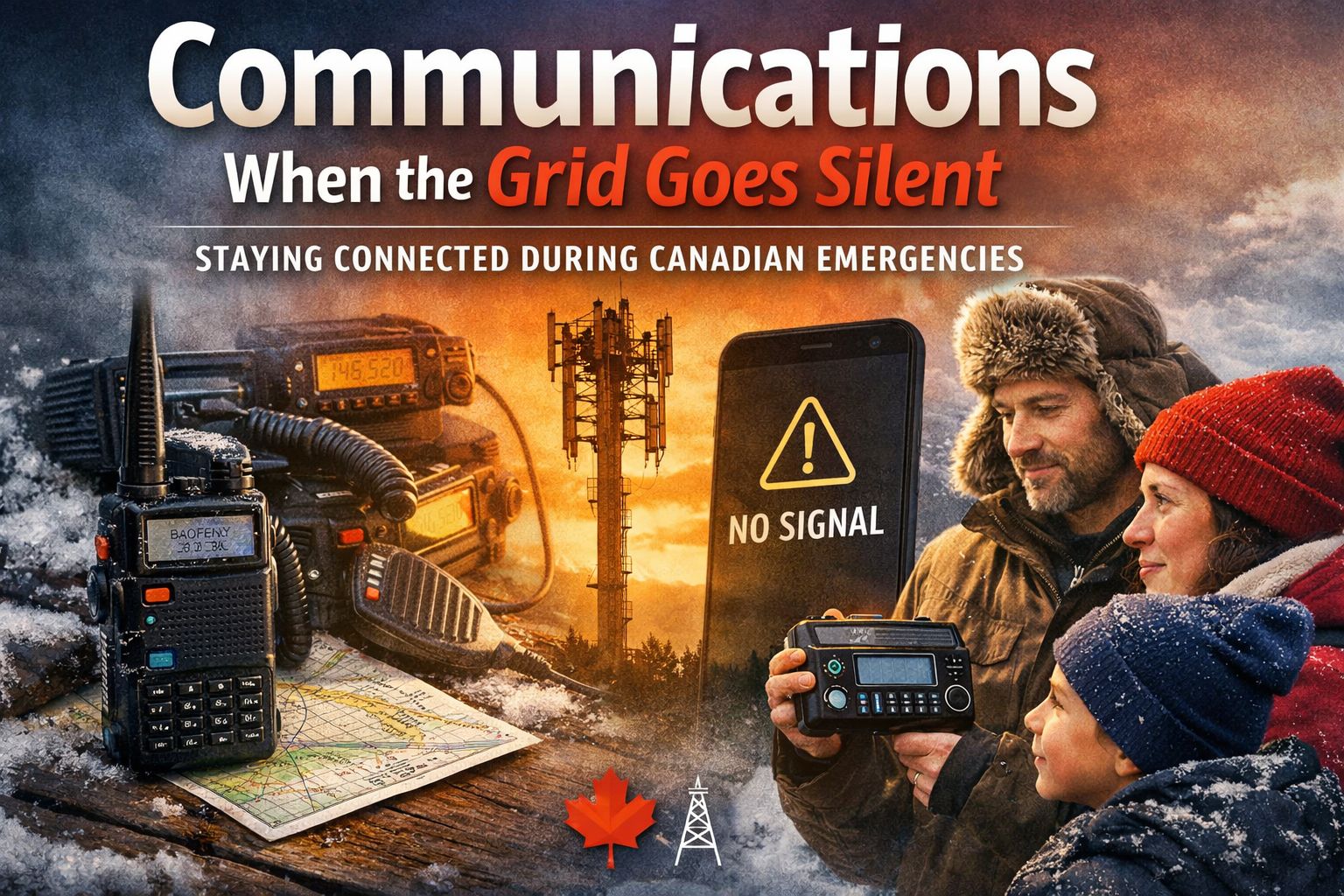
When emergencies strike in Canada, communications infrastructure is often one of the first systems to degrade—and one of the last to fully recover. Ice storms overload power lines, wildfires destroy towers, floods isolate communities, and even routine winter weather can sever connectivity across large regions.
Preparedness is not about hoping your phone keeps working. It is about planning for silence and ensuring you still have ways to receive information, coordinate movement, and maintain contact with others when modern systems fail.
Recent Network Failures Prove the Point
In the past few years, Canadians have repeatedly experienced nationwide and regional communications failures that had nothing to do with war or disaster—only technical fragility.
Large-scale cellular outages have knocked out mobile phones, 911 access, debit terminals, ATMs, and internet services simultaneously, leaving millions unable to call for help, receive alerts, or even buy fuel and food. In several incidents, outages lasted most of a day, with knock-on effects continuing well beyond restoration.
Winter storms have caused regional carrier failures, particularly in rural Ontario, Quebec, and Atlantic Canada, where a single damaged fibre route or tower can isolate entire communities. During wildfire seasons, towers are intentionally shut down or destroyed, leaving evacuees with no connectivity as they move.
These events underline a hard truth:
Communications failure is no longer rare, and it no longer requires an extreme trigger.
This reality reinforces concerns previously raised in Canada’s OnAlert System: What It Can (and Can’t) Do
👉 https://canadianpreppersnetwork.com/canadas-onalert-system-test/
Emergency alerts are only useful if the network delivering them is still functioning.
Why Communications Fail So Quickly in Canada
Canada’s geography magnifies infrastructure weakness. Vast distances, limited redundancy outside cities, and extreme weather combine to create single points of failure. Cellular towers rely on:
- Grid power
- Limited-duration backup generators
- Intact fibre or microwave backhaul
When even one link fails, service can vanish entirely. During high-demand periods, networks may technically remain “online” but become unusable due to congestion.
Preparedness planning must assume no reliable cellular service for at least 72 hours, and potentially much longer.
Layered Communications: The Only Reliable Approach
There is no single device that solves communications in a crisis. Resilient planning uses layers, each covering a different range and function.
Short-Range Communications: Household & Property Coordination
For localized emergencies—power outages, storm cleanup, medical incidents—FRS radios remain the most dependable tool. They operate independently of carriers, fibre, and towers.
A proven option suitable for Canadian conditions is the Motorola Talkabout T465 Two-Way Radio Set
👉 https://www.amazon.ca/dp/B01DM7AJ5K?tag=canadpreppn01a-20
These radios are effective because they:
- Function in cold weather
- Require no licence
- Are intuitive under stress
The critical factor is pre-planning. Radios only work when everyone knows:
- Which channel to monitor
- When to conduct check-ins
- How to identify themselves
Receiving Information Without Internet or Cellular Service
When data networks fail, broadcast systems often remain operational. Environment Canada weather radio continues transmitting even during widespread outages, making it one of the most reliable information sources available.
A solid choice is the Midland ER310 Emergency Weather Radio
👉 https://www.amazon.ca/dp/B01M9IVZ1B?tag=canadpreppn01a-20
This unit provides:
- Environment Canada alerts
- AM/FM reception
- Hand-crank and solar charging
- USB device charging
Weather radios are especially critical during winter emergencies, which we examined in Dealing With Extreme Cold Grid-Down
👉 https://canadianpreppersnetwork.com/dealing-with-extreme-cold-grid-down/
Long-Range Communications: Amateur (Ham) Radio
When cellular, internet, and landlines all fail, amateur radio continues to function. This is not theoretical—Canadian ham operators regularly provide communications during floods, wildfires, and prolonged outages.
An accessible entry-level option is the Baofeng UV-5R Dual Band Handheld
👉 https://www.amazon.ca/dp/B00MAULSOK?tag=canadpreppn01a-20
With basic training and licensing, this allows access to:
- Local emergency repeaters
- Regional information nets
- Community coordination channels
For rural properties and retreat locations, base stations and external antennas dramatically increase range—planning covered in depth in Acres of Preparedness: Planning the Last Safe Place
👉 https://www.amazon.ca/dp/B0F44GV789?tag=canadpreppn01a-20
Power: The Overlooked Failure Point
Recent outages have shown that even short-term failures cascade quickly when power is lost. Cold weather accelerates battery depletion, and replacement options vanish fast.
Every communications plan should include:
- Lithium batteries
- High-capacity power banks
- Solar charging capability
- Vehicle-based 12V charging
This ties directly into broader energy resilience, discussed in Winter Power Outages: Keeping Critical Systems Running
👉 https://canadianpreppersnetwork.com/winter-power-outages-keeping-critical-systems-running/
Written Plans Still Outperform Technology
When systems fail suddenly—as they have during recent outages—confusion spreads faster than information. Written communications plans reduce chaos.
Every household should maintain:
- Printed contact lists
- Primary and fallback rally points
- Radio channels and frequencies
- Scheduled check-in times
Paper remains readable when screens go dark.
Final Thoughts
Recent communications outages across Canada have removed any doubt: modern networks are fragile, and their failure is no longer hypothetical. Preparedness means assuming failure—not hoping for uptime.
If your emergency plan depends on cellular service, it is incomplete.
Build layers. Practise regularly. Train everyone. When the network goes silent, communication becomes survival.