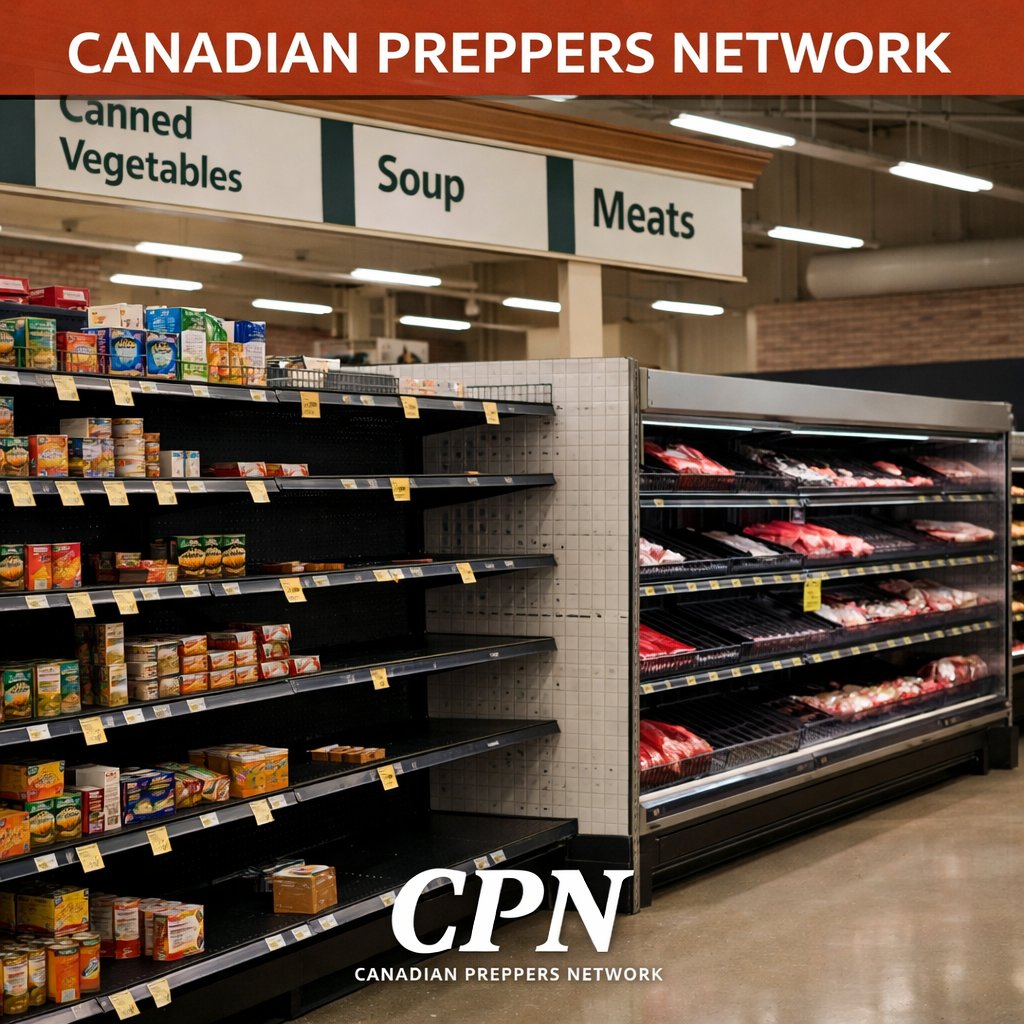
Most people imagine empty shelves as a sudden, dramatic event. In reality, it’s slower, quieter—and far more unsettling. The system doesn’t collapse overnight. It stretches, strains, and then begins to fail in ways that aren’t immediately obvious unless you’re paying attention.
In Canada, with long supply chains and heavy reliance on just-in-time delivery, that process can move faster than most expect.
Days 1–3: The Illusion of Normal
At first, nothing looks broken. News reports may mention disruptions—fuel shortages, transportation issues, labour disputes—but stores are still open, and shelves are still mostly full.

Then the buying starts.
It doesn’t take panic to empty a store. It just takes a slightly elevated number of people buying a little more than usual. Within a day or two, the most familiar items begin to disappear: fresh meat, dairy, bread, and bottled water. Baby supplies and pet food follow close behind—categories people don’t think about until they’re gone.
To the untrained eye, the store still “has food.” But the shift has already begun.
Days 4–10: Gaps Become Patterns
By the end of the first week, the gaps are no longer random. Entire sections start to look thin or inconsistent. Deliveries arrive, but not with what’s needed—and not in the quantities expected.
This is where the illusion breaks down.
There may still be food on the shelves, but much of it requires time, fuel, or additional ingredients. A bag of dried beans doesn’t help much if you don’t have the means to cook them. A shelf full of sauces isn’t useful without the staples that go with them.
At the same time, prices begin to creep upward. Quietly at first, then more noticeably. People start to adjust their buying habits, often too late.
Days 11–20: The System Under Strain
By the second and third weeks, the situation feels different.
Protein becomes difficult to find. Not completely gone—but inconsistent, expensive, and unreliable. People begin to substitute heavily with carbohydrates, which creates a false sense of security. Calories are still available, but nutrition is degrading.
This is also when secondary effects begin to show. Fuel availability impacts deliveries. Limited deliveries worsen shortages. Cooking becomes more difficult for households that rely entirely on electricity or natural gas without backup options.
Social behaviour changes as well. Frustration becomes more visible. People move between stores more frequently, chasing availability. Conversations shift from inconvenience to concern.
Official messaging often lags behind reality at this stage. Statements about “stable supply chains” don’t match what people are seeing in their local stores, and confidence begins to erode.
Days 21–30: A New Normal
By the fourth week, something important happens—not in the stores, but in people’s minds.
Scarcity becomes normal.
Shoppers stop expecting full shelves. They begin buying what’s available rather than what they need. Meal planning disappears and is replaced by improvisation. Households that were unprepared start to feel the pressure in a sustained way.
At the same time, those who prepared earlier have already adapted. They’re no longer part of the daily scramble. They’re not standing in lines, not chasing deliveries, not making decisions under pressure.
The divide is quiet, but real.
The Hidden Weak Point: It’s Not Calories
One of the biggest misconceptions is that food availability equals food security.
In reality, the problem shows up first in protein and fat. These are harder to store, harder to replace, and disappear quickly from retail systems. What remains is often shelf-stable but nutritionally incomplete.
People feel this before they understand it. Fatigue sets in. Meals become less satisfying. Hunger becomes more frequent, even when calories are technically sufficient.
The Role of Fuel
Food doesn’t exist in isolation. It depends on energy at every stage—transport, storage, and preparation.
When fuel becomes constrained, even slightly, the effects ripple outward. Deliveries slow down. Refrigeration becomes less reliable. Cooking becomes a challenge for households without alternatives.
This is where many otherwise well-stocked homes begin to struggle. They have food—but not the means to use it effectively.
The Quiet Advantage
Prepared households don’t experience this period the same way.
They’re not immune to what’s happening, but they’re removed from the pressure. They don’t need to react to empty shelves because they’re not relying on them. They don’t need to adjust overnight because they’ve already built a system that works.
There’s no panic. No urgency. Just distance.
And in a situation like this, distance is everything.
The Moment That Changes Everything
Somewhere between the second and fourth week, most people have the same realization:
This isn’t temporary.
That shift—from expecting things to return to normal, to understanding that they may not—changes behaviour completely. It’s also the moment when preparation either proves its value… or its absence.