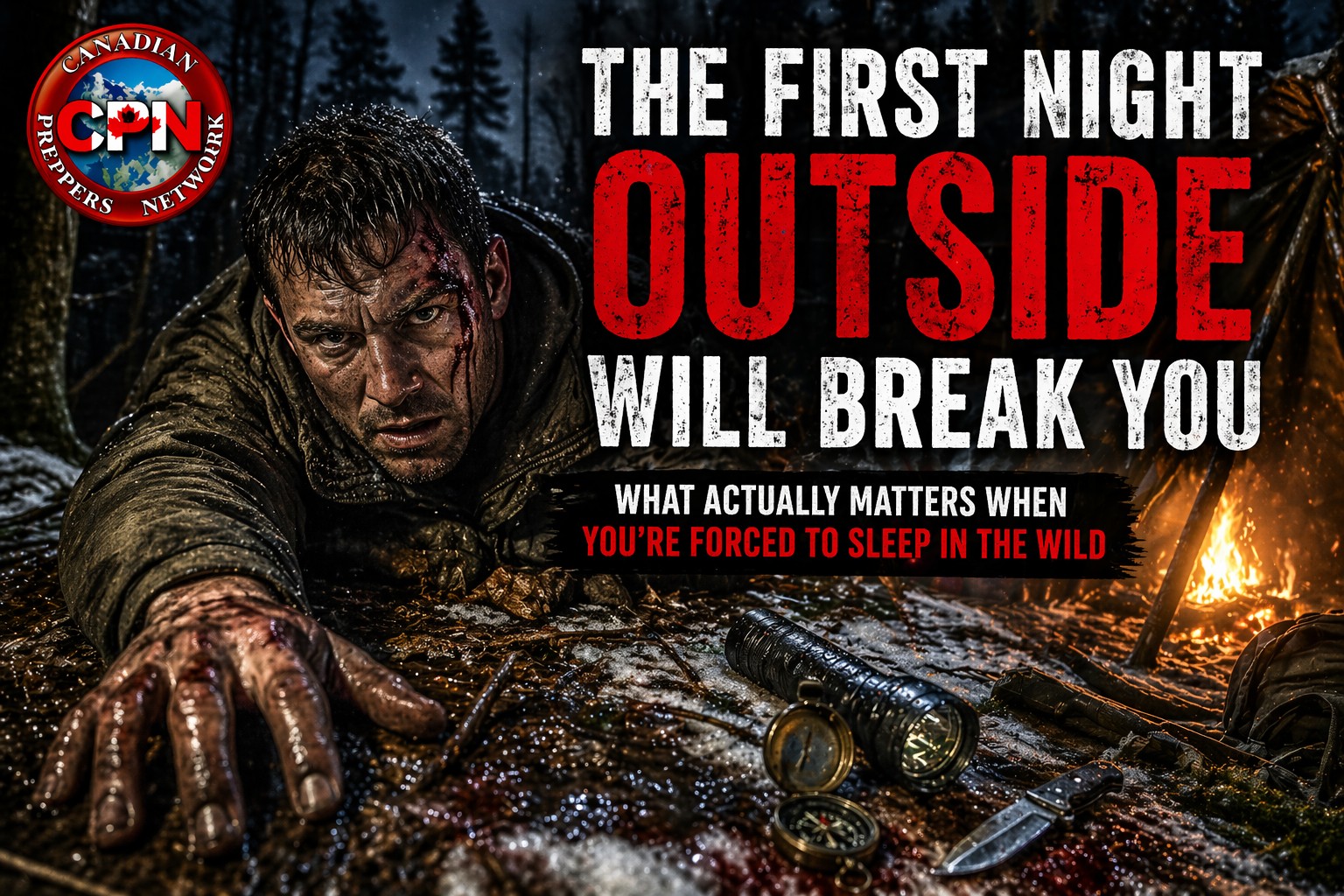
Most people think they could handle a night outside.
They picture a fire, maybe a lean-to, something uncomfortable but manageable. A story they’ll tell later.
That’s not how it unfolds.
The first night—especially in Canada—is where confidence collapses.
Dark Comes Faster Than You Expect

Everything feels manageable until the light fades.
The temperature drops fast. Terrain changes. Visibility disappears.
And most people make the same mistake:
They keep moving.
Shelter Comes Before Fire (Whether You Like It or Not)

Exposure kills faster than most people understand.
Cold comes from below as much as above.
A simple tarp becomes one of the highest-value pieces of kit you can carry:
https://www.amazon.ca/s?k=survival+tarp+heavy+duty+waterproof
Not because it’s comfortable—because it works.
Ground Insulation Is the Real Fight

This is where people lose.
You can have shelter and still get hypothermic if you’re lying directly on cold ground.
You need separation.
A closed-cell foam pad is one of the simplest, most reliable solutions:
https://www.amazon.ca/s?k=closed+cell+foam+sleeping+pad+camping
Cheap. Durable. Doesn’t fail.
Fire Failure Is More Common Than Success

Everyone assumes they can start a fire.
Most can’t—under pressure.
Wet wood. Bad tinder. Cold hands.
Redundancy matters.
A proper ferro rod kit with tinder backup gives you a second chance:
https://www.amazon.ca/s?k=ferro+rod+fire+starter+with+tinder
But the truth is simple:
If you haven’t practiced in bad conditions, you don’t have this skill.
Water Isn’t Your First Problem

Water matters—but not tonight.
Exposure kills first.
Still, carrying a compact filter removes risk and hesitation:
https://www.amazon.ca/s?k=lifestraw+personal+water+filter
It’s one less decision to get wrong.
The Psychological Drop Is Real
The cold. The dark. The uncertainty.
This is where people start making bad decisions.
Rushing. Moving. Burning energy.
This is where survival shifts from physical to mental.
What Actually Gets You Through the Night
It comes down to order:
- Stop moving early
- Get off the ground
- Block wind and moisture
- Then build fire
That’s what works.
Start Before You Need It
You don’t learn this during an emergency.
You learn it when it’s inconvenient—but safe to fail.
If you want to move beyond one-night survival and start thinking in terms of long-term self-reliance, Acres of Preparedness: Planning the Last Safe Place connects those dots in a Canadian context:
https://www.amazon.ca/dp/B0C1J9X9Q8
Final Thought
The first night outside doesn’t test your gear.
It tests your decisions.
And most people don’t realize how fast those decisions fall apart—until they’re already in it.