
Disclosure: This article contains Amazon affiliate links. As an Amazon Associate, Canadian Preppers Network may earn from qualifying purchases.
Wilderness skills are useful, but they are often romanticized.
A person can watch survival shows, buy outdoor gear, talk about bugging out, and still be completely unprepared for a cold night, a wrong turn, a wet fire lay, an injured ankle, a dead phone, a washed-out road, or the sudden realization that the woods do not care how confident someone felt at home.
For Canadian preppers, wilderness skills should not be treated as fantasy escape skills. They are not a replacement for food storage, water storage, shelter, heat, community, medical planning, or a realistic retreat. They are backup skills. They are field skills. They are problem-solving skills for when travel, weather, terrain, distance, or infrastructure failure pushes a household closer to outdoor conditions than expected.
That distinction matters.
A wilderness skill is valuable when it helps you stay found, stay dry, stay warm, signal for help, move safely, avoid bad decisions, protect water, manage injury, and understand your limits. It becomes dangerous when it encourages people to believe that disappearing into the bush is easier than building a real preparedness system.
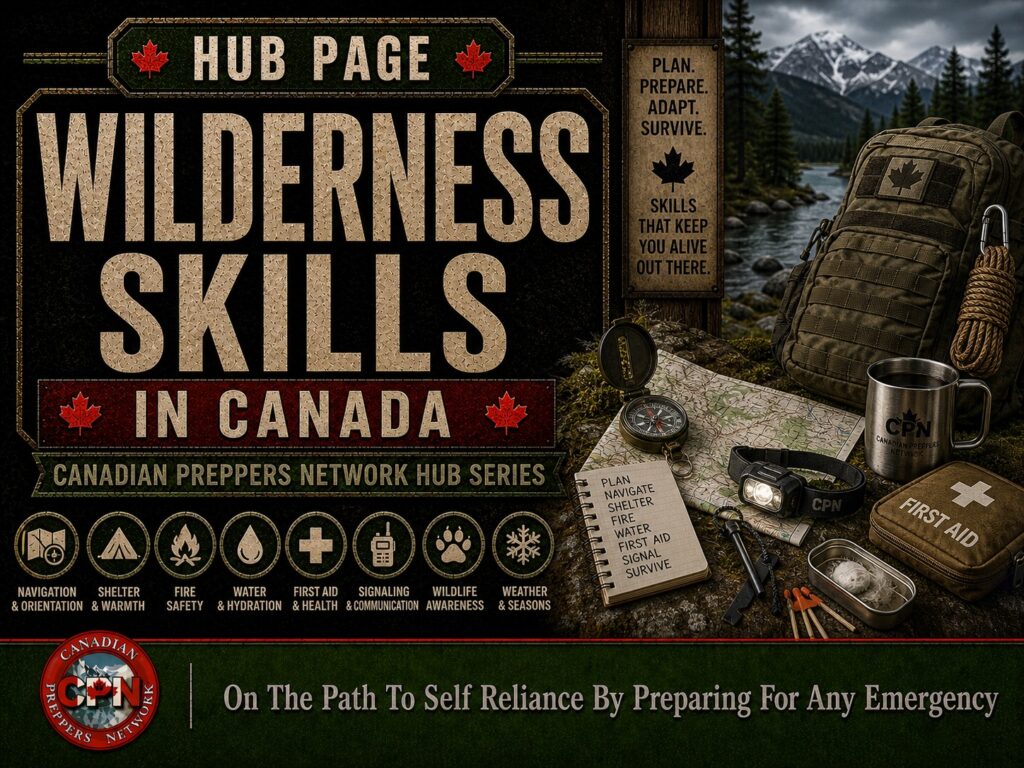
This page is the Canadian Preppers Network hub for wilderness skills. It connects the major parts of the subject into one practical Canadian framework: trip planning, navigation, shelter, fire safety, water, signalling, first aid, weather, wildlife, cold-weather judgement, and the hard truth that wilderness capability supports preparedness but does not replace it.
Why Wilderness Skills Matter in Canada
Canada is not short on wilderness, but access to wild spaces does not automatically create competence. Forests, lakes, mountains, muskeg, northern roads, winter trails, coastal weather, blackfly season, wildfire smoke, fast-changing temperatures, and long distances all create different risks.
AdventureSmart’s “Three Ts” are a useful Canadian foundation: trip planning, training, and taking the essentials. A trip plan explains the destination, route, group members, and return time. If someone does not return as planned, the person holding that trip plan can provide it to police to help initiate a search.
AdventureSmart also recommends carrying essentials such as a flashlight, signalling device, extra food and water, extra clothing, navigation and communication aids, first aid, emergency shelter, and sun protection.
That matters because wilderness problems often start before the emergency. People do not leave a trip plan. They overestimate distance. They underestimate weather. They trust phones too much. They carry gear they have never used. They travel alone without a backup. They move faster than the slowest person. They assume a familiar area cannot become confusing.
For preppers, the lesson is simple: wilderness readiness begins before entering the wilderness.
Wilderness Skills Begin With Not Getting Lost
The first wilderness skill is not fire. It is not shelter. It is not wild food. It is not gear.
The first wilderness skill is preventing the situation from becoming a survival problem in the first place.
That means planning the route, checking weather, carrying navigation tools, telling someone where you are going, knowing when to turn back, and resisting the urge to push deeper into trouble. Navigation is not only about maps and compasses. It is about humility. A person who admits uncertainty early has more options than a person who keeps walking to protect their pride.
In Canada, this is especially true in winter. Snow can erase trails, bury landmarks, flatten terrain, and make familiar places look unfamiliar. Short daylight, cold, wind, and falling temperatures punish delay.
CPN’s article Wilderness Skills: Winter Navigation & Wayfinding When Electronics Fail is a strong companion piece for this hub.
A wilderness plan should always answer basic questions before departure: where are we going, who knows, when are we due back, what is the weather doing, what happens if the route is blocked, and what are we carrying if we have to stop?
The Three Layers of a Prepared Wilderness Skills System
A serious wilderness skills system should be built in layers. Each layer solves a different problem.
The first layer is prevention. This includes trip planning, route selection, weather checks, training, proper clothing, carrying essentials, understanding local hazards, and knowing when not to go. This layer prevents outdoor inconvenience from turning into emergency exposure.
The second layer is immediate survival support. This includes navigation, signalling, emergency shelter, insulation, first aid, water, fire safety, food margin, and staying put when appropriate. This layer helps someone stabilize a bad situation long enough to be found, move safely, or wait out conditions.
The third layer is sustained field capability. This includes winter travel judgement, camp organization, low-tech repair, rope and knot skills, weather awareness, wildlife avoidance, map reading, longer-term shelter planning, fuel conservation, and realistic physical conditioning. This layer matters when conditions stretch beyond a short delay.
Most households should build those layers in order. A person who cannot leave a trip plan, follow a map, manage clothing layers, or carry basic essentials should not start by imagining long-term wilderness living.
The First 30 Days
A practical starting target is thirty days of wilderness skill improvement.
That does not mean attempting a remote solo trip or testing limits recklessly. It means turning the most important wilderness basics into ordinary habits.
The first week should focus on planning. Create a simple trip-plan template. Add emergency contacts. Identify local trails, parks, hunting areas, canoe routes, winter roads, or rural properties where household members actually travel. Print or save offline maps where appropriate. Decide who gets the trip plan and when they should act if you do not return.
The second week should focus on navigation. Learn to read a paper map. Practise orienting a map. Carry a compass. Compare phone GPS to physical landmarks. Walk a short familiar route while actively identifying turns, terrain, water, roads, power lines, and bailout points. Do not wait until you are lost to learn how to navigate.
The third week should focus on personal protection from weather. Build a clothing and shelter layer for local conditions. Practise packing rain gear, insulation, gloves, hat, socks, emergency blanket, small tarp, and basic signalling items. The goal is not comfort. The goal is enough margin to stop moving without immediately becoming cold, wet, and helpless.
The fourth week should focus on communication and rescue support. Carry a whistle. Keep a light available. Make sure phone batteries are protected from cold. Understand where there is no signal. Review how to describe a location. Practise staying put when that is the safer decision.
A month of simple, repeated practice is more valuable than buying gear and assuming it will work.
Navigation Without Electronics
Phones are useful, but they are fragile.
A phone can lose signal, run out of power, get wet, freeze, break, or become unreliable under tree cover, steep terrain, or remote conditions. GPS can show a position, but it does not automatically teach route choice, terrain judgement, safe movement, or when to turn around.
A prepared household should still understand paper maps, compass direction, terrain association, trail junctions, landmarks, road grids, water features, and bailout routes. The goal is not to reject technology. The goal is to avoid depending on one fragile tool.
Useful navigation gear:
- Baseplate compasses are useful for basic map-and-compass work.
- Waterproof map cases help protect printed maps in wet weather.
- Paper road atlases provide a backup when phone maps fail during travel.
- Waterproof notebooks are useful for route notes, bearings, grid references, and messages.
Shelter Is About Staying Dry and Out of the Wind
Emergency shelter is often misunderstood.
The goal is not to build an impressive wilderness hut. The immediate goal is to reduce exposure. Wet clothing, wind, cold ground, and falling temperatures are the real enemies. A simple tarp, bivy, emergency blanket, insulated pad, windbreak, or natural shelter used carefully can buy time.
In Canadian conditions, shelter decisions change by season. In summer, rain, insects, wind, and overnight temperature drops may be the problem. In winter, ground insulation, wind protection, snow load, moisture management, and the ability to avoid sweating while working become critical.
CPN’s The First Night Outside Will Break You is the right internal companion for this section because the first night is where romantic wilderness thinking often collapses.
Useful shelter support gear:
- Emergency bivy sacks provide compact emergency weather protection.
- Lightweight tarps can help create rain and wind protection.
- Emergency blankets are compact backup insulation and signalling tools.
- Closed-cell foam sit pads help reduce heat loss when sitting or kneeling on cold ground.
Fire Skills Require Safety and Restraint
Fire can be useful in the wilderness, but it is also one of the easiest skills to romanticize and misuse.
In Canadian conditions, fire may support warmth, signalling, morale, drying damp gear, and boiling water where appropriate. But fire is not always the right answer. During fire bans, high wind, drought, wildfire conditions, dry forest floors, or unsafe terrain, lighting a fire can create a bigger emergency than the one you are trying to solve.
A prepared person does not treat fire as a trick. They treat it as a responsibility.
The most important fire skill is judgement: knowing when not to light one, knowing local restrictions, keeping ignition tools protected from moisture, and carrying backup methods without assuming that every emergency should involve an open flame.
Fire-starting tools belong in a wilderness kit, but they should be paired with restraint, legal awareness, and safe outdoor habits. A ferro rod, waterproof matches, or tinder tabs are not permission to ignore fire bans, dry conditions, wind, or local rules.
Useful fire-related gear:
- Waterproof matches are a simple backup item for emergency kits, vehicle kits, and outdoor packs.
- Ferro rods are durable ignition tools that can be carried as part of a wilderness kit.
- Stormproof match cases help keep ignition sources dry and organized.
- Fire starter tinder tabs can provide a backup option when natural tinder is wet or unreliable.
- Compact fire bellows can help manage small outdoor fires more safely and with less effort when fires are legal and conditions allow.
Water in the Wilderness
Water is often nearby in Canada, but nearby does not mean safe.
Lakes, rivers, creeks, snow, ice, ponds, and wetlands can all contain biological contamination, sediment, agricultural runoff, fuel residue, animal waste, or other hazards depending on location. Clear water is not automatically safe water. Fast water is not automatically safe water. Remote water is not automatically safe water.
A wilderness water plan should include both carrying water and treating water. Filters, purification tablets, boiling, settling sediment, and careful source selection all have a place, but no single method should be assumed perfect for every threat.
This is where wilderness skills connect directly to the water hub. The person who understands water storage, filtration, purification, and contamination at home is better prepared to think clearly in the field.
Useful wilderness water gear:
- Portable water filters are useful for field kits, vehicle kits, and emergency travel.
- Pump water filters can help process water from shallow or awkward sources.
- Water purification tablets provide a compact backup treatment option when used according to the label.
- Collapsible water bags help carry water back to camp, vehicle, or shelter.
Signalling and Being Found
A survival situation often ends because someone is found.
That means signalling matters. A whistle, light, mirror, bright fabric, reflective material, emergency blanket, headlamp, phone, radio, satellite messenger, or written note can all help depending on the situation.
The key is that signalling equipment has to be accessible. A whistle buried in the bottom of a pack is less useful than one attached to a shoulder strap. A headlamp without batteries is not a signalling tool. A phone that is dead from cold exposure is not a rescue plan.
Being found also depends on staying predictable. If a trip plan exists and the person stays near the route, searchers have a better chance of narrowing the area. Wandering randomly after realizing you are lost can make the search harder.
Useful signalling gear:
- Emergency whistles are lightweight and useful for attracting attention.
- LED headlamps keep hands free and can be used for night signalling.
- Signal mirrors can support daytime signalling in open areas.
- Reflective survival blankets can help with both warmth and visibility.
First Aid in the Field
Wilderness first aid is different from home first aid because distance changes the problem.
At home, help may be minutes away. In the field, help may be hours away or longer. Weather, terrain, darkness, poor communications, and group fatigue can complicate every decision. A minor injury can become serious when someone still has to walk, paddle, climb, or wait in cold conditions.
The Canadian Red Cross offers wilderness and remote first aid training for people who live, work, or travel in remote settings where care may be delayed. For Canadian preppers who hunt, fish, canoe, camp, work on rural properties, or attend remote events, that training is more relevant than a basic kit alone.
A field kit should be compact enough to carry but useful enough to matter. It should include supplies for common injuries, exposure, blisters, minor wounds, splinting support, hygiene, and documentation.
Useful field medical gear:
- Compact first aid kits are useful for packs, vehicles, canoes, and day trips.
- Blister bandages matter because foot problems can turn movement into a serious issue.
- Elastic bandages support basic field first aid kits.
- Nitrile gloves are useful for first aid, sanitation, and cleaning tasks.
Weather Awareness Is a Survival Skill
Weather can change a simple outing into a survival problem.
In Canada, weather risks include cold fronts, thunderstorms, wind, freezing rain, heavy snow, wildfire smoke, heat, fog, and sudden temperature shifts. A person who checks the forecast but does not understand what the sky, wind, humidity, temperature, and terrain are doing may still get caught.
Weather awareness is not only about apps. It is about watching conditions and adjusting early. Turn back before the storm arrives. Add layers before becoming chilled. Stop before darkness forces bad route choices. Leave exposed terrain before lightning becomes a direct threat. Avoid travel when wildfire smoke, flooding, freezing rain, or winter storm warnings make movement unsafe.
With Weatheradio Canada no longer in service, Canadian households and outdoor travellers should lean more heavily on Alert Ready, WeatherCAN, Canada.ca weather tools, local AM/FM radio, printed planning, and backup power for phones and small electronics. That does not remove the need for field judgement.
Useful weather-support gear:
- Battery-powered AM/FM radios can help receive local information without internet.
- USB power banks help keep phones and small devices working longer.
- Waterproof dry bags help protect clothing, electronics, maps, and emergency supplies.
- Compact rain ponchos provide lightweight wet-weather protection.
Wildlife Safety Is Mostly Behaviour
Wildlife safety is not about fear. It is about behaviour.
Canada has black bears, grizzlies in some regions, wolves, coyotes, moose, elk, cougars in some areas, and many smaller animals that can create problems when food, garbage, pets, or poor camp habits attract them.
Most wildlife problems are made worse by careless food storage, approaching animals, feeding animals, surprising animals at close range, travelling silently in poor visibility, or failing to understand local guidance. Parks Canada and provincial agencies provide region-specific advice for wildlife safety, food storage, and travel habits. That advice should be checked before travel.
Wildlife preparedness should be local. A coastal British Columbia trip, a northern Quebec fishing camp, an Alberta mountain trail, and an Ontario cottage area do not carry identical risks.
The core principles remain consistent: keep food controlled, keep camp clean, give animals space, make noise where appropriate, know local hazards, and do not treat wildlife like entertainment.
Food and Foraging: Useful, But Not a Plan
Wild food knowledge can be useful, but it is a poor primary survival plan.
Foraging is seasonal, regional, skill-dependent, and risk-heavy if people are guessing. Hunting and fishing are regulated, require licences, seasons, equipment, knowledge, and success that is never guaranteed. Insects, berries, mushrooms, roots, and plants should never be eaten on vague identification or internet confidence.
For preppers, wild food skills are best treated as supplemental knowledge. They can improve field awareness and add options, but they should not replace carried food, stored food, or planned resupply.
A wilderness kit should include extra calories because judgement declines when people are hungry and cold. Simple, familiar, shelf-stable food is more reliable than betting on the landscape.
Useful field food gear:
- High-energy trail snacks provide simple calories for field kits and vehicle kits.
- Stainless steel camping cups are useful for heating water or drinks where conditions and safe methods allow.
- Lightweight mess tins help support simple field meals.
- Bear-resistant food containers may be useful where local wildlife rules and conditions call for secure food storage.
Cold-Weather Judgement
Cold changes everything.
Tasks take longer. Fingers lose dexterity. Batteries weaken. Sweat becomes dangerous. Water freezes. Fuel behaves differently. Metal tools become painful to handle. Wet clothing becomes a serious threat. Fire becomes harder. Shelter matters more. Minor mistakes compound quickly.
Canadian wilderness skills must include cold-weather judgement. That means layering properly, avoiding sweat, keeping spare socks and gloves dry, protecting batteries, managing pace, carrying insulation, and recognizing when the safest decision is to turn back.
Hypothermia is not only a deep-winter problem. Wet, windy, cool conditions can create serious risk even when temperatures are above freezing. The person who waits until they are shivering hard before acting has already waited too long.
For CPN’s medical side, read Hypothermia: Causes, Symptoms, and Treatment for Cold-Weather Survival.
Useful cold-weather gear:
- Wool socks help manage warmth and moisture better than cotton.
- Insulated gloves protect hands during winter travel and field tasks.
- Neck gaiters help protect exposed skin from wind and cold.
- Hand warmers can provide short-term support in cold-weather kits.
The Limits of Wilderness Bug-Out Thinking
Wilderness bug-out thinking can be dangerous when it is treated as the main plan.
A person who cannot comfortably spend a cold, wet night outside should not assume they can live in the bush. A family with children, pets, medical needs, limited fitness, or no established destination should not imagine that a forest will become safer than a stocked home. A route that looks simple on a map may be blocked by snow, washouts, traffic, fire, private land, exhaustion, or panic.
Wilderness skills have value, but they do not erase logistics.
The strongest preparedness strategy for most households is still a layered home plan, realistic evacuation options, a known destination, stored supplies, community connections, and skills that support those systems. Wilderness skills should improve your ability to travel, shelter temporarily, solve problems, and avoid becoming a rescue case. They should not become an excuse to ignore food, water, heat, security, medical, communications, and community planning.
CPN’s Why a Wilderness Bug-Out Is Almost Always a Bad Plan expands on this point.
Common Wilderness Skills Failures
Most wilderness failures are ordinary.
No trip plan. Dead phone. No paper map. No compass. Cotton clothing. No rain layer. No headlamp. No whistle. No fire restraint. No water treatment. No extra food. No dry socks. No first aid training. No understanding of local weather. No willingness to turn back. Too much confidence and not enough practice.
The solution is not to become a survival-show contestant.
The solution is to practise basic skills under safe conditions, carry essentials, respect weather, plan routes, tell someone where you are going, and build enough judgement to avoid needing the dramatic skills in the first place.
Wilderness preparedness is not proving toughness.
It is staying useful, calm, and alive when the environment stops being forgiving.
Practical Gear Mentioned In This Guide
If your wilderness plan is mostly “I’ll figure it out,” start with practical gear that supports staying found, dry, warm, visible, hydrated, and safe.
- Baseplate compasses support basic navigation when electronics fail.
- Waterproof map cases help protect printed maps in rain, snow, and canoe travel.
- Emergency bivy sacks provide compact emergency shelter.
- Lightweight camping tarps help create rain and wind protection.
- Waterproof matches belong in wilderness kits because ordinary matches can fail quickly in wet Canadian conditions.
- Ferro rods are useful as a durable backup ignition method for people who practise responsible fire safety.
- Stormproof match cases help keep fire-starting tools dry, contained, and easier to find when needed.
- Fire starter tinder tabs provide a compact backup option when legal fire use is appropriate and natural tinder is unreliable.
- Portable water filters support field water treatment.
- Emergency signal whistles help attract attention without relying on voice alone.
- LED headlamps keep hands free and support movement, camp tasks, and signalling.
- Compact first aid kits belong in packs, vehicles, canoes, and field kits.
- Waterproof notebooks support route notes, messages, and field logs.
- Wool hiking socks help reduce cold and moisture problems compared with cotton.
Recommended CPN Reading
To keep building your wilderness skills system, continue with these CPN articles:
- Wilderness Skills: Winter Navigation & Wayfinding When Electronics Fail
- The First Night Outside Will Break You
- Why a Wilderness Bug-Out Is Almost Always a Bad Plan
- Resource Depletion in a Wilderness Bug-Out
- Hypothermia: Causes, Symptoms, and Treatment for Cold-Weather Survival
- Lost in the Bush? How to Prevent It and What to Do If It Happens
- Navigation Without GPS: Why Every Prepper Needs Map and Compass Skills
Canadian Sources Used
- AdventureSmart: The Three Ts
- AdventureSmart: Trip planning and essentials
- Parks Canada: Outdoor safety and wildlife guidance
- Canadian Red Cross: Wilderness and Remote First Aid Program
- Environment and Climate Change Canada: Weather information and alerts
- Alert Ready: Canada’s emergency alert system
- Provincial and territorial wildfire/fire ban guidance
- Canadian Preppers Network wilderness skills archive
Final Thought
Wilderness skills are not about proving you can disappear into the bush.
They are about becoming harder to lose, harder to injure, harder to panic, and easier to rescue if something goes wrong.
A prepared person plans the route, checks the weather, leaves a trip plan, carries essentials, stays dry, manages cold, treats water, signals clearly, respects fire restrictions, and knows when to stop moving.
The wilderness can teach useful lessons, but it does not forgive fantasy.
For Canadian preppers, wilderness skills should support a broader preparedness system. They help when roads close, weather shifts, phones fail, camps go wrong, evacuations stretch out, or a planned route becomes something else entirely.
They are not the whole plan.
They are the backup skills that keep bad days from becoming final mistakes.
They are the backup skills that keep bad days from becoming final mistakes.