Seven site-selection mistakes that turn refuge into a trap.
The first night, a bad wilderness camp can feel like a victory.
The ground appears flat. Water is close. Trees conceal the site. Firewood lies everywhere. After a long evacuation on foot, that may be enough to convince an exhausted group to stop looking.
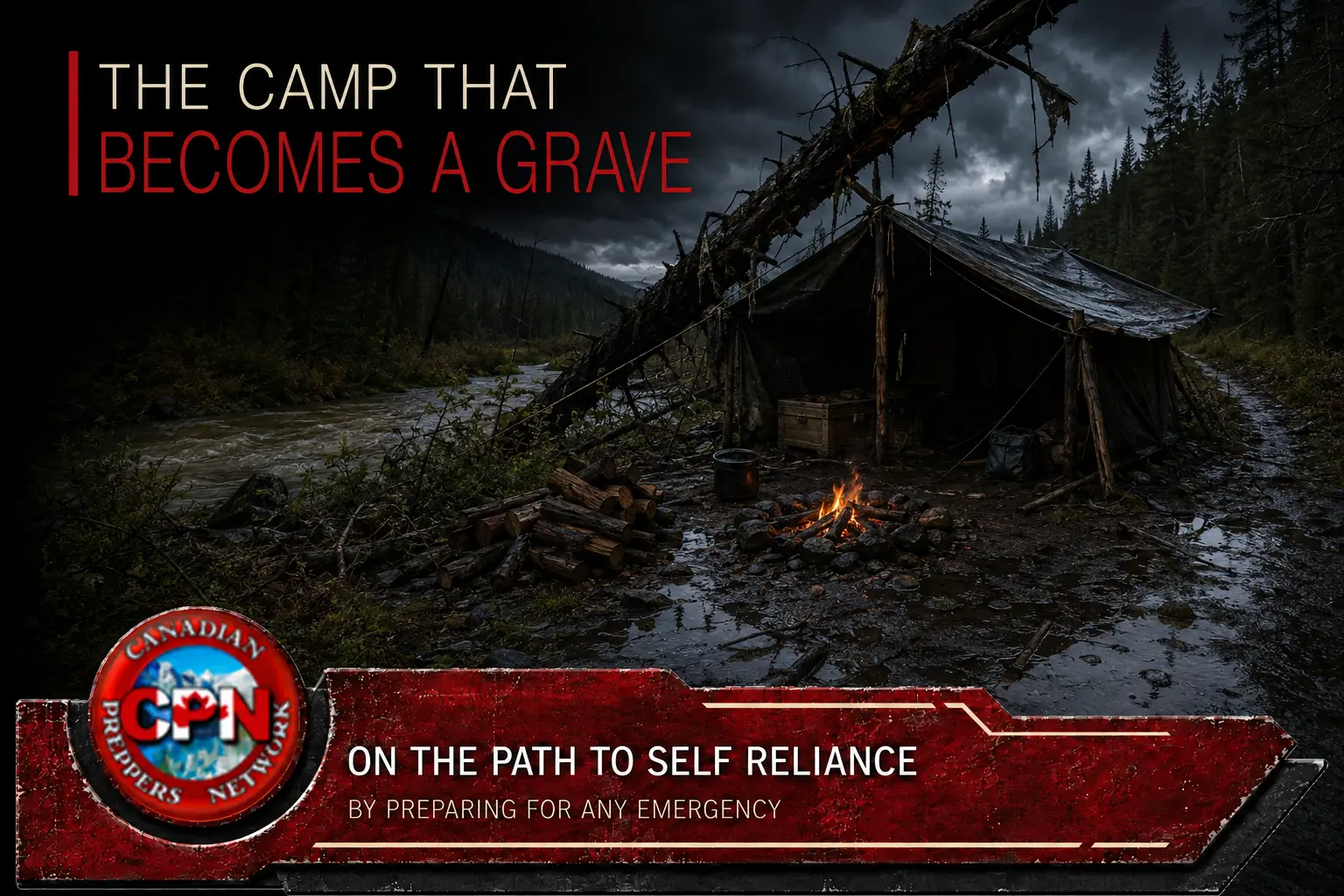
A week later, the same camp may be flooding. The nearby wood has been burned. Dishwater and human waste are threatening the water supply. Food smells are drawing animals through the sleeping area. A windstorm is working on the dead spruce overhead—and the only route out crosses a rising creek.
During an ordinary camping trip, failure means discomfort followed by an early drive home. After a complete collapse, there may be no vehicle, ranger, evacuation centre or search-and-rescue team coming to correct the mistake.
A long-term camp is not simply a place to sleep. It is a small settlement. Its location determines how much labour is required, how quickly resources are consumed and whether the people living there become healthier or weaker with each passing day.
A Campsite and a Survival Base Are Not the Same Thing
Recreational campsites are normally occupied for a few nights. Food arrives in packs, garbage leaves with the campers and damaged equipment can be replaced in town.
A post-collapse camp works differently.
Every fire removes fuel from the surrounding land. Every trip to the creek creates a path. Every meal produces scraps and odours. Every person produces waste. Every storm tests the shelter, drainage and trees. The longer the occupation continues, the more the camp changes its surroundings.
That means a site must not merely work tonight. It must remain workable after thirty days, through heavy rain and into the next season.
If conditions allow, establish a temporary stopping point before committing the entire group and its supplies. Inspect the surrounding ground in daylight. Look uphill, downstream and overhead. A few hours spent examining a site is cheaper than moving an established camp after someone becomes sick or injured.
1. The Flat Ground Is Actually a Floodplain
Water attracts exhausted travellers. A flat bench beside a river offers drinking water, fishing access and easy walking. It can also be land the river temporarily allows you to borrow.
Floodwater does not need to reach the main camp to make the position untenable. It can cut off the exit, contaminate stored supplies, saturate bedding or trap the group between channels.
Look for evidence above the present waterline:
- Driftwood lodged among trees or brush
- Bands of silt on trunks and rocks
- Flattened vegetation pointing downstream
- Exposed roots and undercut banks
- Gravel deposited well away from the current channel
- Side channels that appear dry but recently carried water
- Debris caught higher than an ordinary spring rise
The danger is not limited to large rivers. A narrow creek draining steep ground can rise rapidly after distant rain. A beaver dam, blocked culvert or failed bridge can change local water levels without warning.
BC Parks advises choosing coastal campsites carefully to prevent flooding and contamination of drinking-water sources. The same judgement applies inland: water access is necessary; sleeping beside the water is not.
Choose ground above visible flood evidence while retaining a safe, sustainable route to the water. Do not exchange flood exposure for an exposed ridge where wind, lightning and cold become the next problems.
LIMITED-SPACE OUTDOOR EVENT
PLINKIN’ IN THE WOODS
With Frugal Gunnie
Spend a full day developing practical outdoor rimfire marksmanship skills in a controlled setting. Instruction covers multiple shooting positions, stability aids and individual technique.
Saturday, September 12, 2026
8:00 a.m.–5:00 p.m.
Great Ape Empire
267 Highway 6, Wiarton, Ontario
Event admission: $250 CAD
Weekend camping: $20 per person
Space is strictly limited. Adult participants must meet all applicable legal and organizer requirements.
2. Dry Weather Conceals Bad Drainage
A location can sit above the floodplain and still become uninhabitable after two days of rain.
Soft moss, level ground and thick vegetation may conceal saturated soil. Shallow depressions collect runoff. Heavy clay turns paths into mud and prevents waste water from dispersing. A slight hollow can fill from groundwater even when no stream overflows.
Before erecting permanent shelters, study the small shape of the land:
- Where would water flowing down the slope enter?
- Is the proposed sleeping area on a slight crown or inside a bowl?
- Does the soil beneath the surface feel dry, damp or waterlogged?
- Are nearby plants associated with persistently wet ground?
- Is there a natural route for runoff to leave without crossing the camp?
- Will repeated foot traffic destroy the ground and create a mud basin?
Do not assume you can solve a poor location by digging trenches. Ditches require labour, accelerate erosion and may simply redirect water into another occupied area. Proper positioning usually beats continuous drainage work.
Place shelters on naturally drained ground. Keep storage raised. Protect bedding before improving comfort elsewhere. A camp with dry food but wet sleeping gear is already failing.
For more on why Canadian shelter must be treated as a life-support system, see CPN’s Shelter and Heat in Canada.
3. The Camp Destroys Its Own Water Supply
A clear stream can still carry organisms and contamination that cannot be seen. Parks Canada advises boiling, filtering or chemically treating backcountry surface water rather than assuming it is safe.
After collapse, the larger threat may eventually be the camp itself.
One careless person washing dishes above the intake creates a problem. A group occupying the same ground for months creates a system-wide sanitation hazard. Soap, food residue, human waste and animal remains accumulate faster than most people expect.
Establish distinct zones immediately:
- Water collection: Upstream or up-gradient from every other activity.
- Treatment and storage: Protected from animals, dirty containers and general camp traffic.
- Cooking and washing: Away from the intake and sleeping area.
- Human-waste area: Downhill and well separated from water, food and frequently travelled routes.
- Animal or fish processing: Separate from the water intake and sleeping camp.
Published Parks Canada practices vary with location. Some backcountry instructions use a minimum separation of 30 metres for human waste, while Jasper directs campers to carry washing water 70 metres away from streams and lakes. Those are short-stay minimums—not proof that a permanent camp can safely crowd every activity around one creek.
A long-term settlement should increase separation where terrain permits, monitor drainage and protect the clean-water side of camp relentlessly.
Water treatment also needs redundancy. Filters clog. Containers crack. Chemical treatment expires. Fuel for boiling becomes expensive in labour. CPN’s Water Collection and Purification in Canada provides the broader foundation, but site discipline is what prevents the camp from creating more contamination than its equipment can handle.
FREE CANADIAN PREPAREDNESS DOWNLOAD
Canadian Grid-Down Starter Kit
Use this printable first-72-hours checklist to test your household’s water, food, sanitation, power, communications and operating routines before a short outage becomes a long-term grid-down emergency.
4. The Firewood Is Already Gone
A site surrounded by timber can create a dangerous illusion of unlimited fuel.
The first fuel is easy: dry branches close to camp. Then the deadwood beneath nearby trees disappears. The gathering circle expands. Wood becomes wetter, heavier and farther away. More calories are spent hauling it. More people leave the camp for longer periods. Cutting tools dull, handles loosen and injuries become more likely.
The geometry is unforgiving. Doubling the gathering radius does not merely double the search area—it quadruples it. When nearby fuel is exhausted, every additional metre increases the labour needed to keep the same fire burning.
Before selecting a long-term site, ask:
- Is usable fuel actually present, or does the forest merely look dense?
- Is most of it standing green wood that will be difficult to burn?
- Can fuel be gathered without removing the wind protection around camp?
- Is there dry storage for several days of prepared wood?
- Can cooking, water treatment and heating be done efficiently?
- What happens after prolonged rain or snow covers the ground supply?
- Can cutting tools be sharpened and repaired without replacement parts?
A permanent roaring fire is not a strategy. It is a fast way to consume the easiest fuel.
Use smaller controlled fires, sheltered cooking arrangements and insulated sleeping systems to reduce demand. Separate daily fuel, protected emergency fuel and long-term gathering areas. Never allow the entire camp to depend upon what can be picked up within sight of the shelter.
5. The Clearing Is a Wildlife Corridor
Animals choose efficient routes for the same reasons people do.
Creek banks, lakeshores, saddles, gaps in thick vegetation and gentle approaches to water naturally concentrate movement. A convenient path through the bush may not be abandoned. It may be used every night.
Before occupying a clearing, look for:
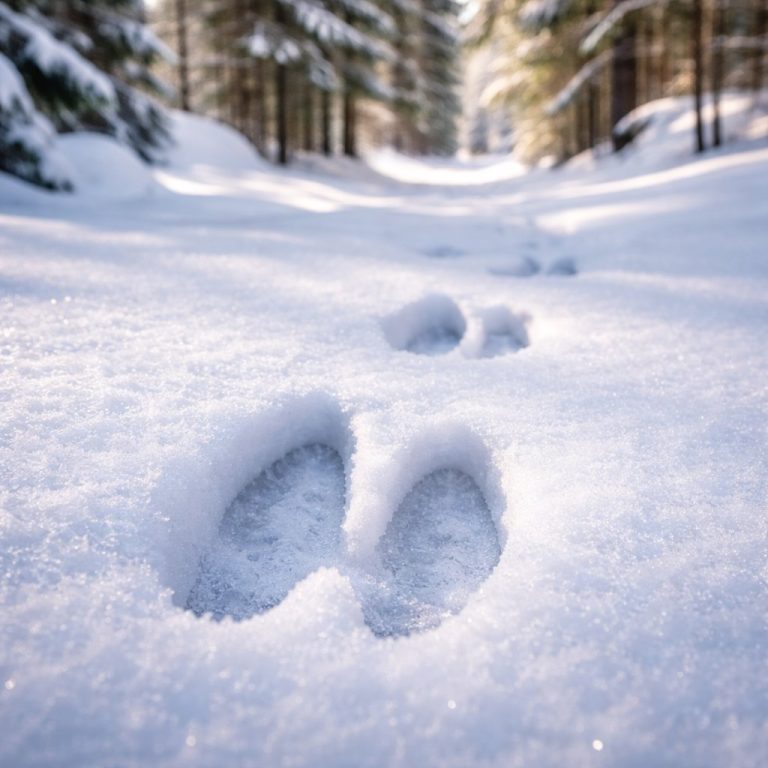
- Repeated tracks travelling in both directions
- Scat of different ages
- Hair caught on branches
- Claw or rubbing marks
- Beds in nearby vegetation
- Fresh digging
- Berry patches or other concentrated food
- Fish remains or a large animal carcass
- A narrow route connecting water, feeding and bedding areas
The Government of Alberta warns that bears use lakeshores, rivers and creeks as travel and feeding corridors. It also recommends storing food away from sleeping areas and, where hanging is necessary, placing it at least 100 metres from tents. Cooking and dishwater disposal should likewise remain away and downwind from the sleeping area.
In a long-term camp, food management cannot be improvised after the first encounter. The sleeping area, cooking area and food-storage location should form separate points rather than one compact cluster.
A fed or rewarded animal may return repeatedly. After collapse, there will be no conservation officer arriving to remove the problem—and losing stored food may be as dangerous as a direct encounter.
PRESERVE THE KNOWLEDGE YOU MAY NEED LATER
CPN Gold Membership
Gold Membership includes access to the CD3WD collection and hundreds of practical offline manuals covering water, sanitation, shelter, food production, repairs, agriculture, health, energy and low-technology self-reliance.
Gold members also receive the monthly Canadian Preparedness Intelligence Briefing, examining global geopolitics, domestic economic pressures, employment, food and energy security, civil-defence developments and other emerging risks.
Only $5 per year.
6. The Trees and Wind Are Waiting
Trees provide concealment, shade, materials and shelter from moderate wind. They also create overhead hazards.
Dead trunks, damaged roots, hanging limbs and fire-weakened trees can remain standing until rain softens the soil or wind supplies the final force. A campsite beneath them may look protected right up to the moment it is crushed.
Prince Albert National Park warns that dead or unstable trees may fall at any time. BC Parks similarly tells campers to inspect nearby trees and keep tents safely away from dead timber, especially during windy weather.
Inspect more than the tree directly above the shelter. A tall trunk can reach well beyond its base. Look for:
- Trees leaning toward the occupied area
- Broken crowns and suspended branches
- Exposed or lifting root plates
- Fungal growth or obvious trunk decay
- Recently burned or beetle-killed stands
- Trees whose roots are being undercut by water
- Multiple windthrows pointing in the same direction
Then study the terrain. Narrow valleys, saddles and gaps may accelerate wind. Sheltered hollows can collect cold air or smoke. A location protected during prevailing weather may be exposed when a storm arrives from another direction.
The answer is not an empty ridge or a dense stand of dying timber. It is healthy cover with adequate overhead clearance and enough observation to recognize changing conditions.
7. There Is Only One Way Out
A camp reached through one narrow creek crossing, bridge, ravine or steep trail has a single point of failure.
That route may disappear through floodwater, fallen trees, wildfire, injury or structural collapse. In a prolonged emergency, it may also become unusable because of human activity along the corridor. A safe-looking camp can become a pocket with no exit.
Borrow a principle used by professional wildland crews: escape routes and safety zones are identified before they are needed. Natural Resources Canada describes fire operations in which safety zones are planned and escape routes mapped in advance. A survival group should apply the same logic to a fixed wilderness base.
A viable site should have:
- Two departure routes that do not rely upon the same bridge or crossing
- A known rally point outside the immediate camp
- A route usable in darkness or poor visibility
- A route suitable for the slowest capable member
- A plan for moving essential supplies
- A small emergency cache positioned away from the main camp
- Seasonal reassessment as snow, ice, water and vegetation change
An exit shown on a map is not necessarily an exit on the ground. Walk it. Time it. Identify obstacles and decision points. Recheck it after major storms.
If the group cannot leave without abandoning an injured person, crossing impassable water or travelling directly into another hazard, the camp is not defensible against nature.
The Seven-Question Camp Audit
- Is the sleeping ground above every visible flood and high-water indicator?
- Where will rainwater travel through the site?
- Can the water intake remain permanently upstream or up-gradient from camp contamination?
- Will usable fuel remain accessible after the first month?
- Is the clearing part of a wildlife travel or feeding corridor?
- What can fall, burn or be driven by wind into the occupied area?
- Can the group leave in two directions without depending on the same obstacle?
An uncertain answer is not a passing grade. It identifies work that must be done before the camp becomes difficult to move.
CPN’s Wilderness Skills in Canada emphasizes that long-term wilderness capability is built in layers. Site selection comes before elaborate shelters, furniture or defensive improvements because every later investment becomes attached to the ground beneath it.
Long-Term Wilderness Camp Tools
These categories support site reconnaissance, water treatment, weather protection, fuel processing and the maintenance of essential equipment.
- Baseplate compasses for route and escape planning
- Survival water filters
- Camping tarps for shelter and protected work areas
- Folding camp saws
- Axes and hatchets for longer-term wood processing
- Sharpening stones for cutting-tool maintenance
- Dry bags for bedding, clothing and protected supplies
Disclosure: This article contains Amazon affiliate links. As an Amazon Associate, Canadian Preppers Network may earn from qualifying purchases.
The best survival camp is rarely the most picturesque location. It is the place that preserves clean water, dry shelter, manageable labour, food security and more than one way out.
After collapse, the wilderness will not forgive a poor site simply because moving is inconvenient. The camp that seemed to save you on the first night may be the camp that kills you in the second month.
Which failure would force you to abandon an otherwise promising camp first: contaminated water, exhausted firewood, wildlife pressure or the loss of your escape route?